Mindless evil
'Salem's Lot: A NovelMindless evil is the novel’s central conception of violence as an impersonal, self-propagating force. It is not merely wickedness committed for a comprehensible purpose, nor a villain’s carefully argued philosophy. It is violence that wants to tear lives apart and offers no appeal to reason, pity, or moral persuasion. The supernatural disaster in Jerusalem’s Lot makes that abstraction visible, but the concept also reaches beyond vampirism: it includes the human brutality, social indifference, and collective refusal to see that allow destruction to move through an ordinary American town.
Definition and Moral Logic
Mindless evil is defined most directly through Ben Mears’s account of the book he is writing. He distinguishes the moral worth of a work from the mere presence of a disgusting killer: the killer may be detestable, and writing about him may make the author feel sick, but the true subject is not the portrait of the murderer. It is the town, and the madness that spreads through it and poisons it. The deepest horror lies in a force for which there is no escape through pleading, bargaining, or logic. Goodness requires an act of faith; evil requires only that someone wait. That asymmetry gives mindless evil its distinctive power: it is patient, undemanding, and able to exploit hesitation.
The concept also appears under the related term “mindless violence.” Ben connects it to modern examples of apparently purposeless killing, including men who announce that they will shoot their victims anyway, Perry Smith moving from room to room and killing human beings as if they were chickens, and the crimes associated with Charles Starkwether, Charles Manson, and Charles Whitman. These references place the supernatural plot inside a history of twentieth-century violence. The vampire is therefore not an escape from modern reality; it is a concentrated image of the violence already recognized in newspapers, popular memory, and public fear.
The Town as Its Mask
Ben’s stated artistic aim is to tear away the mask and reveal that the Grand Guignol exists on the corner of one’s own street and inside one’s own house. Mindless evil is frightening precisely because it does not announce itself as an alien myth. It inhabits familiar spaces: homes, shops, schools, churches, hospitals, and streets. The novel’s deserted-town imagery turns this principle into a landscape. ’Salem’s Lot has no open businesses, no children in its schools, and no ordinary civic life; abandoned shops, houses, lawns, streets, and back roads testify to a catastrophe that has overtaken the routines meant to make danger seem manageable.
Before the truth is recognized, the town’s absence is interpreted through competing stories. Surrounding communities whisper that ’Salem’s Lot is haunted, speculate about colored lights over the Central Maine Power lines, consider unidentified flying objects, and imagine a dark coven whose rituals may have brought divine punishment. Others recall young men who disappeared near Houston and were later found in mass graves. These explanations show how mindless evil enters communal consciousness indirectly: people name the unknown with available cultural narratives, but the multiplication of theories does not produce understanding. It produces a legend around an event that is already real.
The same process operates at a smaller scale in local conversation. A newspaper report about youths desecrating a Catholic church in Clewiston, Florida, complete with obscene writing and human and animal blood, becomes a possible explanation for the disturbing signs in the Lot. The leap from an unexplained local horror to “devil worshippers” demonstrates how rumor converts uncertainty into a moral story. Telephone wires, imagined as carrying gossip through the town, become an emblem of this process: information travels everywhere, yet the circulation of voices does not guarantee recognition. The town hears constantly and understands almost nothing.
Institutions Against the Unseen
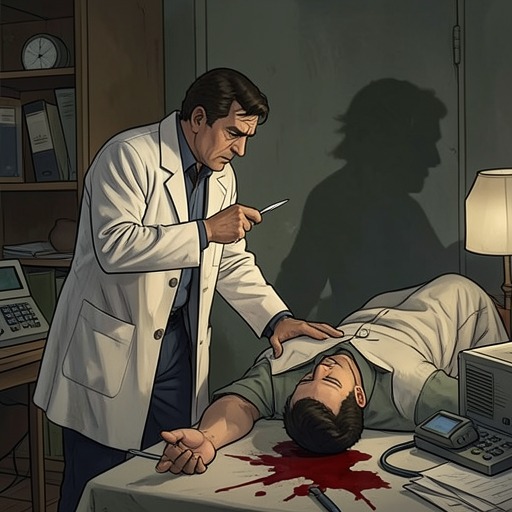
Mindless evil gains ground through the collision between extraordinary facts and ordinary institutional habits. The medical and administrative worlds repeatedly attempt to contain the crisis within familiar categories. A body is examined, questioned, and treated as a possible case of death before its condition can be understood. Parkins Gillespie even asks whether the dead man is really dead, while James Cody’s calm medical examination focuses on the body’s lack of surface lividity and rigor. The language of diagnosis records important evidence, but it does not by itself produce belief in the supernatural cause.
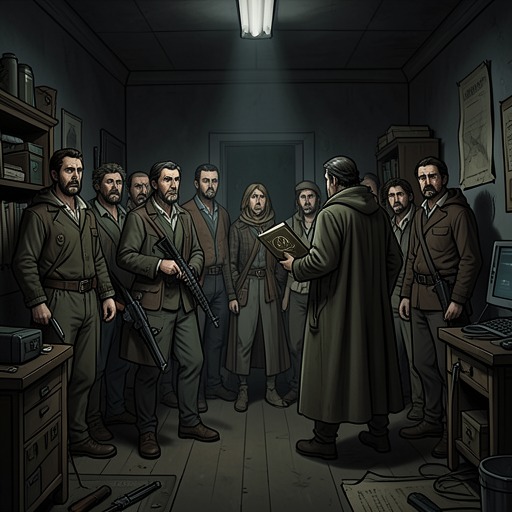
The same failure expands from the individual corpse to public administration. The theft of bodies from the Cumberland County Morgue sounds like a grotesque violation of social order, yet its very strangeness makes it resemble a sensational story rather than a coherent pattern. When Ben and Mark Petrie try to tell Parkins what has been happening, the constable refuses to hear it. His refusal is not a successful rebuttal; it is an institutional act of shutting out knowledge. Mindless evil does not need to defeat every witness in argument when authority can simply decline to listen.
The medical evidence eventually points toward a pattern that ordinary explanations cannot absorb. Marjorie Glick’s body shows no surface lividity and no sign of rigor or incipient rigor, conditions noted as strikingly similar to those of Mike Ryerson. Roy McDougall’s body supplies an even more physical contradiction: daylight makes him writhe, steam and moisture emerge from his pores, his skin sags and yellows, and his respiration stops changing once he retreats into shadow. Such scenes transform the concept from an abstract moral diagnosis into a material process. The evil is mindless, but its effects are precise, repeatable, and governed by rules that the community is slow to accept.
Modernity as Enabler
The origin of the novel’s conception lies in reversing the assumptions of Dracula. The vampire is imagined not in turn-of-the-century London but in 1970s America, and specifically in rural Maine, where a local predator could operate with lethal ease among people resembling the peasants once ruled by an aristocratic master. A figure such as Kurt Barlow can become the boyar of a small town because social familiarity and local self-interest provide cover. The modern setting does not automatically produce enlightenment; it may instead make disbelief more efficient.
The vampire is also conceived as a hybrid: part Stoker aristocrat, part fleshy leech from E.C. Comics, and part bloodthirsty popular-culture monster associated with George Romero’s zombies. This mixture matters to mindless evil because it joins old hierarchy to modern mass imagery. The ancient master does not remain separate from contemporary society. He can enter its commercial life, use its assumptions, and become difficult to distinguish from the ordinary forms of exploitation already present in post-Vietnam America, where wealth accumulates upward while the poor receive welfare only if they are lucky.
The novel’s inversion of Dracula makes technology part of the danger. In Stoker’s story, electric light and modern methods assist vampire hunters and embody Victorian confidence. Here, electric lights and modern inventions help the incubus by making belief in him nearly impossible. The very systems that promise observation and control can therefore become instruments of denial. Mindless evil flourishes not because modernity is powerless in a simple sense, but because modernity teaches people to reject whatever does not fit its approved explanations.
Narrative and Thematic Significance
The concept organizes the book’s movement from isolated disturbance to communal poisoning. A strange disappearance, a body handled as a medical problem, a rumor carried through telephones and taverns, and an authority figure’s refusal to listen may seem like separate failures. Together they form a chain: unexplained violence produces stories; stories displace evidence; disbelief protects the conditions in which violence spreads. The deserted town at the end of that process is not merely a backdrop for horror. It is the visible consequence of a community that could not convert warning into action.
Mindless evil also clarifies the novel’s moral contrast. The evil force requires no grand argument and no elaborate justification; it advances through appetite, repetition, waiting, and contagion. Resistance, by contrast, requires recognition and faith. Ben’s artistic project, the medical observations of James Cody, and the attempts by Ben and Mark to communicate what they have seen all represent efforts to give form to what otherwise appears senseless. The struggle is therefore epistemological as well as physical: to oppose evil, the living must first accept that the familiar world has become the scene of an impossible violence.
By placing the supernatural outbreak beside modern mass murder, local gossip, institutional denial, and technological confidence, the novel refuses to quarantine horror inside folklore. Mindless evil is the principle that links the vampire’s predation to the violence of the surrounding culture. It is most terrifying when the monster no longer needs darkness, legend, or a distant castle, because the town’s own habits—its explanations, commerce, media, and silence—have already made room for it.