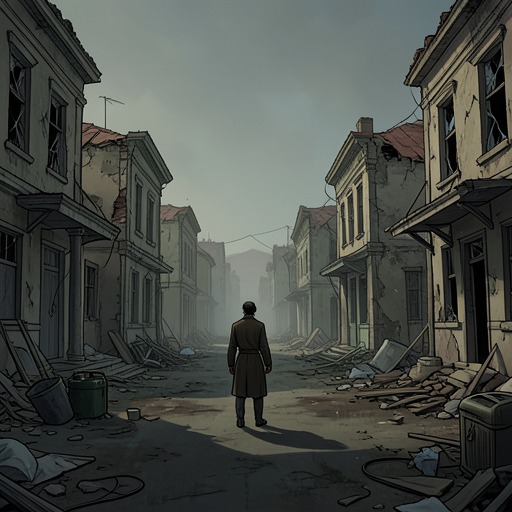
Missing child
'Salem's Lot: A NovelMissing child describes more than an individual child whose whereabouts are unknown in Jerusalem’s Lot. It is a social and narrative condition in which ordinary search procedures, official knowledge, family hope, and inherited local memory all confront an absence that the town cannot explain. Ralphie Glick’s disappearance is the immediate and most consequential instance in the present-day plot, but the same condition reaches backward through the town’s history, linking twentieth-century disappearances with older stories of concealed violence and supernatural catastrophe.
Ralphie Glick’s Disappearance
The state becomes explicit after the search for Ralphie Glick has been exhausted. On Wednesday, September 24, rain prevents further searching, and the consensus is that the boy is gone, “solid gone.” The weather is not merely background: it closes down the practical effort to locate him and turns an active investigation into an acknowledgment of absence. The missing child is no longer treated as temporarily lost in the surrounding landscape, but as someone whom the town may never recover.
Parkins Gillespie approaches Ben Mears to establish where Ben was on the Wednesday evening when Ralphie disappeared. His questions show the first institutional response to the case: the constable must reconstruct movements and test possible connections among residents. Yet the inquiry is already shaped by uncertainty. Parkins has waited until Nolly Gardener is away because Nolly is eager and talkative, while the town’s extensive gossip network threatens to mingle useful information with speculation. The investigation therefore proceeds through both formal questioning and informal surveillance.
The disappearance also alters the meaning of the newly arrived outsiders. Parkins identifies Richard Throckett Straker and Kurt Barlow as partners in a recently opened furniture and antique business; Straker says Barlow is in New York on a buying trip, and claims that the two men previously worked together in London and Hamburg. Parkins does not yet know whether there is even a criminal case, but notes that Ben Mears, Straker, and Barlow appeared in town at roughly the same time. The missing child thus becomes the point at which unrelated arrivals, commercial activity, and local suspicion begin to form a single pattern.
Official Uncertainty and Public Suspicion
The town’s language moves between caution and foreknowledge. When Parkins tells Straker that the village has effectively misplaced a child, he says the boy may not be found alive. Straker responds with distant regret, but the exchange exposes the gap between the constable’s restrained official phrasing and the emotional certainty spreading through the community. The case is not yet resolved in legal terms, but its likely ending has already entered conversation.
That expectation appears within the Glick family’s circle as well. Bill Norton asks Ben whether the other Glick boy will ever turn up alive, and Ben answers that he thinks the boy is dead too. Susan Norton recalls a child-murder case in Houston and says that, if Ralphie is dead, she almost hopes the body will not be found, because whoever could harm a defenseless child would be capable of an act beyond ordinary comprehension. The response shows how a missing child generates a moral panic before the facts are established: the community reaches for known categories such as sexual predation, while the actual threat remains hidden.
The police follow that familiar path by looking for known sex offenders and questioning them. This procedure demonstrates both the usefulness and the limitation of ordinary authority. It gives the disappearance a recognizable criminal frame, but it also directs attention toward conventional human perpetrators at the very moment when the evidence is beginning to implicate something outside accepted explanations. The missing-child state is consequently marked by a clash between institutional procedure and a reality the institution cannot yet name.
A Recurrent Pattern in Local Memory
Ralphie’s disappearance gains its force from Jerusalem’s Lot’s long memory. The town was incorporated in 1765 and later celebrated its bicentennial with fireworks and a park pageant, yet even its civic history is surrounded by accidents, drunkenness, and dark anecdote. More importantly, small-town memory passes old horrors ceremonially from one generation to the next. The Marsten House remains the town’s closest equivalent to a skeleton in its closet because the scandal and violence associated with Hubert Marsten and Birdie Marsten occurred before the current inhabitants were born, but has never ceased to circulate.
The historical record contains an earlier series of unexplained child disappearances. Matthew Burke has examined old copies of the Ledger from 1928 through 1939 and found that four children vanished during the years Hubert and Birdie lived in the Marsten House. Rural explanations remain possible in the abstract: children can become lost, die of exposure, or be buried by a gravel-pit slide. Yet none of the four was ever found. No later hunter discovered a skeleton, and no contractor uncovered remains while taking gravel for cement. The absence of bodies converts the episodes from ordinary accidents into a persistent historical question, especially when set beside Ralphie’s disappearance.
The town’s collective memory is selective rather than complete. Residents know that Hubert Marsten killed his wife, but they do not know what preceded the murder or that Birdie begged him to kill her. Older women remember that charred papers were found in the upstairs fireplace, but not that they represented twelve years of correspondence between Hubert Marsten and an Austrian nobleman, begun through an unusual Boston bookseller. Local knowledge preserves the outline of violence while suppressing or losing its mechanisms. Missing children occupy the same unstable space: publicly remembered as disappearances, privately connected to possibilities that the town cannot or will not articulate.
Concealed Violence and Larger Catastrophe
The missing-child state is not confined to modern police records. Robert Boone’s recovered diary places an even earlier disappearance within the history of Jerusalem’s Lot. The diary’s first entry is dated June 1, 1789, and its last October 27, four days before the catastrophic disappearance associated with the town. It connects Great-uncle Philip, Jerusalem’s Lot, and the book kept in the desecrated church, making the town’s disappearance part of a larger history of obsession, madness, and forbidden knowledge.
This earlier catastrophe changes the scale of the modern cases. The vanished child is not simply an isolated victim or an unfortunate entry in a local newspaper. The condition echoes a recurring pattern in which the town’s institutions, families, and records preserve fragments of an event while losing the bodies, causes, and full sequence. Charles Boone’s later papers provide a related warning: after his wife’s death in 1848, a recurrence of brain fever was assumed to have driven him insane and to murder Calvin McCann, while entries in McCann’s pocket journal were judged forgeries made by Charles to strengthen his paranoid delusions. Even where the supernatural explanation is uncertain or contradicted, disappearance and concealed violence remain structurally linked.
The narrative therefore distinguishes between what the town knows, what it believes it knows, and what its records cannot contain. The story of Albie Crane’s wife, whose skull he cracked before hiding her body down an old well, survives as a distorted local account; the public version says she ran away with a traveling man. The truth persists only as buried matter, just as the missing children persist as absences that resist closure. Jerusalem’s Lot’s evil works through this separation between event and knowledge: violence is committed, stories are circulated, and the decisive facts remain underground.
Consequences and Narrative Significance
For the Glick family, the disappearance shatters the ordinary cycle of domestic life. Ben Mears observes that, within ten days, the family unit has been smashed into pieces. The missing child is consequently a condition of grief before death is officially confirmed: the family must live between hope and mourning, while the town’s speculation repeatedly reopens the wound.
For the investigation, Ralphie’s absence becomes the first visible sign that the apparent crisis exceeds a conventional missing-person case. Parkins seeks connections among Ben Mears, Richard Throckett Straker, and Kurt Barlow; Ben concludes that Ralphie is dead; and the disappearance eventually stands beside the unexplained vanishing of other bodies. When the possibility of exhuming Danny Glick is later discussed, Susan asks whether permission is required, and Ben explains that the Glicks could delay the order through a hearing. He also identifies the central evidentiary problem: Danny is the only corpse with a marked grave, while all the others have disappeared into thin air. The missing child thus becomes part of a broader pattern in which even death refuses to remain materially available for investigation.
The state also exposes the town’s vulnerability to manipulation. Gossip names outsiders, conventional police work seeks familiar offenders, and legal procedure moves slowly, while the actual threat expands through secrecy and absence. Parkins’s efforts to obtain statements, his request that Ben remain for the coroner’s jury after Mike Ryerson’s death, and later demands that Ben and Jimmy Cody report to the county office all demonstrate an authority trying to stabilize a community whose evidence keeps dissolving. Missing child is therefore both a human tragedy and an epistemological crisis: the town loses not only a child, but the reliable chain of facts by which responsibility could be assigned.