Momson
'Salem's Lot: A NovelMomson is a deserted Vermont town whose 312 residents apparently vanished during the summer of 1923, leaving behind furnished homes, ordinary objects, and no satisfactory account of what happened. Introduced through a newspaper feature read after the events in Jerusalem’s Lot have begun to disturb the survivors, Momson functions as both a documented “ghost town” and a structural warning: its unexplained emptying supplies an earlier, apparently secular counterpart to the catastrophe overtaking Jerusalem’s Lot.
Discovery Through the Newspaper Account
Momson enters the narrative through a weekly forty-mile journey to obtain the Portland paper, which is already at least a week old and sometimes yellowed with dog urine. The article appears two weeks after the boy announces his intention to seek instruction from the priest, and the tall man notices that the report mentions both Jerusalem’s Lot and Momson, as well as the tall man himself. He leaves the paper lying around without expecting the boy to read it, but the article unsettles him because it suggests that the disaster in Jerusalem’s Lot is not finished. The boy finds the paper the next day, folded open to the headline “Ghost Town in Maine?”, making Momson the first explicit comparison through which the Lot’s developing desolation is publicly framed.
The report is written by John Lewis, the Press-Herald Features Editor, and begins by placing Jerusalem’s Lot east of Cumberland and twenty miles north of Portland. Its broader subject is the American ghost town: communities in the Southwest that grew rapidly around gold or silver and then collapsed when their mines failed. Momson is introduced as the only apparent New England counterpart to Jerusalem’s Lot, which makes the comparison geographically specific. The article does not treat either town as merely an abandoned settlement; it treats their emptiness as an unusual regional mystery requiring explanation.
The Vanishing of 312 Residents
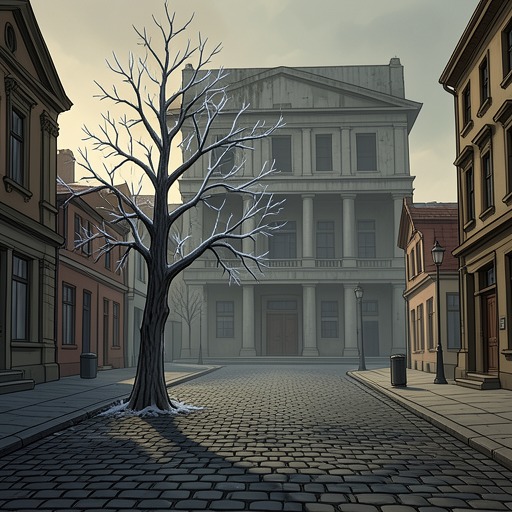
During the summer of 1923, Momson apparently “dried up and blew away,” taking all 312 residents with it. The wording gives the disappearance the quality of a folk saying while the number supplies the hard edge of a census-like fact. The houses and a few small business buildings in the center remained standing, but they had been uninhabited for fifty-two years by the time of the article. Some furnishings had been removed; most had not, preserving the appearance of lives interrupted rather than homes deliberately evacuated.
The surviving interiors make the disappearance especially disturbing. In one house, investigators found an evening table still set, including a centerpiece of long-wilted flowers. In another, upstairs bedclothes had been turned down neatly as if someone were preparing to sleep. The local mercantile store contained a rotted bolt of cotton cloth on the counter; its cash register recorded a price of $1.22, while almost $50 remained untouched in the cash drawer. These details deny the usual economic explanation for a ghost town. Nothing in the account suggests a gradual migration, a failed business district, or a planned removal. The objects instead preserve the final gestures of routine while withholding the event that stopped them.
Legend, Geography, and Uncertainty
People nearby entertain tourists with stories that Momson is haunted and imply that the haunting explains why the town has remained empty. The newspaper offers a more practical alternative: Momson lies in a forgotten corner of Vermont, far from any main road, and its isolation could account for its continued abandonment. Yet that explanation accounts only for why no one returned. It does not account for the original, Mary Celeste-like sudden emptiness, nor for the untouched money and domestic arrangements found inside the buildings.
The report therefore keeps two explanations in tension. Local legend converts the town into a haunted attraction, while journalism supplies remoteness as a rational hypothesis; neither explanation resolves the disappearance itself. Momson’s importance lies precisely in this unresolved gap between visible evidence and available interpretation. The town can be described, surveyed, and compared, but the central fact remains resistant to ordinary historical narration.
Precedent for Jerusalem’s Lot
The article concludes that much the same could be said for Jerusalem’s Lot. This comparison gives Momson a direct narrative function: it is the earlier case against which the Lot’s later fate is measured. Jerusalem’s Lot had recorded 1,319 inhabitants in the 1970 census, a gain of exactly sixty-seven over the preceding decade, and appeared to be a sprawling, comfortable township where little of lasting importance occurred. Its residents believed that nothing too terrible could happen in such a pleasant place. Momson exposes the danger in that confidence by showing that a settled New England community can become empty without an intelligible public cause.
The comparison also changes how the Lot’s disappearance can be understood. Momson is not presented as proof that the two towns share an identical cause, but as a pattern whose recurrence makes the Lot’s fate look less unprecedented. The newspaper’s sober catalog of houses, merchandise, flowers, bedding, and cash becomes an indirect vocabulary for the later town: absence is made legible through the things left behind. In this sense, Momson is a historical mirror, allowing the reader to recognize the shape of Jerusalem’s Lot’s crisis before its full meaning is available.
Historical Memory and the Empty Town
Momson belongs to the novel’s larger landscape of buried local history, in which old violence survives through newspapers, rumor, family recollection, and physical places. The Marsten House is remembered by successive generations as the town’s skeleton in the closet, while older records preserve unexplained disappearances and the 1789 destruction associated with Jerusalem’s Lot. Momson broadens that pattern beyond one cursed community: New England’s landscape contains more than one place where ordinary social time appears to have stopped.
Its deserted buildings also anticipate the novel’s contrast between apparent normality and concealed catastrophe. Jerusalem’s Lot is mapped as a nearly circular township divided by Brock Street and Jointner Avenue, with wooded high ground, farms, the Royal River, the Bend’s trailers, roads, businesses, and public spaces. It is a lived-in social organism whose residents know one another through telephone lines and gossip. Momson, by contrast, is known almost entirely through its emptied structures and the objects stranded inside them. That difference matters. One town is first encountered through population and routine, the other through vacancy; the narrative gradually reveals that the inhabited town may already be moving toward the condition the abandoned one makes visible.
Momson therefore serves as a compact historical analogue, a cautionary legend, and a material record of interrupted life. Its 312 vanished residents, its $1.22 transaction, its untouched cash, and its rooms prepared for absent sleepers make disappearance more frightening than simple ruin. The town’s enduring mystery lies not in a confirmed supernatural explanation, but in the fact that the evidence remains concrete while the cause remains unavailable—a form of uncertainty that prepares the reader for Jerusalem’s Lot’s own descent from comfortable community to ghost town.