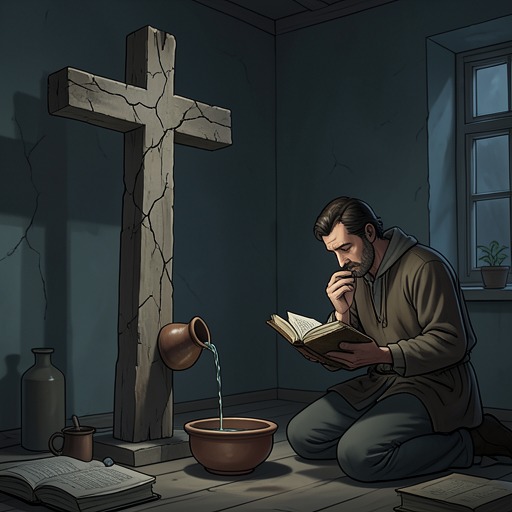
Mother of Carolan's crucifix
'Salem's Lot: A NovelCallahan’s mother’s cross is both a personal relic and the most consequential holy object in the confrontation with Kurt Barlow. Carried by Father Donald Callahan from his mother’s possession, it transforms a terrifying approach to Marsten House into an act of religious command, illuminates the Petrie kitchen during Barlow’s attack, and drives the vampire back. Its eventual failure is not presented as a defect in craftsmanship: the cross loses its force when Callahan’s faith gives way, leaving behind only the plaster object his mother bought in a Dublin souvenir shop.
Origin and Material Form
Callahan’s mother’s cross enters the decisive action as an intimate devotional object rather than as an abstract emblem. Father Donald Callahan takes it from his pocket when the group reaches the house, slipping it around his neck alongside his own crucifix. The setting makes the gesture significant. The trees are stripped by autumn, no bird sings, the grass looks unnaturally dry, and the ground appears gray and exhausted; the warped steps, freshly removed warning sign, and new Yale lock make the house seem both physically altered and spiritually sealed. Against that atmosphere of desolation, the cross is a portable fragment of a different order, brought into a place that appears to exude evil.
Its physical cheapness is eventually made explicit. Barlow identifies it as a piece of plaster purchased by Callahan’s mother in Dublin, probably at an inflated souvenir price. That detail does not reduce its earlier effects. Instead, it establishes the object’s central paradox: its substance is ordinary, but under faith it becomes capable of producing extraordinary consequences. The narrative therefore separates material identity from sacred efficacy without making either side disappear. The cross is never merely a magical tool, yet neither is it merely an inert keepsake.
The Assault on Marsten House
When the group reaches Marsten House, Callahan is seized by an eagerness he had believed lost. He leads the others directly to the entrance, almost impelled rather than reasoning his way forward. Raising the cross, he commands the evil to leave the house and strikes the front door with it. The response is physically unmistakable: light flashes, ozone fills the air, the boards crackle as if they have screamed, the fanlight explodes outward, and the large bay window breaks onto the lawn. The new Yale lock is welded into an unrecognizable mass and is hot when Mark Petrie touches it.
The cross thus does more than symbolize entry into sacred space; it materially changes the threshold. A locked and hostile house is forced open by an object held in a religious act. Callahan himself withdraws trembling afterward, astonished by what has happened, while the sky offers no confirming sign. The episode preserves both dimensions of the event: the cross has acted with overwhelming force, but the act has not given Callahan uncomplicated certainty or a visible divine answer.
The threshold assault also establishes the cross as a collective protection. Callahan waits for the others to enter behind him, and the object determines who can approach the house and under what authority. Its power is not presented as independent spectacle detached from human action. It operates through Callahan’s invocation, his bodily courage, and the religious meaning he assigns to it, making the crossing into Marsten House a rite of expulsion before it becomes an armed raid.
The Confrontation with Kurt Barlow
The cross reaches its greatest power in the Petrie kitchen, where Father Donald Callahan faces Kurt Barlow while Barlow holds Mark Petrie and Henry and June Petrie lie dead on the floor. After the lights fail and Barlow smashes through the kitchen window, Callahan touches the cross at his neck; the room fills with its unearthly light. That illumination breaks the spell that had paralyzed him and lets him see the vampire clearly. Barlow’s attack has converted the family kitchen into a site of sudden violence, while the cross creates a counter-space in which the vampire can be resisted.
Callahan advances with the cross raised, and Barlow’s triumphant grin becomes a rictus of agony. The vampire retreats toward the sink, dragging Mark in front of him. As Callahan backs away while holding the object at eye level, the cross seems to thrum with chained fire, its power coursing up his forearm until his muscles bunch and tremble. The image makes the object’s force almost bodily: it is not only seen but felt through the priest’s arm, linking sacred authority to physical strain.
Barlow attempts to convert that protection into a test of faith. He offers to spare Mark for another night if Callahan will throw away the cross and face him on equal terms, black against white and Barlow’s faith against Callahan’s. Callahan agrees, but less firmly than before. The challenge changes the cross from a shield into the visible measure of Callahan’s conviction. Its presence allows him to resist; the possibility of discarding it forces him to confront whether his belief remains strong enough to sustain the object’s power.
When Barlow moves forward, Callahan thrusts the cross out and the object flares with dazzling brilliance. The moment suggests that Barlow might have been banished if Callahan had dared to press the attack. The cross is therefore not ineffectual in the final confrontation; its failure comes later, at the point where courage and certainty falter. Its power reaches a possible victory but cannot supply the spiritual decision required to complete it.
Loss of Power and Destruction
The cross’s glow begins to die as Callahan hesitates. Barlow approaches while Callahan retreats toward the kitchen table, and the vampire interprets the retreat as evidence that the priest’s faith has failed. At last the trembling cross gives off no light. The energy that had seemed capable of smashing walls and shattering stone disappears, while Callahan’s muscles retain only the memory of its earlier vibration. The object has not changed in appearance, but its relation to Callahan has changed completely.
Barlow then plucks the cross from Callahan’s fingers and breaks both arms of it with two dry snaps before throwing it to the floor. The destruction is personal as well as sacramental. Callahan’s cry recalls the terror of the child who once feared Mr Flip emerging from the closet, so the broken cross connects the present defeat with an older vulnerability. An object inherited from his mother becomes the physical focus of a crisis that reaches backward through memory and forward into lifelong haunting.
Barlow explains the defeat through the doctrine Callahan should have known: the cross, bread, wine, and confessional are only symbols when faith is absent. He reduces the cross to wood in principle and, in this case, to plaster in fact, but his argument also confirms the object’s earlier efficacy. The cross had repelled him because Callahan believed; it fails because Callahan cannot sustain that belief under the terms of Barlow’s challenge. Its destruction is consequently not a simple victory of supernatural strength over sacred matter. It is the dramatization of a spiritual failure in which the material object becomes powerless only after the human foundation that animated it has collapsed.
Narrative and Religious Significance
Callahan’s mother’s cross organizes the book’s conflict between ritual and inward conviction. It works at thresholds, first breaking the lock and windows of Marsten House, then lighting the Petrie kitchen and forcing Barlow backward. In both scenes, a religious sign becomes active through spoken command and embodied faith. The object gives form to protection, but it does not make faith automatic; its force must be renewed in action.
Its trajectory also turns sacred space into a contested arena. The cemetery contains a figure invoking the Lord of Flies and offering spoiled meat, while Callahan later approaches Marsten House with a cross and commands its evil to depart. These scenes oppose competing rites of dedication: one offers carrion to an evil power, while the other invokes God through a consecrated sign. The cross is therefore part of a wider ritual struggle over who may define a place and what power will inhabit it.
Most importantly, the cross prevents the story from treating belief as a decorative label. It produces visible effects, yet those effects remain conditional and unstable. The same object that explodes windows and makes Barlow recoil becomes a broken, meaningless fragment in his hand. Its changing status exposes the difference between possessing a sacred symbol and possessing the faith that makes the symbol effective. For Callahan, the broken cross marks not merely defeat by Barlow but the collapse of the certainty on which his priestly identity had depended.