Parkins Gillespie
'Salem's Lot: A NovelParkins Gillespie is the principal representative of ordinary law in Jerusalem’s Lot, but his importance lies in how visibly that law fails when the town’s hidden violence becomes supernatural. Initially a watchful, procedural constable who handles drunks, searches for missing children, questions witnesses, and oversees the coroner’s business, he ends as a frightened man preparing to flee. His abandonment of the badge is not cowardice in isolation; it is the clearest measure of a community whose familiar institutions can no longer explain or contain what is happening.
Identity and Local Authority
Parkins Gillespie works from the Municipal Building and is embedded in the town’s small, mutually observing civic world. He appears beside Nolly Gardener on the steps, smoking a Pall Mall and cleaning his yellowed fingernails with a pocketknife while watching Ben Mears and Susan Norton enter Spencer’s. The gesture captures his habitual manner: casual, inquisitive, and alert to deviations in local routine. When he remarks that Ben Mears had recently been looking at the Marsten House with a “Funny expression on his face,” his attention is directed as much toward suspicious behavior and town gossip as toward formal investigation.
His authority is practical rather than grand. During the town’s bicentennial celebration, a sparkler set little Debbie Forester’s Indian princess costume on fire, and Parkins Gillespie responded by throwing six men into the local cooler for public intoxication. The anecdote places him within the ordinary machinery of small-town order, where a constable is expected to control drunkenness, public disorder, and embarrassment rather than confront metaphysical evil. His work is likewise tied to Jerusalem’s Lot’s compact geography: the nearly circular township, the crossing of Brock Street and Jointner Avenue, the park, the Royal River, and the roads leading outward all form a manageable civic map—at least before the town’s danger exceeds it.
Investigations and Police Procedure
Parkins Gillespie participates in the search for Ralphie Glick, moving with Nolly Gardener, Tony Glick, and Henry Petrie along the path and the shoulders of South Jointner and Brock streets while they call out through battery-powered bullhorns. His decision that there was no point in sending men into the woods that night because of deadfalls shows a lawman reasoning through mundane physical risks and the likelihood that the boy had simply wandered off the path. The judgment is rational within an ordinary missing-child investigation, yet the supernatural reality makes that rational framework tragically inadequate.
He also becomes involved in the scrutiny surrounding Ben Mears. When Parkins comes to Ben’s door smoking a cigarette and holding the Bantam edition of Conway’s Daughter, he asks mainly about where Ben had been on the previous Wednesday evening. The questioning suggests a police response shaped by location, timing, and local suspicion rather than a clearly understood theory of the threat. Elsewhere, Larry Crockett invokes Parkins as the official to whom Hank Peters could be taken, while warning that exposure of Hank’s conduct with a waitress could produce “a lot of nastiness.” Parkins therefore exists within a network where law, reputation, sexual secrecy, and coercive small-town knowledge overlap.
After Mike Ryerson’s death, Parkins watches the hearse leave and asks Ben Mears to testify before the coroner’s jury. His remark that Mike had driven the hearse so often without guessing how soon he would be riding in its back combines grim humor with procedural necessity. The scene shows him trying to preserve the language of investigation—hearse, jury, testimony—even as the corpse has become part of a much larger and less intelligible pattern. He is also implicated in the handling of Floyd Tibbits, who is locked in the drunk tank after behaving in a “dopey and confused” manner despite not appearing drunk.
Parkins’ relationship to procedure remains visible when the investigation reaches the question of exhumation. Susan Norton asks whether permission is needed for an exhumation order, and the broader police response insists on statements, patrols, and official channels. Jimmy Cody is told to report to the office by ten the next morning or a patrol car will be sent for him. These details make Parkins and the local authorities custodians of paperwork and testimony at the very moment when the evidence is beginning to demand actions—such as opening graves and identifying supernatural causes—that ordinary law does not comfortably authorize.
Watchfulness and the Marsten House
Parkins’ attention repeatedly returns to the Marsten House, the structure that concentrates Jerusalem’s Lot’s inherited violence. The town’s residents remember the scandal and violence associated with the house even though those events occurred before their births; small-town memory passes such horrors from generation to generation. Parkins is one of the people through whom that inherited suspicion remains active. His early observation of Ben’s expression while looking at the house foreshadows the way the building draws both outsiders and local witnesses into its orbit.
Later, Parkins stands on the front step of the Municipal Building with high-powered Zeiss binoculars and silently indicates the Marsten House to Nolly Gardener. He watches rather than enters, and his instrument turns the town’s civic center into an observation post. At 3:41, he checks his scrolled silver watch against the town-hall clock, a precise act of temporal verification set against an increasingly unreal situation. Across Jointner Avenue and the park, he sees an abnormal emptiness: no mothers strolling babies, no idlers around the War Memorial, and a deserted public space that has remained so for much of the day.
This surveillance produces no reassuring mastery. Parkins finally states, “I believe we’ll just leave her alone,” choosing not to intervene in the immediate situation, and then admits, “I believe that I’m scared shitless.” The blunt confession matters because it strips away the professional composure associated with his badge. He is not merely reporting that the town is dangerous; he is acknowledging that his own observational position has become a form of helplessness. The binoculars can reveal the threat without giving him a means to defeat it.
The Breakdown of Civic Order
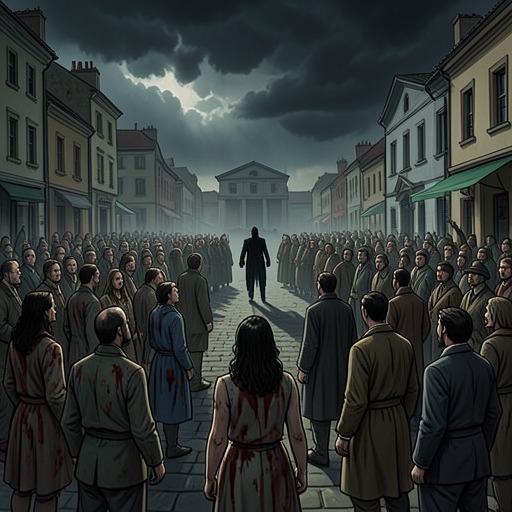
During the night of crisis, Parkins remains at his desk in the Municipal Building while solitaire lies arranged behind him like a clock. He has heard screams, the jagged beating of a horn, and running feet, but he does not go outside to investigate. His refusal marks a decisive change from the constable who organized searches and managed public intoxication. The sounds still belong to his jurisdiction, yet fear has severed the expected connection between hearing danger and answering it.
His appearance registers the physical and psychological cost of this transformation. He shambles toward the coffeepot like a very thin ape weakened by wasting illness; his lined, hollowed face is haunted by what he believes is happening outside. Around his neck he wears a cross, a St Christopher’s medal, and a peace sign. He does not know exactly why he has put them on, but they comfort him. The combination is improvised rather than doctrinal, joining religious protection, travel protection, and a secular emblem of peace as if every available sign might help him survive the night.
Parkins’ fear also exposes the limits of institutional solidarity. Nolly Gardener fails to appear after calling late at night to report seeing Homer McCaslin’s car on Deep Cut Road, and Parkins assumes that Nolly will not return. The disappearance of a fellow municipal worker converts an already frightening town into a place where even official communication can simply stop. Parkins’ calm conversational voice while describing this absence is more disturbing than panic would be: it is the voice of a man trying to remain functional while recognizing that the structures around him are vanishing.
Departure and Narrative Significance
Parkins finally decides to leave Jerusalem’s Lot. He has packed his belongings in the back of his car and intends to visit his sister in Kittery, which he judges far enough away to be safe. More importantly, he leaves his gun, the “bubble,” and his badge on the shelf beside his key ring and declares that he is finished with law enforcement. The act is a formal renunciation of the instruments that once defined him. His departure is not a successful police solution; it is an admission that the town can no longer be secured through weapons, patrols, detention, or official authority.
Even while withdrawing, Parkins remains attentive to the people who intend to confront the threat. He looks at the stakes hanging from Ben Mears’s belt and asks whether Ben plans to use one against the “fella.” The question shows that he understands enough to recognize the stakes as weapons against a particular enemy, though he does not become an active member of the anti-vampire campaign. His position is therefore intermediate: he witnesses the emergence of a counterforce while surrendering his own institutional role.
Parkins Gillespie’s arc gives the supernatural invasion a civic and psychological scale. At first, Jerusalem’s Lot appears to be a town that can be read through maps, clocks, patrol routes, court procedures, and gossip. Parkins embodies that readable order. By the end, the same Municipal Building is a refuge where a lawman listens to screams, wears protective symbols without fully understanding them, and plans escape. His badge remains behind as a quiet emblem of the point at which ordinary governance meets an enemy it cannot name, prosecute, or contain.