Ralphie Glick
'Salem's Lot: A NovelRalphie Glick is the younger Glick brother whose disappearance turns rumor into crisis in Jerusalem’s Lot. He begins as an ordinary, teasing child, but his vanishing on the woods path makes him the first visible casualty of the evil gathering around the Marsten House and provides the plot’s crucial transition from small-town unease to supernatural violence.
Identity and Introduction
Ralphie appears in the Glick household as Danny’s putrid little brother, a child capable of provoking his sibling with a tongue stuck out at exactly the wrong moment. When Marjorie Glick tells the boys to accompany one another, Ralphie responds to Danny’s irritation with a smile, while Danny clenches his fist in impotent anger. The exchange establishes him through family mischief rather than through solemn foreshadowing: he is a small boy in the familiar world of chores, parental instructions, and sibling antagonism.
His immediate destination is Mark Petrie’s house. Danny announces that the brothers are going to see the new boy, Mark Petrie, and Ralphie adds that they want to look at Mark’s electric trains. That detail places Ralphie within the ordinary social geography of the town, where a newcomer’s toys can draw neighborhood children across a path through the woods. The later horror gains force from this harmless purpose: Ralphie does not enter danger while pursuing an adult mystery, but while following his brother on a child’s visit.
Disappearance and Search
The boys were ordered to return by nine. When they had not come home by ten past, Marjorie Glick telephoned the Petrie house and learned that neither boy had arrived there. Her fear becomes the first domestic register of the disappearance, while Henry Petrie and Tony Glick attempt to explain it through plausible rural accidents. They know the boys used the woods path; the brook is shallow after the fine weather; perhaps the children found a woodchuck burrow, smoked cigarettes, or simply delayed their return. Tony agrees to search from his end while Henry begins from the other, imagining that the punishment awaiting the boys will be ordinary parental discipline once they are found.
That expectation is broken when Danny stumbles from the trees and collapses beside the backyard barbecue. He is dazed, slow-spoken, and not consistently sensible, with grass in his cuffs and autumn leaves in his hair. Ralphie is absent. The contrast between Danny’s damaged return and Ralphie’s complete disappearance makes the event more disturbing than a simple case of two lost children: one brother comes back unable to provide a coherent account, while the other has vanished without a trace.
The search eventually stops. On Wednesday, September 24, rain prevents further efforts, and the consensus is that Ralphie is gone—“solid gone.” Parkins Gillespie’s later questioning of Ben Mears is explicitly organized around the night Ralphie disappeared, showing that the case has moved from family concern into official suspicion. The constable asks where Ben was that evening, and Ben recognizes the implication that he may be a suspect. Parkins also contacts the FBI in Portland, identifying himself as the constable of Jerusalem’s Lot and reporting a missing boy. The investigation therefore expands through the town’s institutional channels even as the available explanations grow thinner.
Rumor, Evidence, and the Marsten House
Ralphie’s disappearance feeds the town’s gossip network. Telephone wires seem to carry voices across the community, and the conversations circulating around the new arrival, Richard Straker, and the Glick boy turn coincidence into insinuation. Residents remark that Straker’s arrival and the child’s disappearance are connected by timing, though they cannot yet articulate how. Elsewhere, speculation reaches for Satan worshippers, a dark coven, UFOs, or parallels with missing young men found in mass graves. These explanations reveal the town trying to give a name to an event it cannot understand; the truth is supernatural, but the first public responses take the form of rumor, moral panic, and comparison with distant crimes.
Ben Mears interprets Ralphie’s disappearance through the history of the Marsten House. He recalls that four children disappeared between 1928 and 1939, during the years when Hubert Marsten and Birdie Marsten lived there. None of those children was ever found. The earlier disappearances had been absorbed into the category of rural misfortune, but Ralphie’s case makes the pattern newly legible. Ben sees the house as Hubert Marsten’s monument to evil, a supernatural beacon or psychic sounding board that may have retained the essence of Marsten’s violence in its decaying structure. Its reoccupation, followed by another disappearance, transforms the house from a remembered scandal into an active source of danger.
The town’s collective memory is therefore both a warning and a failure. Small communities preserve old horrors ceremonially, yet the knowledge remains partial: residents know that Hubert Marsten killed his wife, but not the full circumstances, and they know that children disappeared without recovering the causal truth. Ralphie’s case exposes the cost of that incomplete memory. The past does not remain past; it repeats its pattern through a new child, while the town’s habit of explaining away violence allows the recurrence to begin under the cover of familiar stories.
Ritual Sacrifice and Narrative Function
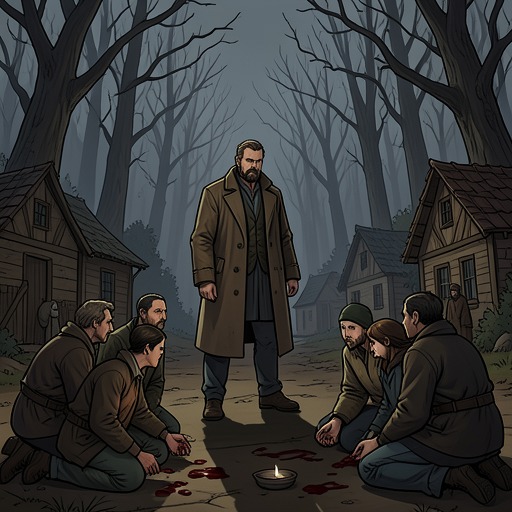
The later account of the Marsten House’s occupation confirms what the search could not. In the Burns Road Cemetery, Straker performs a midnight rite and addresses a hidden Voice as the servant of darkness. He brings what the Voice calls for, and the figure stoops before standing with a sleeping child in his arms. The child is Ralphie. His disappearance is thus revealed not as an accident, kidnapping, or act of local mischief, but as a deliberate sacrifice offered within the supernatural campaign against Jerusalem’s Lot.
This revelation changes Ralphie’s narrative status. At first he is defined by a small comic gesture, a tongue stuck out at Danny; then he becomes an absent body around which parents, police, reporters, and neighbors organize their uncertainty; finally he is reduced by Straker’s ritual to “spoiled meat and reeking flesh,” a human offering used to begin the larger work of corruption. The movement from lively child to unseen victim to ritual object is one of the book’s starkest demonstrations of how evil converts ordinary relationships into instruments of destruction.
Ralphie is also the first disappearance to make the town’s older history impossible to ignore. His case links the present occupation of the Marsten House with the four unexplained child disappearances of the earlier period and helps reveal that the town’s legends are not merely colorful local memory. Even before the vampire outbreak is openly recognized, Ralphie’s fate supplies its essential pattern: a child disappears, official explanations fail, and an older evil uses the town’s secrecy as protection.
Legacy and Significance
Ralphie’s disappearance initiates the chain of consequences that overtakes Jerusalem’s Lot. It intensifies the fear within the Glick family, prompts a search that ends in failure, draws Parkins Gillespie toward formal investigation, and becomes one of the signs by which Ben Mears understands that the reoccupied Marsten House is not simply a haunted landmark. Later, as the town’s residents spread anxious reports and speculate about quarantine, Ralphie’s case remains the original local fact beneath the expanding rumor.
His role is deliberately tragic because his characterization is so slight and so recognizable. Ralphie is not introduced as a chosen hero or a carrier of secret knowledge; he is a child who taunts his brother and wants to see electric trains. That ordinary beginning prevents the disappearance from becoming an abstract supernatural incident. It is a direct assault on the town’s most defenseless social world, and the memory of the boy’s absence gives the later epidemic a human scale. Ralphie Glick is where Jerusalem’s Lot stops being merely strange and begins to reveal itself as a place in which the past can reclaim the living.