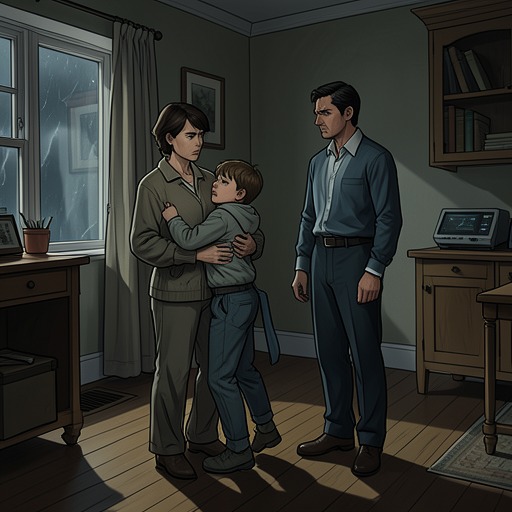
Reggie Sawyer
'Salem's Lot: A NovelReggie Sawyer is defined by the unnerving coexistence of domestic familiarity, physical authority, and controlled cruelty. His gentle smile, shotgun, and matter-of-fact speech make him one of the novel’s most disturbing figures in the scenes surrounding Bonnie Sawyer’s affair with Corey Bryant: he does not erupt immediately into incoherent rage, but converts humiliation into a performance in which he controls the room, the bodies within it, and even the expectation of death.
Identity and Domestic Power
Reggie appears as Bonnie Sawyer’s husband and as a large, armed man returning to a household already disrupted by her relationship with Corey Bryant. He enters the bedroom with a shotgun resting loosely over his forearm, its barrels pointed toward the floor, a posture that looks relaxed without being harmless. His clothing intensifies the scene’s domestic continuity: he wears the same steel-colored suit he had worn when Bonnie kissed him goodbye two hours earlier. The ordinary rhythm of marital leave-taking has therefore become the prelude to an armed confrontation.
His manner is more frightening than an uncomplicated display of anger. Reggie smiles while recognizing that the affair is true, marveling at the confirmation and joking that he owes Mickey Sylvester a case of Budweiser. The reference makes his violence part of a small-town economy of wagers, gossip, and masculine knowledge. He has not merely stumbled upon a secret; he has apparently entered the room with the satisfaction of a suspicion proved correct. His recollection that he once sold number two fuel oil to Corey’s father, years before meeting Bonnie, further places the immediate crisis inside a network of local familiarity. Corey is not an anonymous intruder but the son of someone Reggie knows.
The Affair and the Mock Execution
Bonnie attempts to explain that Corey broke in and behaved like a madman, but Reggie silences her with a contemptuous sexual insult. The insult and the affectionate-looking smile operate together: his violence is not presented as a loss of all control, but as a controlled degradation of both people before him. Corey, terrified and physically humiliated, begs not to be killed and argues that imprisonment would not be worth the consequences. Reggie answers by calling him “Perry Mason,” turning the plea into a joke and treating Corey’s legal reasoning as another form of helpless performance.
Reggie orders Corey into the living room and gestures with the shotgun. He tells Bonnie to remain in the bedroom, threatening to prevent her from learning how Secret Storm ends. The television reference is grotesquely domestic. Even while directing an apparent murder, Reggie frames Bonnie’s confinement through the language of an interrupted serial drama. His power depends on this collision between entertainment and danger: the household remains recognizably ordinary in its objects and routines, yet every familiar element has been made part of coercion.
When Corey is made to turn around, Reggie pulls both triggers. The hammers fall on empty chambers with a double click-click, and Corey faints. The apparent execution is therefore a bluff, but not a harmless one. Reggie has achieved the result he wants without firing a load: Corey’s terror, loss of bodily control, and collapse confirm his absolute dominance over the moment. Afterward, Reggie looks down at him with the same gentle smile and reverses the shotgun so that the butt points upward before turning toward the bedroom. The gesture suggests that the threat has not ended; it has merely changed from staged shooting to direct physical punishment.
Violence After Discovery
The later account of the Sawyer household shows that the confrontation was not an isolated outburst. Bonnie’s bruises are only beginning to fade, she serves dinner silently with her eyes lowered, and she eats standing because she is still too sore to sit. Reggie has flushed all her pills down the toilet, raped her after the earlier beating, and continued raping her every night since. These details transform the bedroom scene retrospectively. His mild voice and smiling face are not evidence of restraint or mercy; they are components of an established regime of domestic terror.
The meal itself exposes the structure of that regime through excessive normality. Reggie eats rib roast, frozen corn, french-fried potatoes, and chocolate bread pudding with hard sauce, all identified as his favorites, while drinking three cans of Budweiser. Bonnie serves him and eats only to avoid attracting his notice. Food, alcohol, clothing, television, and household service remain in place, but they no longer signify comfort. They are instruments by which violence is concealed, repeated, and made to resemble marriage. Reggie’s power is therefore both bodily and disciplinary: Bonnie anticipates his reaction and regulates her own movements, appetite, and posture under the possibility of being watched.
Encounter with the Undead Corey Bryant
Reggie’s later awakening at 4:15 places him in a different kind of crisis. A hammering at the front door penetrates his sleep, first entering his half-consciousness as a dream of carpentry and a memory of building a camp with his father on Bryant Pond in 1960. The sound then becomes unmistakably real. This brief movement from memory to waking danger contrasts with Reggie’s earlier confidence: the man who once staged a killing with an unloaded shotgun is now summoned from sleep by an unknown force at his own door.
When Corey Bryant reaches the hallway, Reggie again places himself between the intruder and Bonnie. He tells her to go into the bedroom, steps forward, and fires both barrels. The blast shreds and blackens Corey’s shirt, yet leaves the flesh beneath incredibly unmarked; Corey’s body appears almost insubstantial, more like a gauze curtain than ordinary flesh. Reggie’s familiar weapon, which had been sufficient to terrify a living lover, has no meaningful power against Corey’s transformed condition.
The reversal is immediate. The shotgun is slapped from Reggie’s hands, he is gripped and thrown against the wall, and his legs fail him. Corey walks past him toward Bonnie, who cringes in the doorway but watches Corey’s face. Her terror and lust alternate across her expression before she reaches toward him and calls him “Darling.” Reggie screams. The scene thus overturns the hierarchy established earlier: the husband who controlled Bonnie and Corey through a gentle smile becomes physically helpless, while the lover he once reduced to a pleading intruder returns as an inhuman force capable of violating the household’s defenses.
Narrative Function and Significance
Reggie’s trajectory is built on a severe value reversal. In the first confrontation, domestic authority appears to guarantee life and death: Reggie possesses the gun, determines who moves, and decides whether Corey will leave the room alive. The unloaded chambers make the result even more humiliating, because Reggie can produce the experience of execution without granting Corey the clarity of an actual shot. Later, the same pattern of confidence collapses when ordinary violence meets the undead. The loaded shotgun produces noise, fire, and destruction of clothing, but not injury; Reggie’s power shifts from apparent control to helpless witness.
His character also links two forms of predation that the novel places in disturbing proximity. Reggie’s treatment of Bonnie is human domestic abuse, sustained through bodily force, sexual violence, deprivation, and surveillance. Corey’s return introduces supernatural predation, but the emotional structure of the scene preserves the earlier household pattern: Bonnie is trapped between terror and compelled desire, and Reggie’s authority is displaced by a stronger possessor. The supernatural does not erase the prior violence; it exposes how fragile the distinction between marital possession and vampiric possession can become.
Reggie is consequently neither a conventional avenger nor a tragic defender. His discovery of Bonnie’s betrayal does not lead to moral justice, and the narrative gives no evidence that he develops remorse or insight. Instead, his gentle smile becomes a mask for coercion, first frightening Corey into unconsciousness and later surviving as an image of failed control when Corey returns. His last decisive action is to fire the shotgun; his last recorded response is a scream. The man who once made the household obey him ends as the witness to its supernatural reoccupation, displaced by the very violence he had believed he could command.