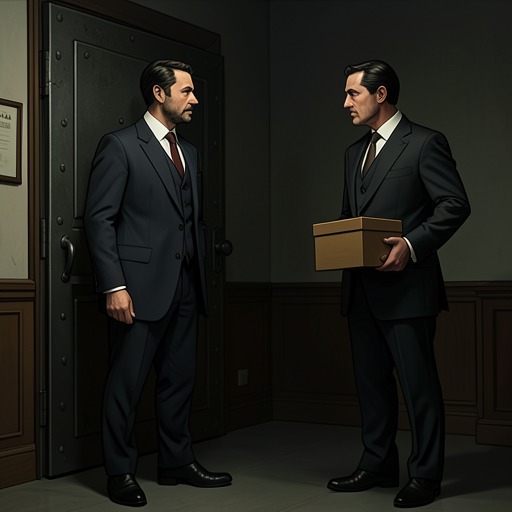
Straker's conditions
'Salem's Lot: A NovelStraker's conditions are the contractual and operational rules through which Richard Straker turns Larry Crockett's local real-estate expertise into an instrument of the partnership between Richard Straker and Kurt Barlow. The bargain promises Larry the land for a proposed shopping center, but only if he transfers the Marsten House and the business establishment for one dollar, conceals the transaction, supplies labor and materials for unexplained renovations, and follows detailed instructions without disclosure. The conditions therefore do more than arrange a sale: they convert ordinary legal and commercial procedures into a protected channel for the reoccupation of the Marsten House and the opening of the shop.
The Bargain and Its Three Conditions
Straker presents the land deal as conditional rather than as a straightforward purchase. The first condition requires Larry to sell the Marsten House and the business establishment to Straker for one dollar. Straker knows that the house is represented by a land corporation in Bangor and that the business establishment belongs to a Portland bank; he expects Larry to persuade both owners to accept the arrangement by making up the difference to their lowest acceptable prices, while also surrendering Larry's commission. The apparent sacrifice of valuable property is thus concealed inside a larger promise: once the conditions are fulfilled, the land on which the shopping center is to be built will belong to Larry.
The second condition concerns silence. Larry must say nothing about the transaction, and if the matter ever arises he is to claim only that he and Straker are partners beginning a business aimed at tourists and summer people. Straker emphasizes that this is especially important and threatens to ruin Larry if he later reveals the unusually favorable deal. Larry's reputation for keeping matters close and his standing as one of the best poker players in Cumberland County make him appear suited to the arrangement, but the condition turns discretion into enforced secrecy rather than ordinary professional confidentiality.
The third condition gives Straker continuing control after the paperwork. The Marsten House will require renovations, and Kurt Barlow, Straker's partner, plans to carry them out himself. Larry must act as Barlow's agent, respond to requests, and provide whatever laborers he employs to transport specified items to the house or the shop. He must not speak about those services. Larry can reject responsibility for illegal activities such as moonshine production, LSD manufacture, or explosives, but Straker accepts that limitation without surrendering the central demand: Larry is to facilitate the work while remaining ignorant, or at least publicly silent, about its purpose.
Administration, Deliveries, and Physical Control
The conditions operate through mundane administrative details. Larry must pay for all services, retain every invoice and bill, and receive reimbursement. This arrangement preserves a documentary record of expenses while keeping the practical burden in Larry's hands. It also gives Straker a local intermediary whose business reputation and established connections can make unusual requests appear to be routine contracting or property work.
Straker later tests the arrangement with an exact delivery order. Larry must procure a large rental truck and have it at Custom House Wharf at seven o'clock that night, with two movers. The movers are identified as Hank Peters and Royal Snow, and Larry immediately writes their names down along with the truck arrangements, following the instructions with such urgency that he does not stop to question why Straker's command must be obeyed to the letter.
The shipment consists of a dozen boxes, all but one destined for the shop. The exception is an extremely valuable Hepplewhite sideboard, recognizable by its size and intended for the Marsten House. Straker orders the movers to carry it into the cellar through the outside bulkhead below the kitchen windows. The route matters: the object is not simply delivered to the residence but directed into a concealed, controlled part of the building, making the house's cellar a practical extension of the partnership's hidden operations.
The locks complete the physical system of secrecy. Larry must obtain five stout Yale padlocks. The movers are to lock the shop's back door when they leave, leave all five keys on the basement table at the house, and then secure the bulkhead door, the front and back doors, and the shed-garage. These instructions place both properties under deliberate closure after the delivery. The locks do not merely protect merchandise; they restrict access, preserve the privacy of the cellar and house, and make the workers' departure part of a carefully managed procedure.
Coercion Beneath the Contract
Straker's language gives the conditions the surface of a business agreement, but his methods reveal a coercive structure. He knows details about Larry's Boston lawyer, Francis Walsh, and about the ownership of the properties without explaining how he obtained that information. His knowledge places Larry in the position of a negotiator whose usual informational advantage has vanished. Larry may be experienced at judging deals, yet Straker controls the facts, the terms, the timetable, and the consequences of disobedience.
The threat attached to secrecy is explicit: if Larry ever boasts about the deal or tells someone what happened, Straker will find out and ruin him. The threat is reinforced by the later way Larry Crockett handles Hank Peters. When Hank hints that he may have seen a body, Larry offers to take him to Parkins Gillespie but warns that police involvement could expose Hank's relationship with a waitress at Dell's and his dishonorable discharge. Larry's hand remains cold and steady while he applies this pressure. The scene shows the condition spreading beyond Straker's office: secrecy becomes a local discipline enforced through reputation, scandal, and the threat of official scrutiny.
The legal system remains present but is placed at the edge of the bargain. Larry invokes what might be illegal manufacture only to protect himself; Hank's possible discovery would ordinarily be a matter for the police; and later Parkins Gillespie asks Ben Mears to testify before the coroner's jury after Mike Ryerson's body is removed. These ordinary procedures contrast with the sealed property transfers and undisclosed deliveries arranged by Straker. The conditions exploit legality's paperwork while suppressing the information that would allow authorities or townspeople to interpret the transactions as a connected threat.
Narrative Function and Consequences
The conditions make the Marsten House's return to use appear first as a transaction and only gradually as a danger. The one-dollar transfer, the promised shopping-center land, the tourist-oriented cover story, the renovations, the sideboard shipment, and the five locks form a chain of clues whose meaning exceeds any individual business detail. Straker's instructions establish that the partnership's arrival is planned, resourced, and protected by local cooperation before the wider crisis becomes visible.
Larry's acceptance is reluctant but economically dazzled. He recognizes that the deal is the kind of opportunity that may come only once, if ever, and imagines that Straker's unseen superior might be a wealthy recluse capable of making such an irrational offer. His calculation is precisely what the conditions exploit: the promise of profit makes secrecy and obedience seem acceptable, while the oddness of the demands is reframed as the eccentricity of a rich client. The bargain therefore reveals how greed and professional self-interest can provide supernatural evil with ordinary infrastructure.
The rules also create a contrast between movement and enclosure. Trucks, movers, boxes, and furniture cross the distance from the Portland docks to the house and shop; once inside, doors, bulkheads, and garages are locked. Commercial circulation ends in architectural confinement. The Marsten House is not simply purchased and furnished; it is supplied, sealed, and prepared under Straker's supervision, while Larry's invoices and local labor connections give the process a respectable administrative shell.
Finally, the conditions foreshadow the limits of normal investigation. Later, questions about exhuming Danny Glick's body become entangled with family permission and the possibility of losing weeks to a hearing, while the other corpses have disappeared without markers. Parkins's demand that Ben Mears appear before the coroner's jury and McCaslin's order that Ben and Jimmy Cody report to his office show law attempting to recover control through statements and procedure. Straker's conditions have already demonstrated the opposing method: conceal the facts, manage the property, control the workers, and make every suspicious act look like a private business matter. Their significance lies in that conversion of commerce into concealment, allowing the partnership's hidden project to take root inside the town's ordinary institutions.