Summer of 1923
'Salem's Lot: A NovelSummer of 1923 is the season in which Momson, Vermont, apparently dried up and blew away, taking all 312 of its residents with it. The event matters not because the book supplies a definitive supernatural explanation, but because it establishes a chilling historical precedent for Jerusalem’s Lot: a settled New England community can become empty without a visible battle, public warning, or orderly abandonment, while the material traces of ordinary life remain behind.
The Vanishing of Momson
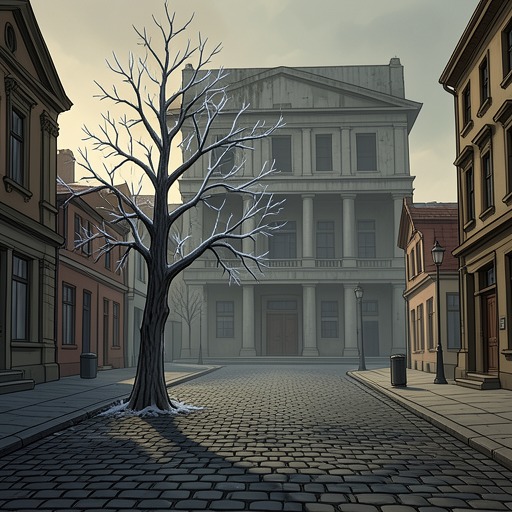
During Summer of 1923, Momson stood in a forgotten corner of Vermont, far from any main road. Its houses and a few small business buildings remained standing, yet the entire population disappeared. Fifty-two years later, the town was still uninhabited. The disappearance therefore became both an event and a condition: Momson was not merely a place whose residents had left, but an apparently preserved community cut off from the normal processes of departure, decay, and replacement. The physical evidence made the absence especially disturbing. Some furnishings had been removed, but most houses still appeared furnished, as if a great wind had swept through during daily life and carried the people away. One house retained a table set for the evening meal, with a centerpiece of long-wilted flowers. In another, the upstairs bedclothes had been turned down neatly, as though someone had prepared for sleep and then vanished before occupying the bed. In the mercantile store, a rotted bolt of cotton cloth remained on the counter, the cash register showed a purchase of $1.22, and nearly $50.00 in the cash drawer had been left untouched. These details transform a census fact into a tableau of interrupted time.
Legend, Geography, and Comparison
People nearby entertained tourists with the claim that Momson was haunted, using the legend to explain why the town had remained empty. The account also offered a more ordinary explanation: Momson was remote and economically unremarkable, a place that could disappear from practical attention because nothing in it seemed unique. Yet the geographical explanation could not dissolve the Mary Celeste–like mystery of its sudden emptiness. The story preserves both possibilities without resolving the tension between folklore and rationalization. Jerusalem’s Lot is introduced through the same pattern. It lies east of Cumberland and twenty miles north of Portland, a small town that is likewise described as having dried up and blown away. The comparison places the Lot within a recognizable American history of failed or abandoned communities, including the ghost towns of the Southwest whose populations vanished after gold or silver veins played out. Momson is presented as New England’s closest counterpart to the Lot’s mysterious emptying, making the earlier event a regional analogue rather than an isolated curiosity.
Historical Echoes in Jerusalem’s Lot
At the time of its 1970 census, Jerusalem’s Lot had 1,319 inhabitants, exactly sixty-seven more than in the previous census. It was a sprawling, comfortable township in which little of public note seemed to happen. The town’s ordinary geography—its nearly circular layout, the crossing roads of Brock Street and Jointner Avenue, the Royal River, farms, the trailer district known as the Bend, and local gathering places—makes the later comparison with Momson more unsettling. The Lot is not introduced as a visibly doomed settlement; it is introduced as a functioning community whose apparent normality conceals a capacity for disappearance. The town’s social life also supplies a mechanism for preserving and distorting the past. Telephone party lines ensure that people always have someone to discuss, while scandal simmers through the community. The residents know fragments of local violence, including the story of Hubert Marsten’s murder of Birdie Marsten, but they do not know the full circumstances. They remember horrors ceremonially across generations, even as the details become partial, conjectural, or suppressed. Momson’s empty houses thus anticipate Jerusalem’s Lot’s broader pattern: ordinary surfaces preserve evidence after explanation has failed.
From Local Precedent to Gothic Foreshadowing
The 1923 disappearance gains additional weight beside the older and later histories attached to Jerusalem’s Lot. Robert Boone’s recovered diary dates the catastrophic disappearance of the earlier settlement to October 1789, while the town’s modern history includes four children who disappeared between 1928 and 1939 without their bodies ever being found. The book therefore places Momson’s vanished population within a recurring chronology of missing people, damaged communities, and secrets that survive in documents, rumors, buildings, and landscape. The contrast between Momson and the Lot is also temporal. Jerusalem’s Lot’s inhabitants believe that nothing too terrible can happen in such a nice little town, and the town’s knowledge of national wars and crises remains largely academic. Momson demonstrates the danger of that confidence: a quiet, unremarkable community may already belong to a different historical rhythm, one in which continuity can end without explanation. When the Lot later falls under supernatural threat, its illuminated houses, roads, institutions, and familiar routines do not refute the danger; they become the ordinary shell around it. Summer of 1923 consequently functions as a historical warning rather than a fully narrated subplot. It supplies a concrete precedent for communal disappearance, preserves the eerie evidence of lives interrupted mid-action, and links the local legend of Momson to the later fate of Jerusalem’s Lot. The season’s decisive significance lies in its refusal to distinguish cleanly between folklore, remoteness, historical accident, and supernatural catastrophe: the empty town remains, while the missing people provide the explanation that the surviving world can never securely recover.