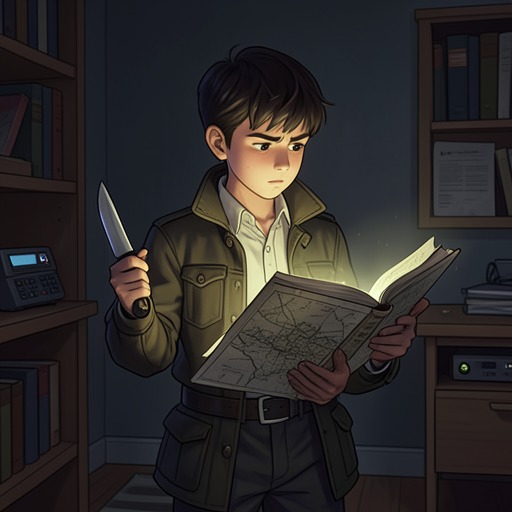
Susan Norton and Mark Petrie break into the Marsten House
'Salem's Lot: A NovelSusan Norton and Mark Petrie break into the Marsten House at the moment when private suspicion becomes physical action. Susan arrives carrying a three-foot stake cut from a red-painted snow-fence roll and wearing a small gold crucifix; Mark has made a sharper stake from a length of yellow ash with his Boy Scout hatchet. Their improvised weapons reveal both the absurdity and seriousness of the undertaking. They are ordinary people entering an extraordinary danger, and the decision to proceed converts disbelief into a test of courage.
Setting and Approach
The intrusion takes place within the sharply divided geography of Jerusalem’s Lot. Brock Street and Jointner Avenue cross at right angles through the nearly circular township, while the northwest quadrant rises into heavily wooded ground and old logging roads. The Marsten House stands on the last of those hills, apart from the more settled streets and farms. Susan reaches it by the Brooks Road, through a shadowed, heavily wooded tract without houses or trailers, then parks at the bottom of a dip on a disused wood-road leading toward the house.
The route matters because the house is not simply another building in the town. It occupies a boundary between inhabited space and the woods, between ordinary local life and the darkness the town has refused to recognize. Susan has already passed the town limits and the dump, and the road's isolation makes the possibility of danger feel more credible. She wonders why a normal man would buy the wreck of a suicide’s house and keep its windows shuttered against sunlight. The thought identifies the practical mystery behind her mission: the Marsten House’s past and its present occupation have become inseparable.
Susan’s preparations combine popular vampire lore with improvised resolve. She knows that a stake must be driven into a vampire’s heart, but the knowledge comes from Hammer films seen at the drive-in rather than from experience. She breaks a picket from the snow fence, carries it back to her car, buys a crucifix in Cumberland, and then puts the two objects together as she begins the climb. The incongruity of marching toward a suspected vampire with a piece of snow fence in one hand gives the scene an ironic surface, but the irony does not neutralize the danger; it measures how far ordinary modern life has been forced into an ancient ritual.
The Meeting of Susan and Mark
Mark Petrie has been watching the hill since twelve-thirty. From concealment beside a tree, he sees Susan climbing and first feels relief because she is not a henchman of the devil, followed by disappointment because she is only Mr. Norton’s daughter. His judgment changes when he notices that she is carrying a stake of her own. He considers her snow-fence weapon inadequate and knows that Straker is inside the house, yet he also recognizes that she understands enough of the situation to be in real trouble.
Mark’s position gives the encounter a double perspective. He is a child, but he already possesses knowledge that the adults around him have not fully acted upon; Susan is an adult, but she is approaching the supernatural with a weapon that looks ridiculous even to him. When Straker’s car backs down the driveway and leaves toward town, Mark decides that they must team up. He has felt the poisonous atmosphere surrounding the house from half a mile away, and the danger of entering alone is greater than the embarrassment or uncertainty of revealing himself.
Mark runs lightly up the incline and places a hand on Susan’s shoulder. She tenses and nearly screams, but he says, “Don’t yell. It’s all right. It’s me.” Her frightened response—“W-Who’s me?”—captures the instability of the moment: a concealed boy, a suspected vampire house, and an adult woman who cannot immediately identify whether the person behind her is rescuer or attacker. Mark identifies himself as Mark Petrie and recognizes Susan as Sue Norton, establishing a temporary alliance through their shared connection to the Norton family.
The alliance is practical rather than ceremonial. Mark has been deciding what to do about Straker, while Susan’s arrival has changed the equation. Neither has mastery of the situation, and neither can make the other’s fear disappear. What they gain is mutual reinforcement: Susan is no longer climbing toward the house alone, and Mark no longer has to confront the house without another witness or another pair of hands.
Crossing into the House
Mark uses his stake to break the hook-and-eye fastener on a shutter. The blunt end shatters the old hardware into two rusty pieces, and the shutters creak open. Susan protests that he should not be breaking in, but the objection exposes the collapse of ordinary rules. There is no useful doorbell to ring, and the house’s silence is itself part of the threat. Mark then knocks the remaining shards from a broken window, reaches through to unlatch it, and pushes it upward.
The open window becomes the threshold through which their alliance is tested. Mark lowers Susan so that she can enter, and she stands beneath the opening before climbing. Her fear is not a simple fear of an unknown noise that can be reduced to a mundane explanation. She understands, as she moves toward the sill, that the danger may be larger than comprehension. The act of moving forward becomes heroic precisely because knowledge has not made the danger manageable.
Susan climbs smoothly over the sill and drops into the dusty parlor. Mark asks for help, and she leans out, catches him under the armpits, and pulls him upward until he can grip the sill; he then folds himself neatly through the window. The physical sequence reverses their apparent roles. Mark has initiated the breach and opened the way, but Susan supplies the strength that brings him inside. Their entry is therefore a cooperative action, not a child leading an adult or an adult rescuing a child.
Inside, the parlor contains peeling wallpaper, dust, old easy chairs, a scarred table, and cobwebs near the ceiling. Yet the decay is not the whole explanation for what they sense. A smell seems to seep from the walls, deeper than animal odor or plaster rot, and the silence is so complete that they hear only the beat of blood in their own ears. They both understand that they are not alone. The house’s physical ruin and its supernatural occupation merge: the abandoned room is visibly degraded, but the real presence is defined by what cannot be seen.
Immediate Stakes and Narrative Significance
The break-in changes the status of the Marsten House from a suspicious object at the edge of town into an entered space with active occupants and immediate stakes. Before the crossing, Susan and Mark possess fragments: local history, vampire lore, the sight of Straker, and the conviction that the house is dangerous. After the crossing, they are inside the evidence itself, surrounded by a silence and atmosphere that resist ordinary explanation.
Their weapons also acquire a different meaning once they enter. Susan’s snow-fence picket is physically fragile, and Mark privately thinks that an ordinary toolbox hammer could split it; nevertheless, both carry the stake as a sign that they have accepted the possibility of confronting a vampire. The gold crucifix similarly joins belief to action. The objects do not make them invulnerable, but they give form to a resistance that would otherwise remain only suspicion.
The scene’s danger is intensified by the wider condition of Jerusalem’s Lot. The town’s roads, neighborhoods, farms, trailer district, cemetery, and wooded margins appear to form a stable social map, while the Marsten House stands as a hostile interruption within it. The town has believed that nothing truly terrible could happen in such a nice little place. Susan and Mark’s entry contradicts that assumption in the most literal way: they cross from the public world into the concealed source of the town’s fear.
Their infiltration also anticipates the later transformation of ordinary domestic spaces throughout Jerusalem’s Lot. On the night when the town’s residents awaken without knowing the truth, many turn on every light and retrieve religious symbols from drawers, attics, or jewelry boxes, yet they refuse to look out their windows. Susan and Mark do the opposite. They move toward the shuttered structure, break its barriers, and look inside. The contrast makes their act a deliberate refusal of the town’s defensive blindness: they do not merely protect themselves from the darkness; they enter the place where it is concentrated.
The immediate outcome of the break-in is not safety but knowledge. The two young investigators stand together in the dead stillness of the Marsten House, aware that another presence shares the building. That recognition supplies the decisive turn of the event. Fear remains, and the house remains dangerous, but uncertainty has become confrontation, while Susan and Mark have become partners in the struggle against the evil occupying Jerusalem’s Lot.