The 1970s exodus from ’Salem’s Lot
'Salem's Lot: A NovelThe 1970s exodus from ’Salem’s Lot is the process by which a settled Maine community loses its population and becomes a ghost town. It begins in the register of ordinary rural mobility—young people leaving after graduation, families relocating, businesses failing, and residents disappearing without a forwarding address—but it culminates in a town with no open business, no children, and no public life. Its decisive significance is that the Lot’s abandonment is simultaneously an understandable social pattern and the outward form of a deeper catastrophe: a familiar community is emptied until its streets and houses seem to have been waiting for the supernatural violence that follows.
A Town Built for Departure
Jerusalem’s Lot lies east of Cumberland and twenty miles north of Portland. Its history does not begin with the 1970s exodus: the township was incorporated in 1765, and its name arose from the local story of Jerusalem, a large sow belonging to the farmer Charles Belknap Tanner, who escaped into the woods and became wild and dangerous. The town’s physical arrangement gives the later emptying a sharply legible geography. Brock Street crosses Jointner Avenue at right angles through a nearly circular township, with the Royal River flattening the eastern boundary, wooded high ground and the Marsten House in the northwest, farms and commuter homes in the southeast, and the trailer settlement of the Bend in the southwest.
By the 1970 census, the Lot still presented itself as a comfortable, functioning township of 1,319 inhabitants, exactly sixty-seven more than ten years earlier. Yet the apparent increase concealed a long-term pattern of departure. The town contained many elderly residents and many poor residents, while young people commonly left with their diplomas and did not return. In this sense, the exodus belongs to the ordinary demographic history of rural Maine: education becomes a ticket out, mobility is organized by cars and roads, and the town’s future is quietly exported to larger places such as Portland, Lewiston, Cumberland, and beyond.
Ordinary Disappearances and the Vanishing Public Sphere
The first reports of people dropping out of sight are treated as potentially mundane. Residents relocate, change occupations, forget to leave forwarding addresses, or escape financial trouble; in an automobile-oriented society, missing persons can be explained as people who have simply picked up stakes. Several apparent disappearances are therefore reclassified as “un-disappearances”: Parkins Gillespie lives with his sister in Kittery, Charles James runs a repair shop in Cumberland, Pauline Dickens has moved to Los Angeles, and Rhoda Curless works with the St Matthew’s Mission in Portland. The language of disappearance thus initially protects the town from confronting what is unusual by placing its residents inside a familiar national pattern of movement.
That explanation becomes inadequate as the missing population includes people with no obvious reason to flee. Henry Petrie, his wife, and their son are gone, although Henry Petrie was a Prudential Insurance Company executive rather than a debtor or drifter. The local mortician, librarian, and beautician are also absent. The list of residents whom the state police would like to locate includes John Groggins, pastor of the Jerusalem’s Lot Methodist Church; Father Donald Callahan, parish priest of St Andrew’s; Mabel Werts, a prominent widow; Lester and Harriet Durham of Gates Mill and Weaving; and Eva Miller, who ran a local boardinghouse. The exodus therefore crosses occupational, religious, familial, and social boundaries instead of belonging to one marginal class.
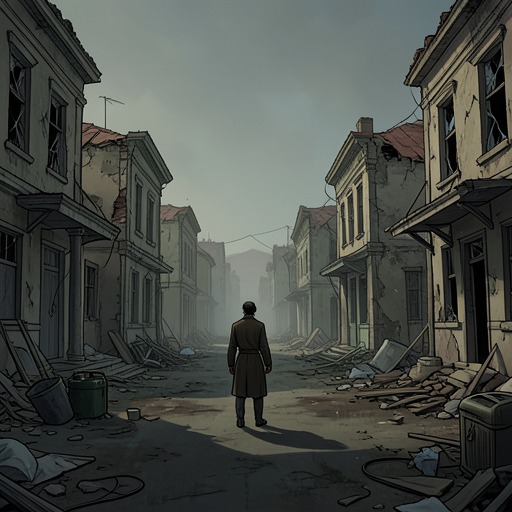
The physical town confirms that the process is no longer a series of private moves. There is not one business left open. Spencer’s Sundries and Pharmacy closes in January, followed into abandonment by Crossen’s Agricultural Store, the hardware store, Barlow and Straker’s Furniture Shop, the Excellent Café, and even the Municipal Building. The new grammar school stands empty, as does the tri-town consolidated high school built in 1967. School furnishings and books are moved to makeshift facilities in Cumberland while the district awaits a referendum, but the practical implication is more final: no children from the Lot will attend when the new school year begins. The town has lost not merely residents but the institutions that make residence collective.
From Local Rumor to Ghost Town
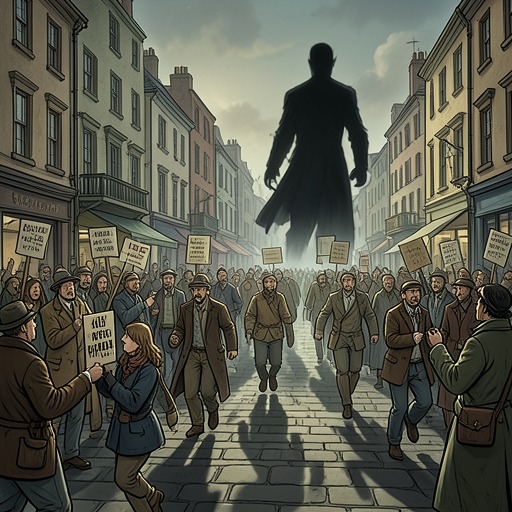
The emptying generates competing explanations. In surrounding towns, a whispering campaign turns the Lot into a legend. Colored lights are said to hover over the Central Maine Power lines, and talk of UFOs is no longer dismissed outright. Others speak of a dark coven practicing black mass and provoking divine punishment, while still others recall young men who vanished in Texas and were later found in mass graves. These stories reveal how the exodus becomes socially legible through rumor: when official explanations fail, the town’s absence is filled by supernatural speculation, religious condemnation, or memories of real political violence elsewhere.
A comparison with Momson, a small Vermont town whose 312 residents apparently vanished during the summer of 1923, gives the Lot’s fate an historical precedent. Momson’s furnished houses still preserve interrupted domestic routines: an evening table with wilted flowers, beds turned down for sleep, a bolt of cotton cloth left on a mercantile counter, and almost fifty dollars untouched in a cash drawer. Tourists call the place haunted, although its isolation offers a more practical explanation. Jerusalem’s Lot resembles Momson in the fundamental image of a community that has not merely declined but has been abruptly emptied, leaving the material settings of ordinary life behind.
The comparison also establishes the ambiguity that governs the Lot’s exodus. The town can be understood as another neglected rural settlement whose population has dispersed through economic and demographic pressures. At the same time, the absence of open shops, children, and ordinary traffic makes supernatural interpretations increasingly difficult to contain. The distinction between gradual departure and sudden disappearance begins to collapse: individual moves supply the plausible surface, while the deserted whole creates the uncanny pattern.
The Town’s Memory and the Approach of Catastrophe
Jerusalem’s Lot has long treated disturbing history as something to be inherited rather than resolved. Its residents remember the Marsten House and the violence associated with Hubert Marsten and Birdie Marsten, even though the events occurred before most living residents were born. The story survives because small towns pass their horrors down ceremonially, making collective memory a social structure as durable as a building. The town also carries older layers of secrecy, including the unexplained disappearance of four children between 1928 and 1939 while Hubert and Birdie lived in the Marsten House. None of the children was ever found.
The Lot’s public identity therefore rests on a contradiction: it is a place that insists that nothing too terrible can happen there, yet it stores violence in gossip, family memory, abandoned buildings, and unverified local history. The town’s customary knowledge of national wars and crises remains distant and mediated by television, while local danger is treated as exceptional and therefore almost unthinkable. The 1970s exodus breaks that confidence. What had looked like a series of ordinary departures becomes part of a larger pattern in which the town’s secrets, its social isolation, and its physical spaces converge.
The Abandoned Town During the Outbreak
Once the supernatural threat overtakes the Lot, the earlier exodus becomes the precondition for a particularly eerie form of occupation. Empty houses, deserted streets, overgrown lawns, boarded shops, closed schools, and back roads provide the outward appearance of a ghost town before the remaining population has fully understood why it is vanishing. The town’s central spaces have already lost their social function, so the catastrophe does not need to destroy a thriving civic order all at once; it moves through a community whose ordinary structures are already hollowing out.
The survivors’ behavior makes this transformation visible. On a night when some residents are sleeping or waking untouched, those who are awake turn on every light in their homes. They search bureau drawers, attic boxes, and bedroom jewelry collections for religious symbols without consciously knowing the truth. They move slowly from room to room and refuse to look out the windows. Cars pass through the fully lit village on their way toward Portland or points south, and a passerby might mistake the scattered lights for a fire or accident before driving on. The image reverses the normal meaning of habitation: light no longer signifies communal life, but isolated fear inside a town already emptied of certainty.
The exodus consequently has two endings. In its social form, it leaves Jerusalem’s Lot without the population and institutions required to sustain a town. In its supernatural form, it prepares a landscape in which disappearance can be mistaken for mobility until the evidence becomes overwhelming. The Lot becomes a ghost town not because one explanation replaces the other, but because ordinary rural decline and occult devastation are made to occupy the same abandoned streets.