The Marshes
'Salem's Lot: A NovelThe Marshes are the unstable southern margin of Jerusalem’s Lot, a landscape where paths, streams, woods, and uncertain ground make ordinary movement feel provisional. They are not merely a backdrop for isolated frightening incidents: the Marshes belong to the town’s practical geography, its local legends, its class divisions, and its accumulated secrets. As the narrative darkens, this peripheral space becomes one of the places through which the town’s suppressed violence and vulnerability can be sensed.
Setting and Physical Geography
The Marshes occupy part of the area beyond the town’s settled streets and farms, within a landscape organized by roads, woods, streams, and changing elevations. Jerusalem’s Lot itself is nearly circular, with the Royal River forming much of its eastern boundary; the town’s roads give it the appearance of a telescopic sight on a map. Against this comparatively legible arrangement, the Marshes represent a less dependable terrain, one that resists easy measurement and ordinary civic order.
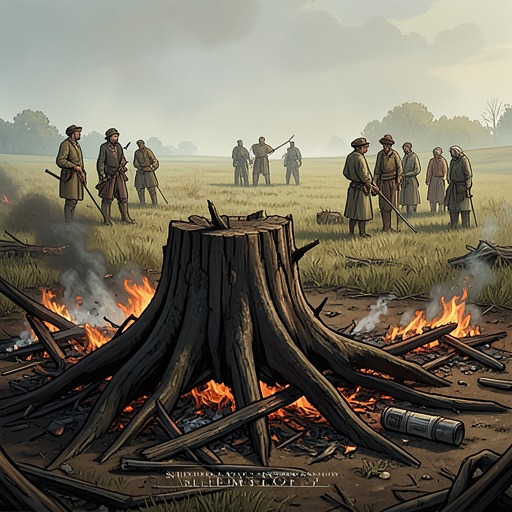
The landscape is also connected to the town’s history of fire and industry. During the 1951 fire, flames swept out of the Marshes and jumped Jointner Avenue under a twenty-five-mile-an-hour east wind. The sawmill seemed certain to burn, but Ralph Miller organized its second shift into a firefighting force and constructed a firebreak that stopped the advance and turned the fire south, where it was contained. The Marshes therefore appear as the point from which a natural disaster entered the inhabited town, while the firebreak marks a temporary human victory over an environment that could not simply be controlled.
The Marshes are also close enough to everyday life to be used as a route rather than treated as an inaccessible wilderness. A path from the Glick house toward Mark Petrie’s home crossed the Crockett Brook by stepping-stones and saved substantial time for children willing to take the shortcut. The route offered pine needles, twigs, whippoorwill song, and crickets, but its familiar details did not make it safe. As daylight faded, the woods filled with moving shadows, and the crossing became a threshold between childhood play and genuine fear.
Childhood Fear and Disappearance
The Marshes carry a local history of missing children, and that history reaches the boys before they understand its implications. Danny Glick tells Ralphie Glick about Jerry Kingfield, a ten-year-old who disappeared there while fishing six years earlier. Some people believed quicksand had taken him; others suspected that a sexual predator had killed him. No body was found, so the town preserved several incompatible explanations rather than a settled truth.
Danny transforms this unresolved disappearance into a ghost story, solemnly claiming that Jerry’s ghost still haunts the woods while omitting that the Marshes were three miles south. The deception is childish, but the fear it produces is not. Ralphie asks Danny to stop because the story has become frightening in the dark, and the scene shows how local rumor teaches children to inhabit the landscape through inherited danger. The Marshes are frightening not only because something may be physically hidden there, but because the town’s stories have already populated the place with the dead.
The route through the woods also links the Marshes to the disappearance of Ralphie Glick. Ralphie and Danny are on their way to see Mark Petrie when Ralphie vanishes, making the ordinary shortcut the last known setting associated with the brothers’ movement through the town. The Marshes thus function as a narrative border: children leave the visible domestic world, enter a space remembered through rumor, and become exposed to forces the adults cannot adequately explain.
Social Margins and Civic Boundaries
The Marshes belong to the same broader geography as the Bend, where trailers and improvised housing have gathered at the town’s edge. That district is marked by junked cars, frayed tire swings, beer cans, makeshift clotheslines, hastily laid septic tanks, and houses compared to woodsheds. Some trailers are well kept, but many yards are overgrown with dandelions and witch grass. The setting places the Marshes near a social margin as well as a physical one, beside people and households treated as sources of disorder by the more established town.
Dell’s stands near the town line where Brock Street becomes Brock Road, close to this marginal zone. Its Friday rock-and-roll bands, Saturday country-and-western music, drinking, and occasional fights make it a gathering point for the town’s “down home cowboys” and their girlfriends. The roads leading toward the Marshes are therefore not empty abstractions: they connect working-class recreation, precarious housing, transportation, rumor, and danger. The same community that knows how to cross the Marshes without getting its boots wet also knows how to use the surrounding roads for escape, drinking, and informal surveillance.
The town’s telephone system reinforces this dense social knowledge. Most lines are shared by two, four, or six parties, so residents always have someone to discuss. The Bend produces much of the scandal, but information moves beyond it whenever a person of higher status supplies something to the communal store. The Marshes sit inside this network of observation and speculation while also defeating it: people know stories about what happened there, yet they do not possess reliable knowledge of what the ground, woods, or darkness conceal.
Buried History and the Town’s Darkness
The Marshes are part of a town whose apparent safety depends on denial. Jerusalem’s Lot has celebrated civic milestones, watched national crises on television, and maintained the assumption that nothing truly terrible could happen in such a pleasant place. Its knowledge of war and political crisis is mostly academic; local violence is treated as exceptional, private, or explainable. The Marshes contradict that complacency because they preserve the possibility that something can disappear beyond the reach of ordinary records.
The same tension governs the town’s memory of the Marsten House. The house’s scandal and violence occurred before the current generation was born, yet small towns pass their horrors ceremonially from one generation to the next. Four children disappeared between 1928 and 1939, during the years Hubert Marsten and Birdie Marsten lived in the house, and none was ever found. Although those disappearances are not all assigned to the Marshes, the Marshes belong to the same geography of unlocated bodies, incomplete explanations, and communal knowledge that stops just short of truth.
The town’s hidden violence is repeatedly represented through inaccessible ground and concealed remains. Residents believe that Albie Crane’s wife ran away with a traveling man, while the more terrible account is that Albie killed her and dropped her weighted body into an old well. The well is hidden by blackberry creepers, leaving the truth physically buried beneath the town’s everyday surface. The Marshes operate according to a similar logic: they are a place where disappearance can be explained as accident, crime, or haunting, while the absence of a body permits the community to continue functioning.
The deeper history of Jerusalem’s Lot extends back to a 1789 catastrophe recorded in Robert Boone’s diary. The diary’s entries, dated from June 1 to October 27, describe a deepening obsession and clarify the relationship among James Boon’s religious settlement, the town, and the forbidden book kept in the desecrated church. The later discovery of these records turns the town’s landscape into an archive whose meaning has been delayed for generations. The Marshes participate in that archival atmosphere: they are not proven to contain every secret, but they embody the material conditions under which secrets survive.
Narrative Significance
The Marshes are significant because they make Jerusalem’s Lot’s boundaries porous. Fire crosses them toward the town, children use paths through them, rumors attach ghosts to them, and the town’s social and economic margins gather nearby. They are simultaneously ordinary and charged: a shortcut, a fishing place, a source of fuel and danger, and a region in which a person can vanish without leaving a clear explanation.
Their menace also develops through contrast. The Royal River is described as a usable, visible resource where fishermen commonly cast from the Brock Street Bridge and usually take their limit. The Marshes, by contrast, are associated with uncertain footing, quicksand, and stories whose facts cannot be verified. One landscape supports routine knowledge; the other turns knowledge into conjecture. That contrast helps explain why the Marshes remain so powerful even when no supernatural event is directly shown there.
By the time the town’s evil becomes active, the Marshes no longer seem like an isolated wilderness outside civilization. The people of Jerusalem’s Lot have built roads, farms, houses, telephone connections, bars, schools, and cemeteries around spaces that remain only partially understood. The Marshes expose the weakness of that arrangement. They show that the town’s apparent order has always been bordered by unstable ground, unacknowledged histories, and forms of violence that civic memory can preserve without truly confronting.