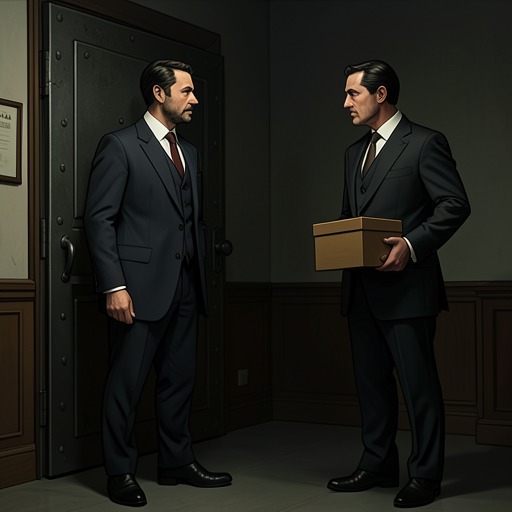
The Portland docks shipment
'Salem's Lot: A NovelThe Portland docks shipment is the first substantial logistical movement behind Richard Straker’s new enterprise, but its apparent purpose as a furniture delivery conceals a darker function. What begins as an order for a rental truck, two movers, and antique furnishings becomes a carefully controlled transfer from the Portland waterfront to the Marsten House and the newly opened shop. The shipment’s decisive significance lies in that conversion of commerce into menace: boxes, invoices, locks, and loading instructions give evil an ordinary route into the town.
Commission and Instructions
Lawrence Crockett receives the request from Richard Straker in the form of a service rather than a negotiation. Straker orders him to procure a large rental truck and have it waiting at seven o’clock that night at Custom House Wharf, specifying that two movers will be enough. Crockett immediately writes down Hank Peters and Royal Snow as the workers and notes Henry’s U-Haul, with an instruction that the truck be ready by six at the latest. His behavior is notably automatic: he does not pause to consider how completely Straker’s urgency has already overridden ordinary judgment.
Straker describes twelve boxes for collection. Eleven are to go to the shop; the remaining item is an “extremely valuable sideboard,” identified as a Hepplewhite by its size, and is to be taken to the house. The distinction between the ordinary boxes and the single valuable piece establishes the shipment’s internal hierarchy before anyone sees it. The sideboard is not merely another item in a consignment. It is isolated by destination, value, and handling instructions, with the Marsten House designated as its final location.
The delivery is also secured in advance. Straker tells Crockett that the sideboard must be put down cellar and that the movers should enter through the outside bulkhead below the kitchen windows. He further demands five stout Yale padlocks. The shop’s back door is to be locked when the movers leave, while the bulkhead, front and back doors, and shed-garage at the house are all to be padlocked. The keys are to be left on the basement table. These directions make the shipment a procedure of closure as much as one of transport: the objects enter, the workers leave, and every possible access point is sealed behind them.
Arrival at Custom House Wharf
At two minutes before seven, the big orange-and-white truck marked “Henry’s U-Haul” pulls up beside the corrugated-steel shack at the end of Custom House Wharf. The setting is practical but theatrically charged. The tide is turning, gulls wheel and cry overhead, and the sunset has stained the sky crimson. The truck’s commercial markings promise an ordinary service, while the waterfront’s shifting water, restless birds, and darkening light place that service within a threatening Gothic atmosphere.
Royal Snow is alarmed to find no one waiting. He worries that the two men may be arrested as burglars, a fear that exposes the gap between the official appearance of the errand and its actual secrecy. Hank Peters points out a police officer, but the presence of a cop does not make the operation feel legitimate. The men have been given access and instructions, yet they lack the reassuring human contact normally associated with a lawful delivery.
Inside, Royal turns on the light, and the warehouse’s physical atmosphere suppresses his earlier humor. Salt, wood rot, wetness, and the imagined presence of rats replace casual joking. The boxes stand in the middle of an otherwise empty warehouse floor, making the collection appear portentous simply because nothing else shares the space. The sideboard’s crate rises taller than the others, and it is the only box not stamped “Barlow and Straker, 27 Jointner Avenue, Jer. Lot, Maine.” Its exceptional appearance thus repeats the exceptional destination Straker had already assigned to it.
The Sideboard and the Workers’ Unease
Royal checks the invoice and counts the boxes, confirming that the consignment is complete. He then takes out his pocketknife and cuts open the brown invoice envelope taped to the side of the sideboard’s box. His justification is practical: the men must make sure they have the right item, since an error could bring punishment from Lawrence Crockett. Yet the gesture also brings the suspicious object into closer scrutiny. Administrative paperwork is peeled back from the crate, but the act reveals no reassuring explanation.
Hank Peters suggests looking inside, while Royal refuses and tells him to grab the box. Their refusal to inspect the contents leaves the sideboard materially present but cognitively unknown. The workers can identify its dimensions and weight, but not its nature. The box shifts heavily when they tip it, and its weight confirms that it could contain a substantial piece of furniture. The men stagger with it to the truck, heaving it onto the hydraulic lifter with identical cries of relief before carrying it inside.
Royal’s unease survives the successful loading. He dislikes the box for more than the absence of a customs stamp, sensing an indefinable quality he cannot name. That missing stamp is a small bureaucratic irregularity, but in the scene it becomes a sign that the object does not fit comfortably within normal systems of ownership and transit. The sideboard is both documented by an invoice and marked by an omission; it belongs to a commercial shipment while appearing to have crossed a boundary outside ordinary accountability.
Return to Jerusalem’s Lot
The drive back to Jerusalem’s Lot is silent, with Hank Peters pressing heavily on the gas because he wants the errand finished. Both men regard the delivery as peculiar, and the urgency that first belonged to Straker has passed into their own desire to be done with it. The shipment therefore changes the workers’ relationship to the journey: what they accepted as paid labor becomes an unwanted burden whose completion matters more than conversation or curiosity.
At the new shop, Hank drives around to the back. The door is unlocked exactly as Lawrence Crockett had promised, but the light switch produces no result, forcing the men to unload in darkness. The failure of the light continues the shipment’s movement from public commerce toward enclosed secrecy. The workers have arrived at the correct destination, yet the building offers none of the ordinary visibility or welcome that would make the delivery reassuring.
The shop also contains an odor that neither man can easily explain. Royal asks whether it smells funny, and Hank recognizes an unpleasant, dry, acrid scent resembling old corruption. He dismisses it as the consequence of the building having been shut up too long and needing air, but that explanation cannot erase the impression created by the darkness, the empty room, and the suspicious crate. The shop has not simply received furniture; it has received an atmosphere, and the shipment makes that atmosphere tangible.
Narrative Function and Gothic Significance
The scene’s tension comes from the widening distance between expectation and result. The men expect a straightforward pickup, but find an unattended warehouse, an unusually isolated consignment, a sideboard without a customs stamp, and a destination whose darkness and odor resist ordinary explanation. Nothing openly supernatural is required. The event works through accumulation: each minor irregularity remains deniable, while together they convert a routine delivery into a passage across an unseen threshold.
The sideboard functions as a material emblem of Richard Straker’s enterprise. Its Hepplewhite identity places it within the world of valuable antiques, yet its separate destination, heavy shifting contents, and restricted cellar delivery make it more than merchandise. The crate is never opened, so the narrative preserves ambiguity while concentrating attention on the object’s physical presence. It is tall, heavy, sealed, and singled out; the unknown inside becomes more ominous because the workers handle it as an object without understanding it.
The shipment also links the shop to the Marsten House through infrastructure. The shop receives most of the boxes, while the sideboard alone is routed to the house’s cellar through the outside bulkhead. The locks then close the route behind the movers. In structural terms, the event establishes a chain from Straker’s command to Crockett’s obedience, from Portland’s warehouse to Jerusalem’s Lot, and from public roads to hidden interior space. Commercial organization becomes the surface form through which the Marsten House extends its influence.
By the end of the sequence, the value of the delivery has shifted. It begins as paid work governed by invoices, truck schedules, and recognizable furniture brands. It ends in silence, darkness, unexplained odor, and a box that the workers instinctively distrust. The shipment’s real consequence is not merely that antiques reach their destinations, but that an ordinary town’s systems of labor and commerce have been recruited into an occult operation whose danger is felt before it is understood.