The Walking Dead
'Salem's Lot: A Novel“The Walking Dead” names the moment when Jerusalem’s Lot’s apparent normality breaks open into supernatural fact. The phrase is not merely a description of reanimated bodies; it marks Ben Mears’s recognition that the town’s streets, houses, institutions, and familiar inhabitants have become part of a landscape populated by the dead.
From Ordinary Town to Living Map
Jerusalem’s Lot initially presents itself as an orderly, nearly circular Maine township. Brock Street crosses Jointner Avenue at right angles through the center, giving the town the appearance of a telescopic sight. Its quadrants seem to divide different kinds of life: wooded north Jerusalem and the Marsten House on the high ground; the Royal River and its farms to the northeast; prosperous farmland and Schoolyard Hill to the southeast; and the trailers, junked cars, beer cans, makeshift yards, and Dell’s in the southwest Bend. The town’s geography therefore supplies a map of visibility, class, movement, and isolation before the supernatural crisis rewrites it.
That apparent stability depends on denial. Jerusalem’s Lot receives national wars and political crises mainly through television, while local tragedies remain isolated accidents: a soldier killed in Vietnam, a mutilated veteran returning home, and teenagers dying in reckless automobile crashes. Apart from such incidents, the town believes that nothing truly terrible can happen there. “Nothing too nasty could happen in such a nice little town. Not there.” The phrase “The Walking Dead” reverses that civic assumption. The threat is no longer elsewhere, exceptional, or safely reported through a screen; it is inside the town’s own social body.
The Recognition of Undeath
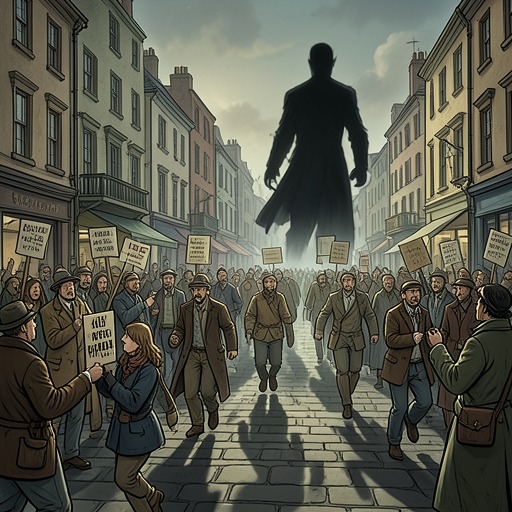
The decisive occurrence comes after Ben Mears carries Mark Petrie out of Jerusalem’s Lot. Ben initially tells himself that the boy has merely fainted, and Mark’s pulse is strong and regular. He starts the car and drives away, but delayed reaction strikes him with physical force. The realization arrives in a short, stark sentence: “They were in the streets, the walking dead.” The wording turns a private shock into a collective diagnosis. Ben does not identify one isolated monster; he understands that the town itself has been overrun.
The recognition is prepared by a series of disturbances that institutions cannot adequately contain. Danny Glick’s burial at Harmony Hill Cemetery draws a large public procession, with classmates, relatives, curious townspeople, and older mourners following the hearse up Burns Road. The communal ceremony preserves the outward forms of ordinary death even as the supernatural meaning of death is changing. Later, Matt Burke questions whether a body is really dead, and the medical examination of the corpse associated with Mike Ryerson records the absence of surface lividity and rigor. At Green’s workroom, Marjorie Glick’s body appears similarly anomalous, while Jimmy Cody refuses to make a final judgment before more time has passed.
The crisis also enters the administrative world of medicine and the morgue. Someone removes bodies from the Cumberland County Morgue in Portland, an act described through the grotesque image of a Boris Karloff creation emerging from Mary Shelley. The language of hospitals, physicians, examination tables, and morgue procedures attempts to classify the bodies, but the bodies repeatedly exceed those categories. “The Walking Dead” is consequently both a supernatural expression and an epistemological one: it identifies a condition that ordinary medical and civic vocabulary cannot safely absorb.
Bodies That Refuse the Boundary of Death
The evidence of walking death is physical rather than abstract. Mark Petrie and Jimmy Cody pull Roy McDougall from a low crawl space into the rain and weakening daylight. Once the light reaches him, Roy writhes, his skin sags and yellows, moisture emerges from his pores, and his eyes roll beneath their closed lids. His breathing takes on a hitching, Cheyne–Stokes rhythm, and the symptoms cease when he retreats into shadow. The body therefore behaves as both corpse and active organism, unable to endure the daylight that belongs to the living world.
This scene also makes the phrase spatial. The dead do not simply exist in graves or hidden rooms; they occupy crawl spaces, roads, houses, and the edges between light and darkness. Mark and Jimmy must physically drag Roy across that boundary to discover what he has become. The town’s familiar spaces have become thresholds, and the ordinary act of moving a body becomes an encounter with a body that can move itself.
The phrase is sharpened by the contrast between this grotesque mobility and Jerusalem’s continuing appearance of normal life. A driver passing through town might see scattered houses with their lights burning in the early morning and mistake the illumination for evidence of a fire or accident. The scene remains visually ordinary enough to be dismissed. Yet the inhabitants who are awake do not know the truth, and many instinctively search drawers, attics, or jewelry boxes for religious symbols. They turn on every light and refuse to look out their windows. Their bodies respond before their minds understand. The town is already occupied by the dead, but its living residents still perform the gestures of domestic routine.
Silence, Surveillance, and Contagion
The expression also gathers force from the town’s older social habits. Jerusalem’s Lot is linked by party telephone lines, so that residents always have someone to discuss; scandal simmers continuously, with the Bend producing most of it and more respectable citizens occasionally contributing their own secrets. This network of gossip makes the town a place of constant observation, but it does not produce genuine knowledge. People can circulate rumors while remaining blind to the central fact of their own transformation.
That failure of recognition explains the strange stillness surrounding the outbreak. When Mark and Susan enter the Marsten House, the silence is so complete that they hear only their own blood, yet they know they are not alone. Elsewhere, illuminated dwellings appear like isolated signs of life in a graveyard of morning. The phrase “The Walking Dead” exposes the irony: the town has plenty of movement, speech, electricity, roads, and domestic activity, but none of these guarantees life. Social visibility has become a mask, and silence has become a form of concealment.
The discovery of stolen corpses makes the contagion legible as a system rather than a succession of unrelated deaths. Bodies disappear from institutional custody; the dead return; surviving residents begin to behave defensively without understanding why. The vampire outbreak thus passes through family homes, medical spaces, cemeteries, and public roads. The phrase describes the result of that process while also implying its danger: death is no longer a final condition but a mobile, infectious presence.
Narrative and Thematic Significance
“The Walking Dead” functions as a recognition formula for the novel’s central reversal. At the beginning, Jerusalem’s Lot believes its disasters are minor, private, or safely externalized through television and local gossip. By the time Ben drives away, the distinction between a town and a graveyard has collapsed. The streets are no longer routes through a protected community; they are corridors through an occupied landscape.
The expression also joins the novel’s medical and religious registers. Clinical signs—missing rigor, abnormal corpses, altered breathing, and reactions to light—make the supernatural visible, while religious symbols appear in the hands of inhabitants who cannot yet articulate the threat. Knowledge comes through accumulated bodily evidence, instinctive ritual, and finally direct recognition. No single institution explains the crisis soon enough; the phrase supplies the plainest possible name for what the town has become.
Its power lies in its compression. “The Walking Dead” contains the horror of movement after death, the social horror of familiar neighbors becoming enemies, and the moral horror of a community continuing to look like itself while its human substance disappears. It is the language of Ben Mears’s delayed understanding, but it also becomes the reader’s final orientation: Jerusalem’s Lot is not merely threatened by monsters outside its boundaries. Its own dead have entered the streets.