The theft of bodies from the Cumberland County Morgue
'Salem's Lot: A NovelThe theft of bodies from the Cumberland County Morgue marks the point at which the strange deaths surrounding Jerusalem’s Lot become an unmistakable assault on the boundary between the living and the dead. What first appears as a breach of morgue procedure becomes evidence that corpses are being removed for a purpose connected to the town’s supernatural crisis, extending the danger beyond local homes, graves, and hospitals into the machinery meant to classify and contain death.
Discovery in the Morgue
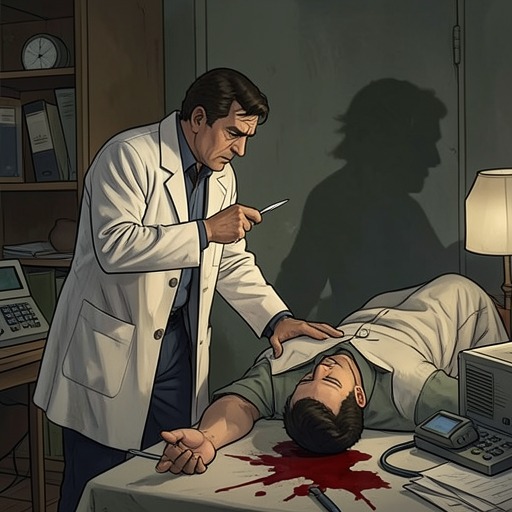
The episode unfolds in the county morgue in Portland, a cold, antiseptic room lined with green-tiled walls and square doors resembling oversized bus-terminal coin lockers. At quarter to ten on Saturday night, attendants are receiving the body of a young man shot in a downtown bar. The routine atmosphere makes the disruption more disturbing: Buddy Bascomb is in the middle of a vulgar joke when he notices that two locker doors in the M–Z section are standing open.
One of the open compartments is assigned to Floyd Martin Tibbits, whose body had been admitted on October 4, 1975. Buddy pulls the door out on its silent casters and finds it empty. The absence is not an administrative abstraction but a physical impossibility: the slab is there, the locker is there, and the corpse has disappeared. The second missing body is Randall Fratus McDougall, identified in the register as an infant. When Buddy explains the abbreviation, he realizes that the morgue is not merely missing an adult victim but also a child’s body, and says that they are in trouble.
From Local Irregularity to Wider Threat
The missing bodies acquire their full significance when the news reaches Ben Mears, Susan Norton, and Jimmy Cody. The report is described as something out of a Boris Karloff film adapted from Mary Shelley, a comparison that captures the collision between modern institutional procedure and an archaic horror of reanimated flesh. The bodies have been snatched from the Cumberland County Morgue in Portland, not simply disturbed in a Jerusalem’s Lot cemetery.
The theft therefore widens the geography of the crisis. Earlier disappearances had been attached to particular people and places, including the unexplained deaths and vanishings in the Lot. The morgue theft shows that the dead are being gathered after official examination and storage, where they should be inaccessible to ordinary predators. The supernatural force is no longer confined to a haunted house, a family tragedy, or a local graveyard; it can reach into a county institution and remove bodies without leaving a usable explanation.
Investigation and the Problem of Proof
The stolen corpses also create a legal and medical obstacle. Susan Norton asks whether an exhumation order requires the permission of the Glick family. Jimmy Cody answers that, technically, it does not, but realistically the family could force a hearing. Such a delay might consume two weeks to a month, and by then his encephalitis theory would probably no longer hold up. The ordinary framework of medical investigation is thus shown to be both necessary and inadequate: it demands permission, hearings, and a diagnosis at precisely the moment when delay may allow the threat to multiply.
Cody identifies the missing-body pattern as the fact that disturbs him most. Danny Glick is the only corpse for which the investigators still have a marker; all the others have vanished into thin air. That contrast turns the morgue theft into a crucial evidentiary link. The investigators are not confronting isolated deaths whose causes remain uncertain. They are confronting a recurring disappearance of bodies, a pattern that connects death, removal, and possible return.
Consequences and Narrative Significance
The theft confirms that official institutions can record death without controlling what follows it. The morgue possesses labels, dates, tiled walls, attendants, and procedures, yet those safeguards cannot preserve the distinction between a corpse and an active supernatural instrument. The missing bodies expose the weakness beneath the confidence of medical and bureaucratic order: the institution can name a body, store it, and register it, but it cannot guarantee that the dead will remain dead.
Within the larger pattern of Jerusalem’s Lot, the episode also makes the town’s accumulated secrets materially present. The community has preserved old violence through rumor and inherited memory, while the disappearances of children from earlier decades remain unresolved because no remains were ever found. The morgue incident gives that older history a new, immediate form. A corpse is not simply absent from the past; it is being removed in the present, and the disappearance suggests that the dead may be returning to the world rather than merely being lost to it.
The event consequently shifts the investigation from suspicion to emergency. The question is no longer only what killed the victims, but what is collecting their bodies and what those bodies may become. By placing the theft in Portland’s county morgue, far from the familiar streets and houses of Jerusalem’s Lot, the narrative shows the outbreak overcoming distance, procedure, and institutional oversight. The horror has acquired infrastructure: it travels through records, hospitals, police reports, and morgue lockers, while leaving the authorities with empty compartments and an explanation that ordinary law and medicine cannot supply.