Tony Glick
'Salem's Lot: A NovelTony Glick is the father of Danny and Ralphie Glick and one of the earliest residents forced to confront the catastrophe in Jerusalem’s Lot. Introduced as an ordinary family man watching a baseball game, he becomes a figure of parental fear, bereavement, denial, and physical collapse. His experience supplies the outbreak with its intimate scale: before the town’s danger is understood as a supernatural invasion, it is a father waiting for two boys to come home.
Identity and Family Life
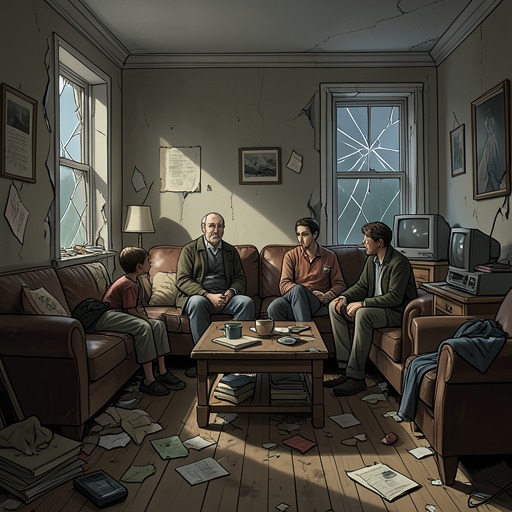
Tony first appears in the living room with his feet up, watching the Red Sox and the Yankees on television. When Danny and Ralphie announce that they are going to visit Mark Petrie to look at his electric trains, Tony asks where they are going and orders them to be home by nine. The exchange establishes him through routine authority rather than exposition: he is attentive to his sons’ movements, but the evening initially belongs to the harmless habits of family life.
The family’s ordinary surface also includes a distinctly personal history. Tony is broad, dark, and heavily muscled, with thick black hair inherited by both boys. His grandfather’s original surname was Gliccucchi, but it was legally changed to Glick after the family was told that an American name would make life easier. Tony’s physical description and family history place him within the social world of the town while also showing the pressure to make identity more acceptable through assimilation.
The Disappearance of Ralphie Glick
When Danny and Ralphie fail to return by ten past nine, Marjorie Glick calls the Petrie house and learns that the boys never arrived. Tony and Henry Petrie discuss the route and agree that the boys may have wandered along the woods path, encountered a woodchuck burrow, or stopped to smoke cigarettes. Tony thanks Henry for his help and comforts Marjorie, while privately deciding that the boys will be punished when they are found. His response is still governed by the assumptions of ordinary parenthood: disobedience, mischief, and a delayed return.
That framework collapses when Danny emerges from the trees before the search begins. He is dazed, slow to answer, and unable to explain what happened. Grass clings to his cuffs and autumn leaves remain in his hair. He remembers that everything became very dark and that he later found himself alone on the path, but he cannot remember Ralphie’s disappearance. Tony’s fear is therefore joined to an unbearable blank: the surviving child cannot provide the explanation needed to locate the missing one.
Parkins Gillespie advises against sending men into the woods that night because deadfalls make the search dangerous. Tony nevertheless joins Parkins, Nolly Gardener, and Henry Petrie in calling along the path and the shoulders of South Jointner and Brock streets with battery-powered bullhorns. The following morning the Cumberland and state police organize a wider search, which continues for four days. Tony and Marjorie move through woods and fields around the deadfalls left by the ancient fire, calling Ralphie’s name with what the narration presents as endless, wrenching hope. The search extends to Taggart Stream and the Royal River, but no result is found.
Danny Glick’s Death and Funeral
Danny is twelve when he is admitted to the hospital on September 22, 1975, with shock, partial loss of memory, nausea, disinterest in food, constipation, and general loginess. Tony is recorded as the admitting parent, a bureaucratic detail that makes his role painfully concrete: he is the person who brings the damaged child into medical care even though neither medicine nor the available explanations can account for what happened in the woods.
Danny is later buried in Harmony Hill Cemetery on September 28, the first true day of fall. Tony arrives in his 1965 Mercury behind the hearse, in a long procession of relatives and townspeople whose headlights remain on despite the daylight. Mark Petrie and his parents attend because Danny and Ralphie had been on their way to visit Mark when Ralphie disappeared. The funeral therefore gathers the family’s private grief with the town’s curiosity, memory, and apprehension.
At the graveside, Tony stands apart from Marjorie, shocked and wandering, repeatedly looking around as though verifying that he is actually among the mourners. His face belongs to a man who believes he is dreaming. When Father Callahan prepares to complete the burial, Tony screams that no dirt will be thrown on his boy. He surges forward, falls through the fake grass covering the grave, and lands heavily on Danny’s coffin. The physical shock of the fall turns grief into spectacle, but the scene is not merely theatrical: Tony’s body literally enters the grave because he cannot accept the separation that burial makes final.
Held back by the men around him, Tony continues to insist that Danny is not dead because he is only twelve years old. He weeps, staggers forward, falls to his knees at Father Callahan’s feet, and begs for his boy to be returned to him, accusing the priest of fooling him. Callahan responds by taking Tony’s head gently in both hands and praying for comfort. The church offers ritual language and holy water, but Tony’s demand is immediate and bodily; no promise of future heavenly reunion can equal the child he wants restored now.
Bereavement and Collapse
After the funeral Tony takes a leave of absence from work and sleeps for long, dreamless stretches. The week becomes hazy and unreal to him, while food arrives from the community in casseroles, preserves, cakes, and pies that neither he nor Marjorie can eat. An attempted sexual reunion with Marjorie ends with both of them crying, showing how completely the loss has disrupted ordinary marital life as well as parental identity.
Tony’s grief is contrasted with Marjorie’s compulsive cleaning. She scrubs the house with ammonia and Lysol, beats the rugs in the backyard, and packs Danny’s clothes and toys into labeled cartons for the Salvation Army and Goodwill. Tony finds those silent cartons more horrible than anything he has seen. The contrast does not suggest that either parent is processing the loss successfully; each converts unbearable grief into repetitive action, Tony through sleep and withdrawal, Marjorie through cleaning and disposal.
The family’s tragedy then becomes part of the vampire outbreak’s chain of consequences. Marjorie dreams that Danny has come home and calls her Mommy, but the dream carries an unsettling mixture of sweetness and bitterness, recalling infancy and the painful bite of a child beginning to grow teeth. Tony wants Dr. Reardon to examine her, yet she seems not to hear him. Her death follows early on Saturday morning, and Tony is taken to Central Maine General in shock. By the time Ben Mears and Jimmy Cody reach the Glick home, the house is silent: Mrs. Glick’s body has been removed, while Tony has become a hospital case.
Narrative Role and Significance
Tony’s trajectory marks the progression from a missing-child mystery to a family catastrophe and finally to the town-wide supernatural crisis. At first, the danger can be interpreted as a boy wandering into the woods. Then the search fails, Danny dies, the funeral erupts into denial, Marjorie receives the dead child in dreams, and both parents are destroyed. Each stage strips away another ordinary explanation without requiring Tony to understand the forces at work.
His insistence that Danny cannot be dead because he is only twelve also gives the story a tragic counterpoint to its vampire logic. The supernatural promises a grotesque form of return, while Tony’s plea seeks the return of the living child he remembers. That distinction is crucial: resurrection in this world does not restore the family but corrupts it. Tony’s collapse reveals the cost of that corruption before the wider town recognizes its source, making him less an investigator than the human measure by which the novel’s hidden horror becomes undeniable.