Vampire contagion
'Salem's Lot: A NovelVampire contagion names the process through which vampirism passes from one victim to another until an apparently ordinary town becomes a concealed vampire colony. Its decisive force lies not only in the bite itself but in the delay between infection, diagnosis, death, disappearance, and recognition: each stage can be mistaken for illness, accident, private violence, or administrative failure, allowing the danger to multiply behind ordinary houses and institutions.
Definition and Initial Obscurity
The contagion first appears through bodily abnormalities that invite rational explanations. After Mike Ryerson’s death, Matt Burke’s account is treated as a possible dream, while another explanation proposes that Mike died from unknown natural causes. The physical scene resists that interpretation: the second-floor screen was lying outside, yet its latch locked from the exterior and there were no pry marks or ladder marks beneath the window. Susan Norton still tries to imagine murder, a rigged screen, ventriloquism, planted evidence, or an undetectable poison, while Ben Mears searches for a motive that would explain such elaborate deception. The difficulty is epistemological as much as medical: the evidence is concrete, but the supernatural explanation remains harder to accept than a chain of unlikely human acts.
The town’s institutions reinforce the delay. On September 23, 1975, Daniel Francis Glick is recorded in a clinical document under his address in Jerusalem’s Lot, giving the horror an administrative surface before its wider meaning is understood. When Mike’s body is examined, Parkins Gillespie even asks whether he is certainly dead and whether anyone tried to wake him. Later, the body of Marjorie Glick shows no surface lividity and no sign of rigor or incipient rigor, a condition strikingly similar to Mike Ryerson’s. Medical vocabulary therefore becomes double-edged: acute anemia and other clinical possibilities offer temporary shelter from the vampire explanation, but the recurring physical pattern gradually turns diagnosis into recognition.
The Chain of Transmission
The contagion becomes legible as a chain rather than as a series of isolated deaths. Ben Mears and Jimmy Cody explicitly consider the possibility that Danny Glick infected Mike Ryerson, who then infected another victim, perhaps Floyd Tibbits; they also ask whether the McDougall baby might have infected one or both of his parents. The uncertainty over the exact links does not weaken the model. It demonstrates how quickly transmission can outrun knowledge, especially when the dead are not securely contained and the living are not systematically checked.
Jimmy Cody experiences the mechanism directly when Marjorie Glick bites him. He cries that she bit him and calls himself unclean, then washes the tainted blood from the wound. The injury reveals two puncture wounds near the jugular, one horribly mangled. His immediate use of a hypodermic and tetanus treatment shows the medical response available to him, but the scene also exposes its limits: a wound that can be disinfected still carries a supernatural danger that ordinary emergency care cannot resolve. The bite turns contagion from an inferred pattern into an immediate threat to the investigators themselves.
Expansion Behind Ordinary Life
The most dangerous feature of Vampire contagion is its compatibility with the town’s social structure. Jimmy Cody observes that Jerusalem’s Lot is primarily a bedroom town for Portland, Lewiston, and Gates Falls, with no local industry where rising absenteeism would be noticed. Its schools are consolidated across three towns; many residents attend church elsewhere or not at all; television has weakened old neighborhood gatherings; and only older men remain regulars at Milt Crossen’s Agricultural Store. Under these conditions, a growing absence list can remain invisible, while changes inside houses stay concealed behind drawn shades.
The physical layout encourages the same concealment. Brock Street crosses Jointner Avenue at right angles through the town’s nearly circular plan, while the southwest Bend is crowded with trailers, junked cars, makeshift yards, children, and informal social life. Such a town looks legible from its roads but contains countless private interiors, cellars, bedrooms, and outbuildings. The contagion travels through those domestic spaces rather than through a visible public epidemic, converting familiarity into camouflage.
That camouflage produces a horrifying arithmetic. Ben imagines people disappearing for a week, two weeks, or a month without being missed, and wonders whether two hundred or three hundred residents could simply drop out of sight. The theft of bodies from the Cumberland County Morgue makes the danger still larger: Carl Foreman is missing, the bodies of Floyd Tibbits and the McDougall baby have vanished, and Mike Ryerson’s body is gone as well. Once the dead can be removed from official custody, the distinction between death and disappearance collapses, and every unaccounted-for person becomes a possible new agent of transmission.
Institutional Breakdown and Contagious Uncertainty
The disappearance of bodies turns the outbreak into a crisis of custody as well as infection. At the hospital, the news that someone had taken bodies from the Cumberland County Morgue sounds like a grotesque impossibility, yet it gives concrete form to what the earlier medical explanations had concealed: the dead are not passive remains, and ordinary procedures cannot guarantee that a victim has been removed from danger. The investigators consequently begin to connect separate absences—Carl Foreman’s disappearance, Floyd Tibbits’s death in his cell, the missing body of Mike Ryerson, and the vanished McDougall baby—rather than treating each as an isolated medical or administrative matter. The pattern makes the town itself the medium of contagion, because every unexamined death and every unverified disappearance may return as another point of transmission.
Spatial Concealment and Collective Response
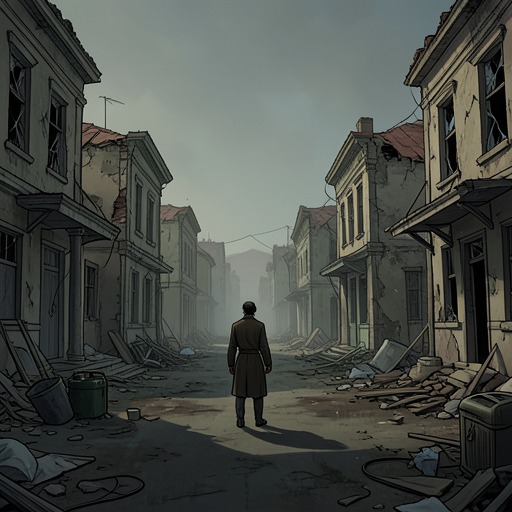
The outbreak’s spread is also shaped by the town’s geography and by the habits that geography has produced. Jerusalem’s Lot is organized around the crossing of Brock Street and Jointner Avenue, with wooded high ground, open farmland, the Royal River, and the trailer-filled Bend occupying distinct quadrants. Yet the apparent clarity of this map conceals a dense interior life: homes, bedrooms, cellars, sheds, and improvised dwellings remain largely inaccessible to public scrutiny. The contagion therefore does not need a spectacular public attack to advance. It can move through ordinary domestic thresholds, while roads and landmarks preserve the illusion that the town remains fully observable.
The town’s social character makes that illusion more durable. Jerusalem’s Lot believes that nothing truly terrible can happen in such a pleasant place, and its knowledge of national wars and crises remains largely mediated by television rather than by direct communal experience. Even local deaths may be absorbed into familiar explanations involving accidents, anemia, heart trouble, or private misconduct. The result is a collective delay in which suspicion exists without becoming organized knowledge. The town’s longstanding gossip network can circulate scandal, but it cannot initially distinguish scandal from an actual supernatural emergency.
As the contagion advances, ordinary civic visibility begins to fail. Some residents sleep or wake untouched, especially single people without relatives or close friends in town, and remain unaware that anything is wrong. Those who are awake turn on every light in their houses, search drawers, attics, and bedroom collections for religious symbols, and move from room to room without looking out the windows. This behavior is not informed by a clear diagnosis; it is an instinctive response to a danger the residents cannot articulate. Their refusal to look outside becomes a communal symptom of the outbreak, showing that fear has spread even where knowledge has not.
The contrast between the brightly lit houses and the surrounding darkness makes the contagion appear both everywhere and nowhere. A driver passing through might see isolated dwellings fully illuminated in the graveyard of morning, suspect a fire or accident, and then continue toward Portland without understanding what has happened. Jerusalem’s Lot can therefore look almost normal from the road even while its population is being transformed behind closed shades. The epidemic’s deepest power lies in this separation between outward continuity and inward collapse: the town remains readable as a familiar settlement precisely when its private spaces have become the active field of infection.
Narrative Significance and Limits of Recognition
Vampire contagion ultimately functions as a crisis of recognition: the infection spreads through bodies and households faster than the town can produce a language adequate to describe it. The earliest explanations—natural death, acute anemia, murder, poison, or hallucination—are not wholly irrational; they are the categories supplied by medicine, law, and ordinary experience. Their failure arises from the way the evidence accumulates across institutions. A body that resembles a medical case becomes a vanished body; a missing person becomes a possible returning predator; a bite treated as an injury becomes a threat to the investigators themselves. Jimmy Cody’s puncture wounds near the jugular make that conversion brutally visible, while the later sight of Roy McDougall writhing in the rain and retreating into shadow shows that even the boundary between corpse and living victim has become unstable. The contagion thus destroys confidence in the procedures meant to contain it: diagnosis cannot settle whether death has occurred, morgue custody cannot keep the dead secure, and local familiarity cannot reveal which homes still contain human occupants.
The outbreak also reverses the usual meaning of community. Shared roads, consolidated schools, gossip, churches, stores, and passing traffic should make a small town socially transparent, yet those same networks become mechanisms of concealment when residents are absent without immediate consequence and private households remain uninspected. The town’s apparent safety—its belief that nothing truly terrible could happen there—becomes the condition that permits the danger to mature. Even resistance begins as an instinct without comprehension: residents turn on lights and search for religious symbols without knowing the truth, while refusing to look through their windows. This collective behavior marks a threshold between ignorance and knowledge. The residents have not yet named the contagion, but their bodies and rituals register its presence before public reason can do so.
In this sense, Vampire contagion is not merely a supernatural disease model. It is a narrative of delayed knowledge in which every attempt to isolate one case exposes a wider system: Danny Glick’s disappearance implicates Mike Ryerson, Mike’s death raises questions about Floyd Tibbits, the McDougall baby’s disappearance implicates the family, and stolen corpses suggest that the dead themselves may continue the chain. The decisive horror lies in the possibility that no single investigation can establish the outbreak’s boundaries. By the time a pattern becomes undeniable, the pattern has already entered homes, institutions, memories, and habits of perception. Jerusalem’s Lot does not simply suffer an invasion from outside; it becomes a hidden network in which ordinary life supplies the routes, delays, and blind spots through which vampirism can reproduce.