Vampire myth
'Salem's Lot: A NovelVampire myth is the central imaginative mechanism through which the novel turns an apparently ordinary Maine community into a field of contagion, memory, and moral resistance. Stephen King conceived the project by combining the overlord-vampire tradition of Bram Stoker’s Dracula with the naturalistic fiction of Frank Norris and the EC horror comics he had loved as a child. The result is not a simple revival of European folklore: it is an American transformation of the vampire story, one that places an ancient predator inside the social, technological, and psychological machinery of a twentieth-century town.
Origins and Literary Inheritance
King’s starting point was the fantasy that Dracula and Tales from the Crypt could be joined into a major American novel. He even planned an opening section called “Extracta,” filled with notes, clippings, and epigrams about vampires, in deliberate parallel with the whale materials placed before Moby-Dick. This ambition identifies the myth’s double inheritance: the vampire is at once a legendary monster and a literary form capable of supporting documentary fragments, competing explanations, and a broad social portrait.
The model supplied by Dracula is structurally optimistic. Count Dracula leaves his Transylvanian domain and enters London, where he encounters Abraham Van Helsing, John Seward, Mina Harker, and a group of educated investigators equipped with blood transfusions, shorthand, diaries, and other modern instruments. Stoker’s underlying thesis is that a foreign child of the Dark Powers cannot ultimately withstand rational, technically capable British people. Dracula is driven from Carfax, pursued back toward Transylvania, and staked at sunset. The hunters suffer for their victory, but their eventual triumph remains largely certain.
King’s version deliberately begins from the opposite expectation. When he wrote the novel in 1972, he saw technology not as a reassuring arsenal but as something increasingly sinister: a society choking on its own waste, consuming diminishing energy resources, and living under the threat of nuclear weapons and nuclear proliferation. The vampire therefore belongs to a world in which modernity has lost its innocence. The imagined outcome is not that fearless hunters defeat the monster, but that the vampire may “eat the fearless vampire-hunters for lunch.” The grotesque joke preserves the myth’s appetite while reversing its moral direction.
The Americanized Monster
The novel’s vampire imagination draws more heavily on the nervously comic Jewish-American mythology associated with William Gaines and Al Feldstein than on Romanian folk tales. The EC tradition contributes a physically emphatic horror: vampires are not merely aristocratic predators who sip blood with ceremonial restraint, but pale, paranoid, monstrous bodies associated with huge fangs, fleshy red lips, tearing, and violent consumption. That inheritance makes vampirism immediate and bodily, while Stoker contributes the larger structure of an organized supernatural invasion led by an overlord figure.
The myth is consequently relocated from a remote castle to Jerusalem’s Lot, whose social texture is naturalistic and provincial. The town is mapped by Brock Street and Jointner Avenue, which cross at right angles through a nearly circular township; the geometry gives the community the appearance of a telescopic sight, an image of looking, aiming, and surveillance. Its wooded northwest quadrant rises toward the Marsten House, while the Royal River, bridge, farms, roads, cemetery, stores, and homes establish a recognizable civic landscape. The vampire threat gains force because it does not arrive in a visibly fantastic setting. It moves through the same municipal spaces, domestic rooms, funeral routes, morgue procedures, and local conversations that ordinarily organize communal life.
Small-town memory is part of the myth’s American form. The residents continue to remember the scandal and violence attached to the Marsten House even though the events occurred before most of them were born; such places pass horror down ceremonially from one generation to the next. The house becomes the town’s “skeleton in its closet,” so vampiric evil is not an entirely external invasion. It enters a community already carrying a history of violence, secrecy, and inherited fear. The old story is therefore not merely repeated; it is absorbed into local gossip and collective memory until supernatural danger and civic folklore become difficult to separate.
From Suspicion to Physical Fact
The novel preserves an important interval of uncertainty before the vampire explanation becomes undeniable. Ben Mears remembers entering the Marsten House as a child and seeing what he believed might have been Hubert Marsten. He cannot initially decide whether the experience was supernatural or a hallucination produced by fear and heightened imagination. His theory that houses absorb the emotions spent within them treats the building as a kind of charged psychic reservoir, capable of producing an active manifestation when an imaginative person acts as its catalyst. He does not describe this simply as a ghost; he imagines something potentially alive, “a monster,” generated by the accumulated pressure of the place.
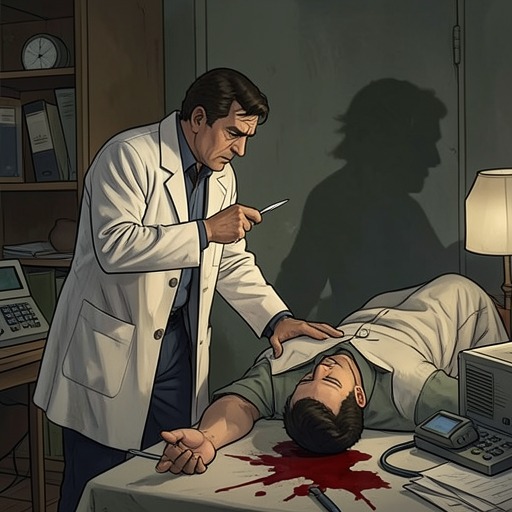
That hesitation gives the myth an epistemological dimension. The supernatural does not first announce itself through a complete explanation; it appears as a sequence of irregular signs that can be medicalized, mocked, or rationalized. A corpse in Matt Burke’s guest room is examined by Parkins Gillespie, who asks whether the man is really dead and whether anyone tried to wake him. The question is absurd in retrospect, but it represents the ordinary town’s attempt to keep death within familiar categories. James Cody’s medical attention and the investigators’ observations make clinical knowledge both a possible shield and a possible obstruction.
The same tension appears in the treatment of Marjorie Glick’s body. In Green’s workroom, she lies on a stainless-steel table resembling those in hospital delivery rooms. James Cody notes that her condition resembles Mike Ryerson’s: there is no surface lividity and no sign of rigor or incipient rigor. The body is therefore presented through forensic vocabulary, but the vocabulary does not explain the phenomenon. Medicine records an abnormal state without yet possessing the conceptual language to identify undeath.
The vampire myth finally forces the natural and supernatural explanations into direct contact. The theft of bodies from the Cumberland County Morgue in Portland sounds like a grotesque imitation of a Frankenstein story, but within the developing pattern it confirms that the dead are being mobilized. Later, when Mark Petrie and Jimmy Cody pull Roy McDougall from a crawl space into the whitening daylight, his body reacts visibly: steam and moisture emerge from his pores, his skin sags and yellows, his eyes roll, his arms thrash, and his respiration begins in shadow and stops when he retreats from the light. The scene converts a debated legend into an observable rule. Daylight is not atmospheric decoration; it is a physical force that exposes and damages the vampire state.
The Master, the Familiar, and Contagion
The inherited overlord structure is preserved through Kurt Barlow and Richard Straker. Matthew Burke concludes that Straker is the creature’s human watchdog, bodyguard, and familiar, a servant who must have arrived before Barlow and prepared the town through rites performed in propitiation of a higher dark power. Barlow is thus not necessarily the ultimate authority. Even the vampire master may have a master, and the mythology expands upward into a hierarchy of service, sacrifice, and submission.
Ralphie Glick’s disappearance acquires its full significance within that structure. Matthew Burke suspects that the boy was Barlow’s ticket of admission: Straker took Ralphie and sacrificed him as part of the rites that enabled the supernatural occupation. The child’s fate is consequently both a personal tragedy and a ritual threshold. A local family’s loss becomes the mechanism by which an ancient myth gains access to the town.
Once established, vampirism behaves like an epidemic as well as a curse. Bodies vanish from institutional custody; corpses display altered physiological states; familiar residents return as predators; and the infection spreads through intimate contact. The myth’s old imagery is therefore joined to modern fears of contamination and systemic failure. The town’s medical, police, funeral, and domestic institutions continue to operate, but their procedures are repeatedly forced to confront bodies that no longer obey the boundary between life and death.
The result is a form of social contagion. The danger is not confined to the Marsten House or to an isolated supernatural antagonist. It travels through families, friendships, workplaces, bedrooms, graves, and hidden spaces. The apparently stable town becomes an interlocking field in which every ordinary relationship can become a route of transmission. The vampire is frightening not only because it kills, but because it returns the dead to the community in altered form and turns recognition itself into a danger.
Faith, Knowledge, and the Reversal of Stoker
The response to the myth is not supplied by technology alone. In Stoker’s novel, modern inventions and scientific expertise reinforce the hunters’ confidence; in ’Salem’s Lot, medicine can describe symptoms, but religious faith and ritual become necessary forms of protection. Father Donald Callahan and the other opponents of Barlow must treat the vampire as a supernatural adversary whose defeat depends on more than empirical observation. The opposition between the two novels is therefore not simply old folklore against modern science. King replaces Stoker’s easy faith in progress with a harder alliance among incomplete medical knowledge, personal courage, communal action, and religious belief.
This alliance is repeatedly tested by the town’s ordinary habits of denial. Parkins Gillespie’s attempt to treat a corpse as possibly wakeable, the clinical examination of Marjorie Glick, and the shocked response to the stolen bodies all show people trying to preserve a naturalistic account of events. Yet the investigators gradually learn that the physical evidence is not an alternative to the myth; it is the means by which the myth’s rules are discovered. Absence of rigor, altered respiration, retreat from light, and reanimated bodies form a forensic trail toward the supernatural.
The ending’s significance lies in its partial reversal of King’s original intention. He expected a vampire novel in which the monster would triumph over the rational representatives arrayed against it. Instead, the characters become more than symbolic representatives of reason. They act intelligently, sometimes foolishly and bravely, and the story’s developing life pushes them beyond the author’s planned design. The result remains darker than Dracula: many characters do not survive, and the town is marked by destruction and loss. Yet the book becomes unexpectedly optimistic because resistance proves possible even in a world where technology has become dangerous and the inherited myth seems stronger than its opponents.
Vampire myth thus functions as both plot engine and literary argument. It carries Stoker’s architecture of invasion and pursuit, the EC comics’ appetite for grotesque bodies, the naturalistic novel’s attention to institutions and local society, and the 1970s’ distrust of technological progress. It also explains why the story can move from a child’s frightening encounter with the Marsten House to medical inspection, funeral ritual, morgue theft, daylight exposure, and organized resistance without abandoning coherence. The myth survives by changing shape: first a bookish inheritance, then a local rumor, then a medical anomaly, then a contagion, and finally an undeniable enemy. Its deepest power comes from making the old monster newly plausible—not because the modern world has become less rational, but because its rational systems are no longer sufficient to protect it.