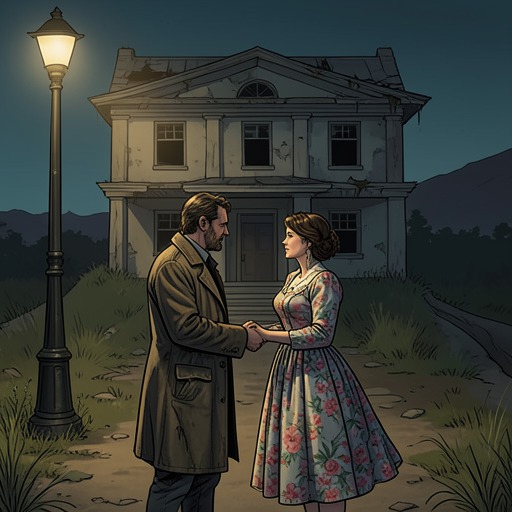
the town park
'Salem's Lot: A NovelThe town park is the most visible communal space in Jerusalem’s Lot, a place of municipal ceremony, everyday sociability, and private encounters. Positioned within the town’s nearly circular layout, it appears at first to embody the settled order that residents believe protects them. Yet its War Memorial, remembered disasters, and shadowed paths also make it a landscape where the town’s past and present quietly overlap.
Setting and Civic Place
The park occupies the town’s civic center within a pattern formed by Brock Street and Jointner Avenue, whose crossing gives Jerusalem’s Lot the appearance of a telescopic sight. It stands near the Municipal Building and functions as the town’s shared outdoor room. During rainy weather, when the park became uninhabitable, older residents moved instead to Milt Crossen’s Agricultural Store; this practical detail confirms the park’s status as a regular gathering place rather than a decorative green space used only for special occasions.
The park contains curving concrete walks beneath leafy trees, a wading pool, and the War Memorial. Its setting joins recreation, government, and remembrance: children use the pool and open grounds, while the memorial records the town’s participation in wars extending from the Revolutionary War through the Vietnam War. The newest names are sharply cut into the brass, an image that makes national violence present within an otherwise quiet local landscape.
Public Memory and Historical Time
The park is also the scene of civic commemoration. Jerusalem’s Lot celebrated its bicentennial there with fireworks and a pageant, but the festivities produced an episode of disorder when little Debbie Forester’s Indian-princess costume caught fire from a thrown sparkler and Parkins Gillespie arrested six men for public intoxication. The incident compresses the town’s public identity into a characteristic mixture of ceremony, accident, alcohol, and local authority.
That mixture matters because the park presents history as something both officially displayed and casually absorbed. The War Memorial lists names from successive conflicts, while the town’s residents otherwise receive national crises largely through television reports. Their distance from the country’s torment is described as academic: the memorial gives war a local presence, but the town continues to imagine itself insulated from anything truly terrible. The park therefore becomes a physical expression of the belief that Jerusalem’s Lot is a safe, ordinary place.
Ben Mears and Susan Norton
The park becomes more intimate when Ben Mears and Susan Norton visit it at night. Susan proposes going there instead of Spencer’s, treating the place as familiar and safe enough for an evening walk. Her joking reference to a town ordinance requiring muggers to be indoors by seven turns local security into flirtatious comedy, while her remark that teenagers use the bushes for sexual encounters establishes the park as a space where public and private behavior coexist.
They enter from the west, facing the Municipal Building, and find the park shadowy and almost dreamlike. The walks curve away beneath the trees, and the wading pool glimmers in the streetlight. Ben does not see anyone, but the absence of visible people does not make the scene wholly secure. As they sit on their jackets rather than on the benches, Susan tells Ben that Parkins Gillespie has been checking up on him, linking their courtship to the town’s pervasive gossip and surveillance.
The conversation turns toward the Marsten House, whose presence Ben instinctively searches for when he looks over his shoulder. The Municipal Building blocks his view, but it cannot remove the house from his thoughts. In the park, surrounded by civic symbols and the memorial’s names, Ben thinks that the town has the wrong name and ought to be called Time. The thought connects the park’s remembered wars, its inherited scandals, and the Marsten House’s older violence to a sense that the past is not finished but continually visible beneath ordinary life.
Their conversation also becomes a physical declaration of trust. Ben explains that Susan is different from Miranda because Susan’s questions do not feel like interrogation, and then Susan asks him to kiss her while he thinks about his book. He kisses her on the grass, and the encounter develops into their first sexual intimacy in the park’s supposedly public setting. The location thus shifts from civic space to a temporary refuge for mutual disclosure and desire, even as Ben’s attention remains fixed on the house associated with his childhood fear.
The Park During the Town’s Crisis
The park’s ordinary meaning is eventually overwhelmed by the supernatural crisis. Danny Glick’s burial takes place at the Harmony Hill Cemetery on the first real day of fall, but the town’s broader pattern of communal gathering contrasts with the increasingly isolated responses to danger elsewhere. In the early hours of the outbreak, some residents remain untouched or unaware, while those who are awake illuminate their houses and instinctively search for religious symbols without understanding the truth. The town’s public spaces and private homes alike are transformed into zones of fearful concealment.
The park’s significance lies partly in this contrast. It is open, central, and designed for collective life, yet the people of Jerusalem’s Lot are ultimately unable to use communal visibility to recognize what is happening. They know one another through telephone lines, gossip, and inherited stories, but they do not know the full secrets of their town. The darkness that overtakes the community therefore does not arrive in an alien landscape; it enters the most familiar civic geography and exposes the limits of local memory, public ritual, and the conviction that nothing truly bad can happen there.
Narrative Significance
As a location, the town park mediates between the novel’s social realism and its supernatural horror. It is a place for bicentennial celebration, children’s recreation, war remembrance, gossip, romance, and the quiet observation of civic life. Its surfaces are benign, but its proximity to the Municipal Building and its memorial history make it a site where public order is repeatedly shown to be provisional.
The park also provides one of the clearest spatial contrasts with the Marsten House. Ben and Susan can sit together beneath the trees, but Ben cannot stop looking for the house; the darkness of the private dwelling reaches into the public landscape through memory. The park’s transformation is consequently less a physical change than a change in meaning. What begins as the town’s reassuring common ground becomes part of a geography in which safety, history, desire, and threat occupy the same paths and cannot be cleanly separated.