Tatouages de Jungkook
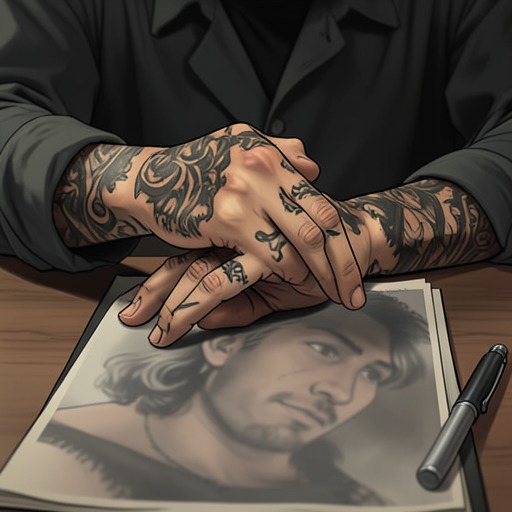
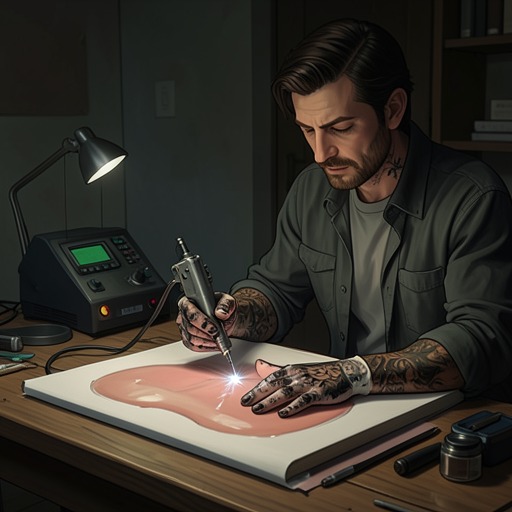
𝐋𝐚𝐜𝐮𝐧𝐚 | 𝑱𝒆𝒐𝒏 𝑱𝒖𝒏𝒈𝒌𝒐𝒐𝒌Tatouages de Jungkook are not merely decorative markings but a visual autobiography etched across Jungkook Jeon’s body. When Shelby Anderson Barnum asks what they mean, he identifies a private system of images in which violence, mortality, freedom, family, resilience, and emotional uncertainty coexist. The tattoos give visible form to the parts of himself that Jungkook usually keeps behind indifference, anger, or silence, while the unexplained word “Love” leaves open the possibility that his identity has not yet been fully interpreted even by him.
The Right Arm and the Shape of His Demons
The imagery on Jungkook’s right arm is governed by threat, death, and the inheritance of pain. A demonic Japanese samurai on his right biceps represents a part of him that has been present since childhood. A mandala beginning at the elbow completes the composition, giving the violent figure a surrounding structure rather than presenting it as an isolated emblem. The tattoo therefore connects Jungkook’s adult appearance to an enduring childhood presence: the demon is not a temporary mood but something he understands as having accompanied him for years.
On his forearm, a geisha wearing a Kitsune mask represents the mischievous side of Jungkook’s personality. The image complicates the darker figures by acknowledging playfulness and cunning alongside menace. The chrysanthemum carries several related meanings: it is associated with death because of its use at Japanese funerals, expresses the desire for a beautiful death, and also signifies determination and durability. Mortality and endurance consequently occupy the same design. The tattoo does not treat death as simple annihilation; it places the wish for a meaningful or beautiful ending beside the capacity to persist.
The oni on Jungkook’s right hand is openly threatening and, in his explanation, personifies his own demons. A tantō is lodged between the creature’s teeth, while smoke and thorns surround it. The image externalizes aggression as something recognizable and almost embodied, yet its placement on the hand links that aggression to action: the hand is the instrument through which anger can become violence. The word “Hate” on his knuckles is a direct allusion to his father. It is the most explicit family reference in the tattoo collection, compressing paternal influence into a single word carried wherever Jungkook reaches, strikes, or protects himself.
The Left Arm and Counterforces of Life
The left arm offers a more restorative counterweight to the right arm’s demonic imagery. A dragon encircling the biceps represents wisdom and strength, while cherry blossoms accompanying it symbolize empathy. Clouds and another mandala extend the composition, creating a visual continuity with the right arm but changing its emotional register. The arm is not free of danger or darkness; rather, those elements are placed within a more balanced field of qualities that Jungkook has either developed or wishes to preserve.
A tiger represents the freedom to live and Jungkook’s unpredictable side. The image gives his volatility a second interpretation: unpredictability can appear as danger, but it can also be the refusal to surrender the freedom to exist on his own terms. Beside it, the Buddha was tattooed for his mother because she has faith in that philosophy. A small red daruma carries the same significance. Jungkook says that both symbols reflect calm, making them signs of an emotional refuge connected to his mother rather than to the violent world associated with his father and the underground fights.
Two koi carp represent resistance in the face of adversity. Jungkook specifically connects them to the period when he fought at Ares Garden, so the fish transform an experience of physical combat into an emblem of survival. Their meaning is not abstract resilience detached from the plot: they are tied to the body that endured repeated fighting and to the identity Jungkook constructed through adversity. Set against the dragon, blossoms, Buddha, daruma, tiger, and clouds, the koi help make the left arm “more cheerful” than the right without erasing the hardship from which its symbols arise.
The Wrist, the Korean Symbol, and the Unanswered Word
Three black lines on Jungkook’s wrist represent geon, a symbol of paradise, the sky, and justice on the South Korean flag. This marking introduces a national and ethical dimension into a collection otherwise dominated by Japanese imagery and personal mythology. Its meanings—heaven, justice, and an ideal order—stand in tension with the demons, death imagery, paternal hatred, and violence carried elsewhere on his skin. The wrist therefore becomes a compact point of aspiration within a body marked by conflict.
Another oni appears on the same side, with horns and two tusks, but this figure is not aggressive. The cherry blossoms soften the mask and lend it a sense of bliss, a reading Shelby Anderson Barnum recognizes when she observes the design. Jungkook confirms her interpretation with a smile. The contrast between the threatening oni on his right hand and the peaceful oni on the other side suggests that the monstrous image itself is not fixed: it can be surrounded by violence, or it can coexist with tenderness and calm.
The word “Love” is the collection’s central blank space. Unlike the other tattoos, it has no settled explanation. Jungkook says that he has carried the lettering for some time but has still not discovered its meaning, and he can offer Shelby Anderson Barnum only an honest admission that he does not know. Her hypothesis is that, deep down, he may believe in the feeling. His uncertainty makes the word more revealing rather than less. “Hate” is linked clearly to his father, while “Love” remains without an assigned origin, motive, or object; one emotion is inherited and named, while the other waits to be lived or understood.
A Conversation That Reveals Jungkook
The tattoos become narratively important because Shelby Anderson Barnum studies them with her eyes and traces the permanent drawings with her hands before asking about their meanings. Jungkook is initially taken aback. Apart from Namjoon Kim and Sunmi Eun, nobody has asked him about the significance of his tattoos, and he has not often been required to translate his body into spoken language. His willingness to explain them marks a rare movement from visual concealment toward direct disclosure.
Jungkook delivers the explanations with apparent ease, but Shelby Anderson Barnum notices that this composure does not match his initial reaction. His indifference seems practiced rather than natural, especially because the question has surprised him. The tattoos thus operate through a contrast between what is shown and what is felt: the designs expose demons, death, paternal hatred, maternal faith, and the memory of Ares Garden, while Jungkook’s calm manner attempts to keep those meanings emotionally distant.
The scene also places the tattoos within intimacy rather than spectacle. Shelby Anderson Barnum is close enough to touch the designs, and Jungkook’s body is described as physically responsive to her attention. Later, he affirms the whole of her body, including her scars and stretch marks, as beautiful. In that context, the tattoos are not presented as frightening barriers to intimacy. They become marks that Shelby can approach, ask about, and read without reducing Jungkook to his violence.
Symbolic Function and Continuing Mystery
Tatouages de Jungkook organize the contradiction at the center of Jungkook Jeon’s character. The right arm holds the childhood demon, the masked geisha, mortality, durability, and a hand-bound emblem of personal rage. The left arm answers with strength, empathy, freedom, maternal devotion, calm, and resistance. The wrist adds justice and paradise, while the paired oni demonstrate that even a monstrous figure can be made gentle through its surrounding symbols. The body becomes a map of opposing forces rather than a single declaration of identity.
Their meanings also connect private history to later action. The koi recall Jungkook’s battles at Ares Garden; the Buddha and daruma preserve his bond with his mother; the samurai locates his darkness in childhood; and “Hate” points toward his father. Yet the collection refuses complete closure. The unexplained “Love” remains a mystery to Jungkook himself, so the tattoos do not simply explain him to Shelby Anderson Barnum or to the reader. They show a person who can name many sources of pain and endurance while still lacking a final language for tenderness. That incompleteness gives the markings their decisive significance: they are both a record of what Jungkook has survived and a visible sign of what he has not yet learned to understand.