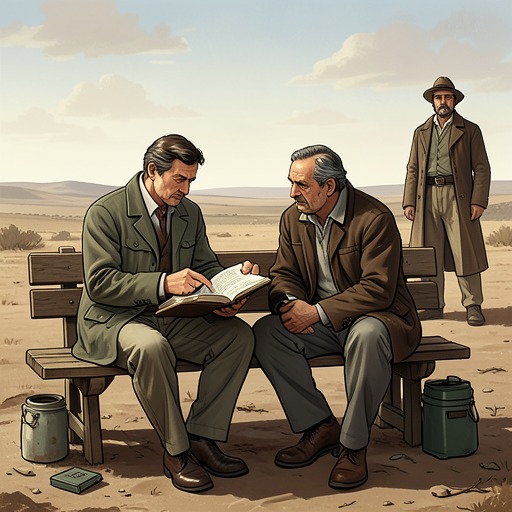
Anti-vampire team established and prepared to attack Masuten manor
'Salem's Lot: A NovelThe formation of the vampire-hunting group is the decisive transition from private dread to collective resistance in Jerusalem’s Lot. What began as disconnected evidence—Danny Glick’s unnatural corpse, Mike Ryerson’s impossible condition, Marjorie Glick’s disturbed body, missing morgue corpses, and the disappearance of Dud Rogers—becomes a deliberate expedition against the evil associated with the Marsten House. The group’s strength lies not in a single explanation but in the combination of Ben Mears’s testimony, Mark Petrie’s practical courage, Jimmy Cody’s medical knowledge, Matt Burke’s reasoning, and Father Donald Callahan’s religious authority.
Causes and Recognition
The group forms because ordinary explanations have begun to fail in several institutions at once. At Danny Glick’s funeral, Father Callahan confronts the familiar language of mourning and the older question of what can be changed in the face of death. His remembered seminary credo joins serenity, tenacity, and the danger of failing too often, giving the later expedition a moral as well as tactical frame. The funeral is followed by Mike Ryerson’s grave robbery and the opening of Danny Glick’s coffin, where the boy’s open eyes, rosy cheeks, and apparent vitality reveal that the dead body cannot be treated as an ordinary corpse.
Medical evidence deepens rather than resolves the mystery. When James Cody examines the body connected with the group’s investigation, he is struck by the absence of surface lividity and rigor, symptoms that resemble the condition of Mike Ryerson. Marjorie Glick’s body presents the same disturbing pattern. The discovery that bodies were stolen from the Cumberland County Morgue in Portland supplies a further concrete link between the local deaths and a wider process of reanimation or concealment. These facts make investigation urgent: the group is not pursuing folklore in the abstract but responding to bodies that violate both medical expectation and social order.
Recruiting Father Callahan
Matt Burke approaches Father Callahan because the group needs more than weapons or diagnosis. Callahan admits that his lifelong interest in occult subjects has become inseparable from difficult questions about evil, and Matt asks him to investigate the suspected supernatural activity with holy water and pieces of the Host. Callahan initially recognizes that this request places him on uneasy theological ground. His agreement therefore represents a conscious crossing of institutional boundaries: the priest accepts that the Church’s claims must be tested against an immediate and hostile reality.
Callahan sets a condition before joining. Ben Mears must speak frankly to Richard Straker at the new shop, while the others observe Straker’s reactions and allow him an opportunity to ridicule them. This condition makes Straker a threshold figure between ordinary commerce and the hidden violence surrounding the Marsten House. It also gives the expedition a preliminary investigative purpose. Before the group attacks, it must confront the suspected human agent, test the evidence publicly, and determine whether Straker’s behavior confirms or undermines their fears.
Preparation and Ritual
The expedition gathers Ben Mears, Mark Petrie, Jimmy Cody, Matt Burke, and Father Donald Callahan. Callahan leads the participants to the church and hears their confessions before departure, turning the planned intrusion into a religiously framed act rather than a simple armed raid. When the group sets out in Jimmy Cody’s large Buick near one o’clock, Callahan wears his full gown, surplice, and white stole bordered with purple. He gives each companion water from the Holy Font and blesses them with the sign of the cross, while carrying a small silver pyx containing pieces of the Host.
The preparation also includes secular instruments of force. Jimmy Cody retrieves McCaslin’s revolver and conceals it beneath a baggy sport coat; he carries an ordinary Craftsman hammer with a blue-steel head and perforated rubber grip. The contrast is deliberate in effect even when the characters do not state it as doctrine: the group proceeds with medical knowledge, firearms, tools, holy water, confession, and sacramental protection. Its method is hybrid because the threat has exposed the limits of every single system of explanation.
Assault on the Marsten House
At the Marsten House, Father Callahan’s role changes from cautious investigator to active ritual commander. The house appears to exude evil through the cracked paint, and Callahan is seized by an eagerness he believed had vanished. He does not merely lead the others to the door; he seems impelled toward it. Calling on God the Father, he commands the evil to leave and strikes the door with the crucifix.
The attack produces a physical response that validates the group’s fears. A flash of light, the pungent smell of ozone, and a crackling sound accompany the impact. The fanlight explodes outward, the bay window sheds its glass onto the lawn, and the new Yale lock is welded into an almost unrecognizable mass. The house therefore becomes an active adversary rather than a passive setting. Its resistance also confirms that the group’s ritual action has crossed into a genuine supernatural confrontation.
Consequences and Significance
The group’s formation changes the narrative scale of the crisis. Before it exists, individuals encounter isolated warnings: a grave opened, a body examined, a missing person noticed, or a corpse removed from the morgue. After it forms, those clues are assembled into a shared theory and converted into action. Even the discovery of Roy McDougall’s body demonstrates the stakes of delay: exposed to light, the corpse steams, yellows, moves, and retreats into shadow, behaving like a dead thing that remains bound to the darkness.
The expedition ultimately reaches the central object of its investigation. Ben Mears and Mark Petrie stand before Kurt Barlow’s coffin; its locks and seals split as they touch them, and Barlow lies inside with the appearance of a vigorous young man rather than a decayed corpse. This encounter confirms that the group has found the source or master of the threat and turns preparation into direct confrontation. The campaign is therefore both an investigative alliance and a ritual passage: confession separates the hunters from ordinary life, the journey places them at the threshold of corrupted space, and the assault tests whether faith, knowledge, courage, and coordinated violence can resist the vampire occupation of Jerusalem’s Lot.