Barlow and Jerusalem's Lot
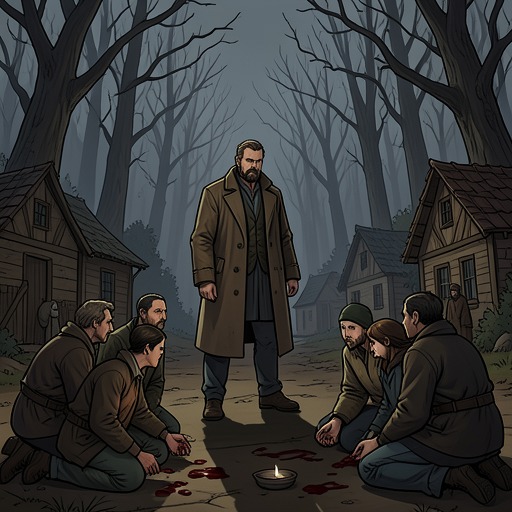
'Salem's Lot: A NovelBarlow and Jerusalem's Lot names the relation between Kurt Barlow and the town he progressively occupies: a small, socially divided community becomes the operating ground of a vampire colony and, by the morning of October 6, a dead town that still looks alive. The conquest is decisive because it turns ordinary places, habits, and neighborly assumptions into instruments of concealment. Jerusalem's Lot does not fall in one spectacular instant; it is hollowed out household by household, while the surviving routines of work, school, breakfast, and traffic continue to disguise the transformation.
The Town Before the Conquest
Jerusalem's Lot is organized around a nearly circular township whose two principal roads cross at right angles, giving the map the appearance of a telescopic sight. The Royal River marks the eastern edge, north Jerusalem is wooded high ground, farms occupy the southeast, and the southwest Bend is crowded with trailers, junked cars, makeshift yards, children, pickup trucks, and motorbikes. The town's spaces already carry social distinctions: agricultural land and commuter homes stand apart from the rougher trailer settlement, while the roads, bridge, cemetery, school, tavern, library, and private houses form a network of daily circulation and observation.
That apparent ordinariness is part of Jerusalem's Lot's vulnerability. The town receives national crises mainly through television and treats violence elsewhere as something academic. Local deaths occur, including the fatal automobile crash on Deep Cut Road, but the prevailing assumption remains that nothing truly terrible can happen in such a pleasant place. The town's two- and six-party telephone lines sustain constant gossip, yet this dense circulation of talk does not produce reliable knowledge. It produces surveillance without comprehension: everyone may know something about everyone else, while no one recognizes the larger danger approaching through the town's private spaces.
The geography also creates concealment. The wooded northwest, the river and its cliffs, the outlying Bend, barns, cellars, abandoned or neglected structures, and dark upper rooms provide places where predation can occur outside public view. The Royal River, Brock Street Bridge, Schoolyard Hill, and the surrounding roads remain recognizable landmarks, but Barlow's occupation makes the familiar landscape morally unstable. What had been routes to work, fishing places, farms, and homes become the connected terrain of an unseen night-world.
The Occupation Through Disappearance
The conquest becomes visible first as absence. No one declares Jerusalem's Lot dead on the morning of October 6, and no one knows that it is dead, because the bodies of previous days have retained every semblance of life. Ruthie Crockett disappears while her mother lies hidden in the cellar beneath a canvas tarpaulin; Larry Crockett wakes pale, weak, and painfully sensitive to sunlight, yet explains his condition as illness. His altered body is presented to himself as an ordinary domestic inconvenience, allowing vampirism to pass through the language of sickness and routine.
Other disappearances reveal the same pattern of social blindness. Ruthie sleeps in an abandoned freezer near Dud Rogers, whose advances she now finds acceptable within the night-world of her new existence. Loretta Starcher, the librarian, vanishes without anyone noticing because no close relative is present to mark her absence; she instead occupies the locked third floor of the Jerusalem's Lot Public Library, the very place associated with guarded knowledge and restricted access. Virgil Rathbun is missed by no one when Franklin Boddin notices his empty pallet and returns to sleep, while Virgil waits beneath the shack among fallen leaves and rusted beer cans for night to come.
The occupation also enters the homes of people who believe themselves merely busy. Eva Miller notices that Weasel Craig is absent from breakfast, but the work of feeding tenants, clearing dishes, and preparing for the week delays recognition. His garbage bags remain on the back steps rather than being taken to the curb for Royal Snow, a small domestic irregularity that becomes an understated sign of disappearance. The details matter because Barlow's power is not represented only by attacks; it is represented by the way ordinary obligations absorb attention until absence becomes indistinguishable from inconvenience.
Children and families are drawn into the same system. Danny Glick finds Jack Griffen and feeds on him, after which Jack goes to his brother Hal's room and ends his troubles with school, books, and an unyielding father. Both boys lie hidden in the hay of the upper mow, their bodies surrounded by chaff and pollen while the town outside wakes to a clear autumn morning. Charles Griffen interprets the missing boys as having run away, but the explanation is false. The vampire occupation therefore reproduces itself through misreading: disappearance is explained as rebellion, illness, drunkenness, absence from work, or a private matter rather than as evidence of a coordinated supernatural assault.
The Conversion of Public Life
The town's apparent continuity makes the conquest especially complete. The morning after the night's work is beautiful, crisp, and sunny, and the townspeople go to their jobs without knowing that the town is dead. Sunset is fixed at 7:00 p.m., and the shortening days move toward Halloween and winter, giving the invasion a seasonal rhythm. Daylight does not restore normality; it merely places the newly created vampires into hiding while the living continue the routines that conceal their absence.
The same occupation reaches people who are still alive but no longer secure. Susan Norton visits her mother after being invited in, does little damage, and leaves satisfied, now able to come and go as she pleases. The invitation is not a social courtesy but a lasting alteration of access, and Susan's new hunger will return each night. Through this transformation, Barlow converts family intimacy into a channel of infection: the home is no longer a refuge from the town's danger because kinship itself can authorize the vampire's entry.
The consequences spread into the town's institutions and roads. A patrol car lies abandoned at the end of Deep Cut Road while McCaslin is curled inside its trunk and the radio calls him without response. The public machinery of order remains physically present but has ceased to function. The image is characteristic of the occupation as a whole: recognizable objects survive, but their purposes have been emptied out. Police communication, household schedules, garbage collection, libraries, farms, and family rooms continue as shells around a transformed population.
Recognition and Counterforce
Recognition comes late because the invasion has already crossed the boundaries between private and public life. Matt Burke tells Ben Mears that the next task is not only to hunt Barlow but also to pursue the many lesser vampires who will follow. Barlow's hunger is described as insatiable: the new vampires will feed until they are glutted, while the nights belong to their master. The counterstrategy therefore has to reverse the temporal structure of the occupation. The vampires rule after dark, but the human hunters must use daylight to pursue them until they are forced into the sun.
The threat to the Petrie family makes the scale of the conquest unmistakable. When Jimmy Cody calls the Petries' number, the line is out of service rather than ringing; he concludes that Barlow has them. The broken telephone connection turns the town's communications network into evidence of isolation. A family that had been reachable through an ordinary number has become unreachable because the occupation has removed not merely a person but an entire household from the civic world.
The drugstore provides another moment of recognition. After dark, it is utterly quiet, and no one has entered since Father Callahan. The observation that things have gone bad in the Lot now marks the point at which the town's emptiness can no longer be dismissed as a sequence of isolated absences. Yet even those who remain awake do not know the truth. Their suspicions are vague, but they instinctively search bureau drawers, attic boxes, and bedroom collections for religious symbols, turn on every light, and avoid looking out their windows. The gesture is bodily and inherited rather than rationally explained: people reach for protective objects before they understand the enemy.
A Rewritten Social and Moral Landscape
By the time the town's awake residents illuminate their houses, Jerusalem's Lot has become a graveyard of morning disguised as a village. Cars still pass toward Portland and points south; a traveler might see scattered fully lit dwellings, suspect a fire or an accident, and then continue on. From outside, the town remains legible as one more small settlement along the road. From within, its inhabitants are divided between the newly dead, the threatened, and the few who sense danger without being able to name it.
The most revealing act is the refusal to look out the windows. The residents do not confront the unknown directly, because the truth is more frightening than the noises and possibilities surrounding them. This avoidance completes Barlow's conquest at the level of perception. He does not merely occupy houses; he governs what the town can bear to see. Jerusalem's Lot's social habits—gossip, routine, privacy, family loyalty, and faith—are not erased but redirected, becoming conditions through which the occupation can remain hidden.
The relation between Barlow and Jerusalem's Lot is therefore both territorial and transformative. He takes a mapped community of roads, farms, trailers, bridges, schools, libraries, and homes and turns it into a nocturnal feeding system. The town's earlier belief that nothing too nasty could happen there becomes tragically ironic: its confidence in normality supplies the camouflage the invasion requires. Even after the people have been taken, the landscape continues to perform the gestures of life, leaving Jerusalem's Lot not simply conquered but made into a convincing imitation of itself.