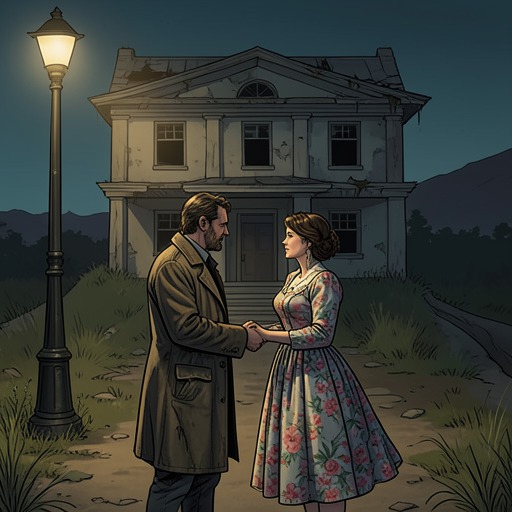
Ben Mears and Susan Norton’s First Meeting
'Salem's Lot: A NovelBen Mears and Susan Norton’s First Meeting is the quiet, intimate event that sets the novel’s central human relationship in motion. On Tuesday, September 16, the first day of school, Ben encounters Susan in the town park, where her recognition of him as an author becomes the pretext for conversation, her guarded interest becomes mutual warmth, and a casual ice-cream invitation becomes the beginning of their relationship. The scene’s importance lies in its contrast with the violence and inherited darkness surrounding Jerusalem’s Lot: before the town’s buried history reaches into their lives, Ben and Susan meet through books, humor, embarrassment, and the possibility of ordinary happiness.
The Park Encounter
Ben is sitting on a park bench when he notices Susan watching him. She is described as very pretty, with a silk scarf tied over her light blond hair, and she is reading beneath the dappled shade of a gnarled old elm. A sketch pad and what appears to be a charcoal pencil lie beside her, giving the first impression of someone absorbed in both reading and visual observation. The park itself has temporarily shed its rowdier element because school has begun; mothers with infants, old men near the war memorial, and children at the wading pool form a calm, public setting for the meeting.
Susan’s physical hesitation reveals more than her later words. When she realizes that Ben has seen her looking at him, she looks down at her book, looks up again, starts to rise, changes her mind, rises, and then sits down once more. She is plainly unused to approaching strange men in the park, and when Ben walks over holding his paperback Western, she checks his intentions rather than meeting his eyes openly. The encounter therefore begins with an imbalance of knowledge: Susan recognizes Ben, while Ben must ask whether they know each other.
Ben makes the first direct move by walking over and greeting her. He asks, “Do we know each other?” Susan answers that they do not, then identifies him as Benjaman Mears. His raised eyebrows register mild surprise, while her nervous laughter and quick glances show that recognition has not erased her caution. The exchange remains socially ordinary, but the small acts of looking away, testing, and approaching give the scene its emotional movement from distance toward trust.
Books, Recognition, and Courtship
The object that connects them is a library book. Susan is reading Air Dance, Ben’s second novel, and the copy bears the stamp of Jerusalem’s Lot Public Library. She shows him the photograph on the back jacket, a four-year-old image in which his face looks boyish and frighteningly serious, with eyes compared to black diamonds. The book makes Ben simultaneously present and absent: Susan is meeting the living man while carrying an older public image of him in her hands.
Susan says, “I thought I was seeing a ghost.” The remark is playful within the immediate encounter, but it also gains retrospective force in a story saturated with returning dead and supernatural threat. Ben responds with the joking observation, “Of such inconsequential beginnings dynasties are begun,” a line that hangs in the air like a prophecy spoken without intent. The scene gives their meeting a sense of future consequence without making either character understand what has begun.
Susan asks Ben to autograph the book, and he teases her about its being a library copy. She promises to buy it from the library and replace it, preserving both her admiration for his work and her practical consideration for the institution that owns it. Ben finds a mechanical pencil in his sweater pocket, opens the book to the flyleaf, and asks her name. He writes, “For Susan Norton, the prettiest girl in the park. Warm regards, Ben Mears,” adding the date beneath his signature. The inscription turns a circulating public object into a private token of their first meeting.
Their conversation expands through discussion of Ben’s writing. Susan refers to Billy Said Keep Going and reports that Miss Coogan at the drugstore considers it rather racy. Ben defends the book as almost puritanical, explaining that rough language suits the uneducated country boys he is writing about. His answer reveals both his awareness of literary technique and his willingness to speak plainly about it, while Susan’s interest gives the encounter a subject more substantial than flirtation. When Ben says that he is beginning to want an ice-cream soda, he converts the conversation into an invitation without making the shift ceremonious.
From Chance Meeting to First Date
Susan checks his eyes a third time before smiling warmly and accepting the invitation. She says that ice-cream sodas at Spencer’s are great, and the narrator identifies this acceptance as the beginning of their relationship. The value shift is small but decisive: Susan moves from wary observation of a stranger to an explicit willingness to spend time with him, and Ben’s tentative overture becomes reciprocated interest rather than polite refusal.
Their easy conversation continues at Spencer’s. Ben later asks Susan whether she would like to go to a movie that night, and she answers that she would. When he asks which theater is closest, the proposed evening becomes a concrete first date rather than an isolated exchange in the park. They talk for another fifteen minutes before Susan reluctantly explains that she has errands to run, then agrees that she can be ready at seven-thirty.
The separation after that conversation does not undo the meeting’s intimacy. When they go in different directions, both marvel at the easy, natural, coincidental impingement of their lives. The phrasing emphasizes that their attraction does not initially arise from dramatic pursuit or calculated seduction; it feels like two previously separate paths have unexpectedly touched. Ben’s quick autograph, Susan’s repeated testing of his gaze, the ice-cream invitation, and the planned movie together form a sequence in which small social choices accumulate into romantic possibility.
The Meeting Against the Town’s Memory
As Ben walks back down Jointner Avenue after parting from Susan, he pauses at the corner of Brock Street and looks toward the Marsten House. The movement links the fresh beginning with the place whose history will define much of the novel’s danger. He remembers that the great forest fire of 1951 burned almost to the house’s yard before the wind changed, and he thinks that perhaps the house should have burned and that such an ending might have been better. The thought interrupts the warmth of the meeting without erasing it.
That interruption reflects Jerusalem’s Lot’s long memory. The town was incorporated in 1765, and its name arose from the story of Jerusalem, a large sow owned by Charles Belknap Tanner that escaped into the woods, became wild and mean, and gave rise to Tanner’s warning about entering the Jerusalem wood lot. The town’s history is therefore carried through both official chronology and grotesque local anecdote. The same community that can preserve a pig’s name also preserves the violence associated with the Marsten House.
The Marsten House’s story has passed from generation to generation despite occurring before the current residents were born. Hubert Marsten and Birdie Marsten’s scandal and violence constitute the town’s closest equivalent to a skeleton in its closet. Later revelations complicate the public version further: the town knows that Hubert killed his wife but does not know what preceded the shooting, and residents preserve only partial accounts of the house’s horror. Ben and Susan’s meeting consequently occurs in a landscape where ordinary social life rests beside suppressed histories.
Narrative and Thematic Significance
The first meeting is presented through Ben’s immediate perception, but its significance is enlarged by retrospective narration. The moment involving the children, the swings, and the mother calling to Roddy is remembered by Ben for years as though a small slice had been cut from time. The narration explicitly treats such instants as fragile: if nothing catches between two people, the moment falls back into general memory. Here, something does catch, and the remembered scene becomes an emotional marker for the relationship that follows.
The event also establishes a pattern of objects and texts mediating human contact. Susan approaches Ben through Air Dance and its author photograph; Ben answers with a mechanical-pencil inscription; their courtship proceeds through talk about books, ice cream, and a movie. Against the town’s secrets, these are transparent forms of connection. Yet the book’s later history makes the first meeting retrospectively uneasy: Susan’s ghost joke, Ben’s accidental prophecy about dynasties, and his glance toward the Marsten House all acquire meanings that exceed the characters’ understanding at the time.
The meeting therefore functions as both a romantic beginning and a structural threshold. It introduces Susan not through the supernatural crisis but through her hesitation, intelligence, reading, and willingness to accept a date. It presents Ben not merely as a returning novelist but as a man capable of approaching a stranger with courtesy and humor. Their first exchange creates the relationship whose later significance is measured against the town’s violence, its buried child disappearances, and the recurrence of evil that the residents only partly comprehend.