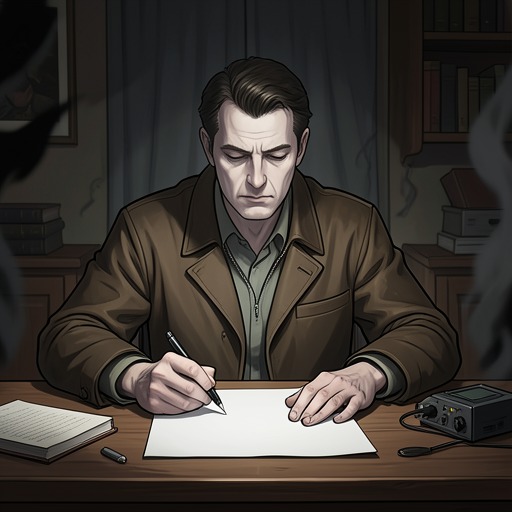
Ben burns the manuscript
'Salem's Lot: A NovelBen Mears burns the manuscript he has been writing in a scene where literary creation, childhood memory, and supernatural danger collapse into one decisive act. Returning to Jerusalem’s Lot at dawn after leaving Mark Petrie in a motel room, he enters the increasingly deserted town, destroys the pages in his room at Eva Miller’s boardinghouse, and then smashes the childhood object that turns his own face into the face of the monster. The action marks not merely the abandonment of a book but Ben’s attempt to break the hold that the Marsten House and its buried history have exerted over his imagination and identity.
Return to a Closed Town
Ben Mears begins the sequence by driving back the next day at dawn, stopping first at a busy hardware store in Westbrook to buy a spade and a pick. The tools give his return a practical, physical purpose, but the town he reenters seems to resist ordinary life. Jerusalem’s Lot lies silent beneath a dark sky; few cars move through the streets, Spencer’s remains open, and the Excellent Café has been shut up, its green blinds drawn, its menus removed, and its daily-special chalkboard wiped clean. The erased signs of routine make the town appear emptied before its inhabitants have entirely vanished.
That silence produces a bodily chill in Ben and summons the image of an old rock-and-roll album bearing the title “They Only Come Out at Night.” The association is more than atmospheric decoration. It gives the town’s quiet a temporal threat: daylight has not restored safety, and the apparent stillness suggests a population or force waiting for darkness. The town’s secrets remain concentrated in the Marsten House, which broods over Jerusalem’s Lot like a ruined king, making the house both a physical presence and the governing image of the town’s corruption.
The Manuscript in the Wastebasket
Ben goes first to Eva Miller’s boardinghouse and climbs to the second floor, where his room remains exactly as he left it. The unmade bed, the open roll of Life Savers on the desk, and the empty tin wastebasket preserve the ordinary surface of his temporary life. He pulls the wastebasket into the middle of the room, converting a commonplace container into the site of a deliberate rite. The room is not transformed by new furniture or an external command; Ben transforms it through the arrangement of objects and the decision that follows.
He takes the manuscript, throws it into the wastebasket, and makes a spill of the title page across the paper. Lighting it with his Cricket, he waits until the flame catches and then tosses the lighter’s work onto the drift of typewritten pages. The fire moves eagerly through the manuscript: corners char, curl upward, and blacken, while whitish smoke billows into the room. Ben opens the window without thinking, allowing the smoke to escape, but the gesture also opens the private space to the dangerous world outside. His written account is reduced from organized language to flame, ash, and smoke; the book that once held his attempt to shape experience is surrendered to material destruction.
The burning changes the value of the manuscript from a possible means of understanding to an object that must be eliminated. Ben does not revise it, save it, or leave it behind. He destroys the pages completely, as though the story’s continued existence would preserve the connection between his imagination and the horror he has encountered. Yet the scene does not offer a clean escape. As soon as the manuscript disappears into fire, another object from the past takes its place as the focus of memory.
The Paperweight and the Childhood Monster
Ben’s hand finds the glass globe that has been with him since his boyhood in Jerusalem’s Lot. The paperweight belongs to the childhood visit in which he entered the house of a monster, and its presence links the adult return to the original source of his fear. It is a small, portable object, but it carries the old house and the old experience within it. Shaking the globe once again makes snow float over a little gingerbread house with a path leading toward it.
The miniature house appears harmless only until imagination animates it. Its shutters are closed, yet one seems to fold back under the pressure of a long white hand. A pallid face then appears, grinning with long teeth and inviting the observer into a house beyond the world, a fantasyland of false snow where time is a myth. The image repeats the structure of the Marsten House: a house that seems still and enclosed, yet conceals an opening through which something watches and calls. The paperweight therefore does not merely represent Ben’s past; it reenacts the mechanism by which the past continues to enter the present.
The decisive reversal comes when the face looking out from the globe is identified as Ben’s own face. The child’s imagined monster and the adult witness are no longer safely separate. Ben sees himself occupying the place of the pallid, hungry figure, confronting the possibility that the horror he has pursued has also become part of his self-image. The revelation turns the paperweight into a miniature mirror, though it is not a normal reflective surface: it produces a distorted likeness through snow, house, fantasy, and memory. The monster is recognized not as an entirely external figure but as an image in which Ben is implicated.
Destruction and Consequence
Ben throws the paperweight into the corner, where it shatters, and leaves without waiting to see what might leak out of it. The broken globe completes the destruction begun with the manuscript. First the written object is burned; then the childhood object that has preserved the image of the haunted house is smashed. Both acts attack containers of memory, but neither guarantees release. The manuscript’s pages become smoke, while the globe breaks into fragments that may expose rather than erase what it contained.
The phrase describing what might leak from the shattered paperweight keeps the scene suspended between psychology and supernatural fact. Ben does not remain to inspect the pieces, and the narrative does not confirm that anything literally emerges. What is certain is the consequence of the act: the stable boundary between object and memory, imagination and haunting, has been broken. The glass globe has ceased to be a transparent toy and becomes conspicuous matter, damaged and threatening in its material presence.
As an action, Ben burns the manuscript because he can no longer treat the story as separate from the darkness it records. The fire rejects literary permanence, while the shattered globe rejects the comforting idea that childhood fantasy can remain safely enclosed in a decorative object. Together, the two destructions form a harsh counter-ritual to the Marsten House’s power. Ben tries to stop the circulation of its image through pages and possessions, but the final revelation—that the monster’s face is his own—shows why the act cannot be reduced to simple escape. The house has entered his history, his imagination, and his understanding of himself.