Birdie Marsten
'Salem's Lot: A NovelBirdie Marsten is the wife and murder victim of Hubert Marsten, whose 1939 killing became the defining skeleton in Jerusalem’s Lot’s collective memory. Her death is not merely an old crime in the town’s background: it is the hidden domestic rupture around which the Marsten House’s reputation, Hubert’s monstrous history, and Ben Mears’s investigation all gather. Birdie is largely known through other people’s accounts, but that very absence becomes significant, because her silenced life survives as physical evidence, communal legend, family testimony, and perhaps a final supernatural communication.
Identity and Marriage
Birdie Marsten lived with Hubert Marsten at the Marsten House after the couple retired to Jerusalem’s Lot in 1928. Hubert had previously been the president of a large New England trucking company, supposedly respectable but suspected of using the business to move Canadian whisky into Massachusetts after midnight. He and Birdie arrived wealthy, then lost much of that wealth in the stock-market crash of 1929. During the following decade they lived almost as hermits, appearing in town only on Wednesday afternoons to shop. Their marriage therefore existed behind the walls of a conspicuous house and within a community that watched them from a distance, collecting fragments rather than receiving explanations.
The town’s knowledge of Birdie is inseparable from its knowledge of Hubert. Later research establishes that the trucking company was a front for organized crime and that Hubert had been suspected of contract killings in the Boston area. In 1927, the Boston organization had begun to fear him; he was questioned about a gangland killing and separately about the murder of an eleven-year-old boy who had been eviscerated. His employers protected him, after which he withdrew to Jerusalem’s Lot under the cover of retirement. Birdie’s position within this history is not described as that of a criminal partner, but as the wife living alongside a man whose violence had already exceeded ordinary human wrongdoing.
Murder at the Marsten House
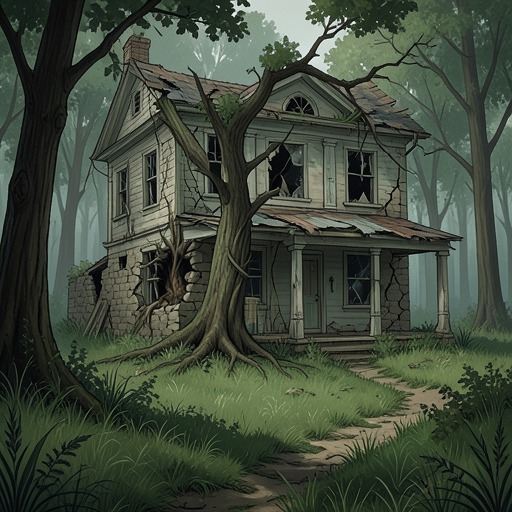
Birdie was killed in the summer of 1939, when Hubert shot her at close range with a thirty-ought-six. Larry McLeod, the mailman, discovered the crime after five days of newspapers and magazines had accumulated in the mailbox. The August grass in the front yard stood calf-high, honeysuckle had run wild over the western trellis, and the house still looked fine from outside. The contrast between its respectable appearance and the violence within gives Birdie’s death its characteristic force: the crime is concealed not in a ruined lair but in a well-built home whose ordinary surface has become a mask.
Larry first noticed a smell like spoiled meat halfway up the walk. The front door offered no answer, and the interior appeared thick with gloom. At the back of the house the odor was worse. The unlocked door led him into the kitchen, where Birdie lay sprawled in a corner, barefoot and with half her head blown away. The town’s later retelling added the image of flies filling the kitchen, buzzing around the body and lifting away again. That detail became part of the ritualized story passed from one Ladies’ Auxiliary member to the next, turning Birdie’s death into both a crime scene and a communal horror narrative.
The discovery also shows how little direct voice Birdie receives. Larry sees her body, retreats, and summons the constable and several townspeople; the community then preserves the event through repetition. Birdie’s identity is consequently constructed by witnesses who arrive after the violence, by relatives who remember Hubert, and by Ben Mears, who reconstructs the past for Susan Norton. Her physical remains are certain, while the meaning of the murder remains open to increasingly disturbing interpretation.
Memory and Possible Psychic Testimony
Minella Corey, Birdie’s sister, becomes the most unsettling witness to the murder’s emotional and possibly supernatural reach. Decades later, Minella is seventy-nine and lives in a nursing home in New Hampshire. She cannot remember what she had for breakfast, Ben reports, but she has never forgotten anything that happened before 1940. Her testimony is therefore presented through a tension between failing ordinary memory and an unusually fixed relation to the past.
Minella said that she was three hundred miles away on Cape Cod on the day Hubert killed Birdie. At a quarter after two in the afternoon, while making a tossed salad in a large wooden bowl, she experienced a bolt of pain “like lightning” through her head and heard a shotgun blast. She fell to the floor, and when she rose twenty minutes had passed. Looking into the bowl, she saw what appeared to be blood and screamed. A moment later, the bowl contained only salad, the headache had vanished, and everything around her seemed normal again. Yet Minella said she knew that Birdie had died and had been murdered with a shotgun.
Ben acknowledges that Minella’s account is unsubstantiated, but he does not dismiss it as deliberate deception. He considers the idea that Birdie transmitted the fact of her death across three hundred miles less difficult to believe than the monstrous evil he imagines buried in the outlines of the Marsten House. This comparison shifts Birdie from a forgotten victim in a historical case to a possible agent of knowledge. Even in death, she may have crossed the silence imposed by Hubert and reached the one surviving family member capable of recognizing what had happened.
Narrative Function and Afterlife
Birdie’s murder supplies the Marsten House with its first decisive human stain. The town remembers the scandal and violence despite the fact that they occurred before most current residents were born, because small-town memory passes horror ceremonially from one generation to another. The house becomes a repository in which Hubert’s criminal past, his isolation with Birdie, and the unexplained force surrounding the property are fused together. Birdie’s death is thus both the historical origin of the house’s notoriety and the event through which later characters interpret its evil.
For Ben Mears, Birdie’s fate is linked to his childhood encounter with the house and to the novel he begins while traveling with a silent boy across the country. The book first appears to be about Jerusalem’s Lot, but Ben gradually recognizes that it is really about the Marsten House. His research into Hubert—drawing on Boston police information and Minella Corey’s testimony—makes Birdie’s murder central to that realization. The narrative’s documentary forms reinforce the uncertainty around her: newspaper material, remembered local stories, medical and dated records, letters, and the conspiratorial conversation between Ben and Matt Burke all place truth at different distances from the reader.
Birdie therefore occupies a paradoxical position. She is the most decisive human casualty in the Marsten House’s origin story, yet she is almost entirely represented by others; she is silenced by murder, but her death generates the testimony that exposes Hubert; she belongs to the past, yet the past reaches forward through the house and through Minella’s possible psychic perception. The story does not resolve whether the blood in Minella’s salad bowl was supernatural evidence or the expression of traumatic intuition. It does establish that Birdie’s death cannot remain contained within 1939. The murder survives as memory, accusation, architecture, and an enduring challenge to every later attempt to treat the Marsten House as merely an empty building.