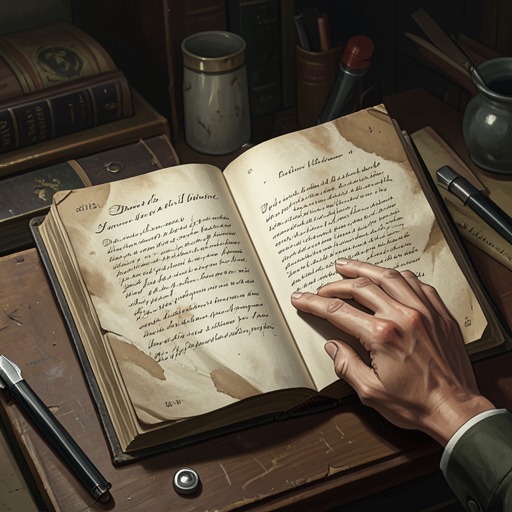
Blood calls to blood
'Salem's Lot: A Novel“Blood calls to blood” is both a warning and a theory of inheritance: in Chapelwaite, family descent is not merely genealogical but supernatural, drawing the living toward an ancestral crime and the evil attached to Jerusalem’s Lot. The expression explains why Charles Boone cannot treat the house, his lineage, or the village’s history as distant subjects; blood becomes the medium through which buried violence returns.
Family Inheritance and the Original Rift
Charles Boone knows that Chapelwaite has been the home of Philip Boone’s line since the 1780s, while Philip’s brother Robert, Charles’s grandfather, settled in Massachusetts after an argument over stolen papers. The family division was never repaired. Charles understands only fragments of Philip’s history: an unhappy shadow passed from father to son to grandchildren, Marcella died in a tragic accident, and Stephen fell to his death. Stephen intended Chapelwaite to become the home of Charles and his family, hoping that possession of the house might mend the old rift; the warning he receives is that it can never be mended.
The phrase therefore operates against Charles’s hope of restoration. What appears to be a family property and a possible reconciliation instead functions as a hereditary summons. The original quarrel over Robert Boone rifling Philip Boone’s desk is not confined to an argument between brothers. It becomes the first visible sign of a division whose consequences continue across generations, turning the Boone family tree into a route by which the past reaches the present.
Philip Boone and Jerusalem’s Lot
The expression acquires its most ominous meaning when Mrs Cloris explains Philip Boone’s connection to Jerusalem’s Lot. She describes him as a blood relation of the village and says that the Mark of the Beast was upon him even though he wore the clothes of the Lamb. On the night of October 31, 1789, Philip Boone disappeared, and the entire populace of the damned village disappeared with him.
This account joins two mysteries that Charles had previously held apart: the fate of his ancestor and the disappearance of Jerusalem’s Lot. Philip is not merely a distant Boone whose branch of the family suffered an unexplained decline; he is connected by blood to the vanished community and to the religiously coded evil that Mrs Cloris associates with him. The date and scale of the disappearance give the warning historical weight. One ancestor’s blood relation to the village becomes the apparent bridge between a family tragedy and a collective catastrophe.
The Warning and Its Immediate Force
Mrs Cloris offers little further explanation. She repeatedly urges Charles to leave Chapelwaite, invoking “blood calling to blood” together with “those who watch and those who guard.” Her agitation increases as twilight falls, and Charles promises to give her wishes serious consideration, though he does not yet leave. The warning is thus delivered as an incomplete tradition, preserved through Mrs Cloris’s mother and grandmother rather than through a complete written history.
Its effect is intensified by what follows Charles’s return home. He finds that the noises in the walls have grown worse and tries to persuade himself that they are only rats, but Mrs Cloris’s terrified, earnest face makes that explanation unstable. The phrase turns an apparently private disturbance into evidence of a larger inheritance. Charles’s suspicion is no longer simply that Chapelwaite contains something frightening; it is that the house is answering a summons carried in his family blood.
Awakening the Buried Force
After the horror in the church, Charles concludes that the warning was “horribly right.” He believes that he has become a pawn in a deeper drama and that he cannot simply flee from the house. The phrase now describes an active causal force: his presence has drawn him into the history of Philip Boone and Jerusalem’s Lot, while the evil beneath that history has begun to recognize and claim him.
Charles fears that he has awakened a Force that has slept in the tenebrous village for half a century. He connects that Force with the deaths of his ancestors and with their being taken into unholy bondage as nosferatu, “the Undead.” The movement from family memory to supernatural danger is decisive. Blood does not merely remember; it summons, identifies, and exposes. The Boone inheritance is consequently presented as a form of involuntary participation in an older evil, one that Charles can perceive only in fragments and cannot yet fully understand.
Narrative Significance
As a recurring expression, “Blood calls to blood” gives the embedded history of Chapelwaite its governing principle. It condenses the story’s pattern of delayed revelation: a family quarrel, unexplained deaths, Philip Boone’s disappearance, the vanishing of Jerusalem’s Lot, and the present disturbances emerge as parts of one continuing chain. The warning also gives bodily force to the Gothic idea that a house can preserve a family’s suppressed history. Chapelwaite does not simply contain the past; through Charles’s arrival, the past calls its descendants back into contact with it.
The phrase remains deliberately ambiguous. Mrs Cloris knows enough to fear the connection but not enough to explain it, and Charles ends his account admitting that he sees only part of the truth. That incompleteness makes the expression more than a supernatural rule stated and solved. It is a refrain of inherited trauma and unfinished testimony: the dead, the vanished village, and the surviving Boone line remain bound together, while the act of discovering the connection becomes itself a dangerous form of witnessing.