Brock Street School
'Salem's Lot: A NovelBrock Street School is the old wooden schoolhouse of Jerusalem’s Lot and, during the vampire crisis, a suspected refuge for Kurt Barlow. Built in roughly the same period as the Marsten House, it embodies the town’s older, darker architecture: a three-story frame building with a basement, partially abandoned but still woven into the town’s daily life through the children who use its first floor. Its empty rooms and boarded windows make it both a neglected remnant of local infrastructure and a place where the investigation’s most dangerous uncertainty gathers.
Structure and Setting
Brock Street School stands within the town’s rectilinear street plan, where Brock Street crosses Jointner Avenue at right angles. The school belongs to the older physical fabric of Jerusalem’s Lot, unlike the modern one-level schools later built with the same bond money. Its wooden frame, three stories, and basement place it among the town’s aging structures, alongside the Marsten House in historical period and atmosphere.
The building’s age was also a public concern. When the school bond issue was being debated, townspeople discussed Brock Street School as a fire hazard. A schoolhouse fire in Cobbs’ Ferry, New Hampshire, in which three children died, helped persuade the community to approve funding for newer facilities. The old school therefore survives as an architectural warning: a building retained for practical use even as the town recognizes that its construction belongs to an earlier and more dangerous era.
Use and Abandonment
By the time of the investigation, only the first floor remained in regular use, serving grades one through four. The rest of the building had effectively become surplus space. The entire school was scheduled to be phased out in two years, when an addition to Stanley Street Elementary School would make the older building unnecessary.
The contrast with the newer schools is decisive. Stanley Street Elementary School, like the high school, was modernistic, full of glass, built on one level, and designed to admit sunlight. Those features made it an unattractive place for a vampire seeking daytime shelter. Brock Street School offered the opposite conditions: height, age, darkness, enclosed rooms, and a neglected upper portion beyond the ordinary circulation of teachers and children.
The Suspected Hiding Place
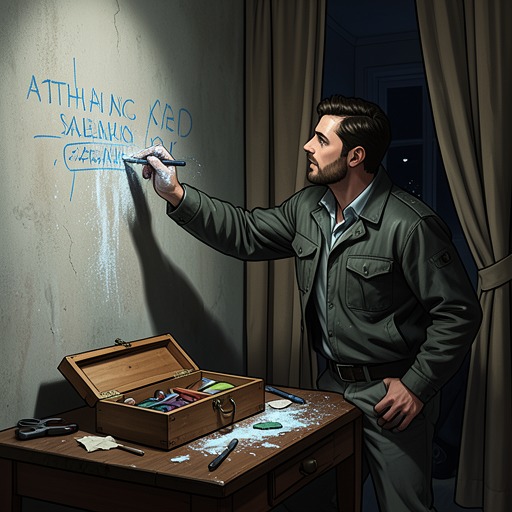
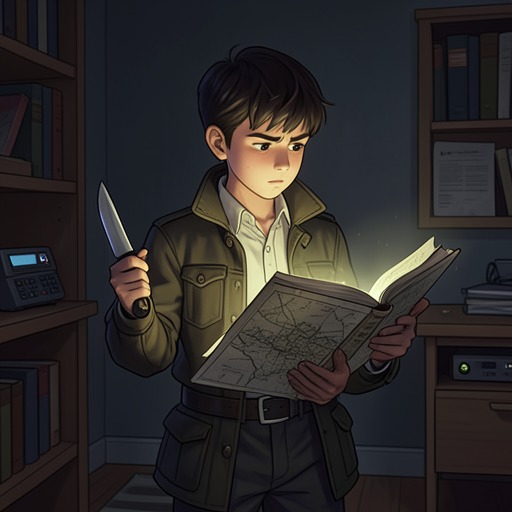
The possibility that Barlow was hiding in the school emerges when Ben Mears, Matt Burke, and Jimmy Cody consider where a vampire could conceal himself during the day. They first examine places where colored chalk might be kept, since the investigation has reason to believe that blue chalk is connected with their target. Backstage at the high school seems dark enough, but it would be heavily used if a teacher took over the class play. The grammar schools likewise appear unsuitable because their modern design, glass windows, and constant activity expose rather than shelter anyone inside.
Mark Petrie identifies Brock Street School as the more convincing alternative. Matt explains that its second and third floors contain empty classrooms and that the windows have been boarded over because children repeatedly threw stones through them. Those boarded windows transform ordinary damage into tactical concealment: the building is not merely old, but sealed against light and observation. Matt concedes that it could provide Barlow with a hiding place, while remaining uneasy because the answer seems too simple and transparent. Ben nonetheless concludes that the school must be their target, and Jimmy’s repeated focus on blue chalk gives the suspected location an additional, unsettling specificity.
Role in the Investigation
The school’s importance is practical as well as symbolic. Because the first floor is still occupied by young children, the investigators cannot safely enter the building until after three o’clock, when the school day has ended. This restriction determines the timing of their planned reconnaissance and places the vampire hunt within the routines of a functioning community. The supernatural threat does not erase ordinary schedules; it exploits the gaps between them.
The building also exposes the limits of local modernization. Jerusalem’s Lot has new schools, electric lights, telephones, cars, and other signs of contemporary life, yet the investigators must look backward toward an obsolete wooden structure to find the kind of darkness Barlow requires. Brock Street School thus becomes a physical diagram of the town’s vulnerability: modern institutions surround an older space that has not been fully removed, watched, or understood.
Narrative Significance
Brock Street School converts civic neglect into gothic possibility. Its history as a fire hazard, its empty upper floors, its boarded windows, and its pending closure all make it a place suspended between public usefulness and abandonment. The school is not an isolated haunted mansion; it is a familiar communal building whose danger depends on the town’s assumption that nothing truly terrible can happen there.
That tension mirrors Jerusalem’s Lot itself. The town presents ordinary surfaces while preserving unexamined spaces, old stories, and concealed violence. In the investigation, Brock Street School becomes one of the locations through which those hidden layers are mapped. Its dark upper floors offer Barlow a potential sanctuary, while its continued use by children makes the suspected refuge especially disturbing: the building contains both the town’s everyday future and the buried darkness of its past.