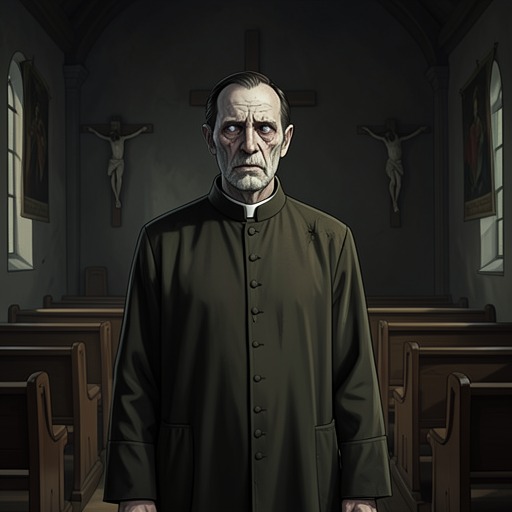
Callahan’s spiritual contamination
'Salem's Lot: A NovelCallahan’s spiritual contamination is the condition imposed on Father Donald Callahan after Kurt Barlow forces him to participate in a blasphemous communion. The contamination is not presented as an ordinary vampire infection alone. It becomes a visible and institutional rupture: Callahan bears Barlow’s blood on his face, believes the church has become closed to him, and interprets his exclusion through the biblical figure of Cain, the marked fugitive who remains under divine judgment while living outside the community.
The Forced Communion
Barlow frames the assault as a contest between religions rather than a simple attack. He addresses Callahan as a “false priest” and invites him to learn “a true religion,” then presses the priest’s mouth against the vampire’s cold throat, where an open vein pulses. Callahan resists by holding his breath and twisting his head away, but Barlow’s hands hold him immovably. At last he drinks the blood, an act that reverses the meaning of communion: a priest who should distribute a sacred substance is compelled to receive the substance of the vampire. The scene therefore changes Callahan’s status through ritualized violence. He is neither simply an untouched human opponent nor fully described as an ordinary vampire; he has crossed a polluted threshold under coercion, with Barlow’s power entering him through an imitation of sacrament.
Exclusion from Sacred Community
The contamination becomes unmistakable when Callahan tries to return to St Andrew’s Catholic Church. He approaches the church in rain, wearing a muddy and bedraggled gown, with Barlow’s blood still smeared across his mouth. He believes prayer might recover the older God and grant him a second chance, but the attempted return fails before any human authority can judge him. The instant his hand touches the middle door, a blue flash throws him backward down the granite steps. The impact sends pain through his back, head, chest, stomach, and shins; when he raises his hand, he finds it burned. The church remains behind him with its doors shut, converting spiritual rejection into a physical barrier. Callahan names the condition himself as he lies trembling in the rain, repeating that he is “Unclean,” while the wounded hand supplies visible proof that the sacred institution no longer receives him as it did before the encounter.
The Mark of the Fugitive
Callahan’s contamination also alters how he understands his place among the living. After the church rejects him, he travels alone through the streets believing that no vampire will touch him because the Master has marked him and will eventually claim him. This apparent immunity is not freedom; it is a sign that Barlow’s power has placed Callahan outside ordinary human protection while reserving him for a later claim. At a railway station, Callahan explains his condition through the biblical story of Cain, citing the mark placed upon Cain so that no one who found him would kill him, followed by Cain’s departure from the presence of the Lord as a fugitive on the earth. The allusion gives his exile a theological shape: Callahan is neither restored to innocence nor accepted among the undead, but condemned to move between communities under a mark he cannot remove. His spiritual contamination is therefore an ongoing state of suspension, in which survival itself becomes evidence of estrangement rather than deliverance.
Ritual Contamination and the Failure of Reintegration
Callahan’s condition gains its fullest significance when set against the novel’s competing rituals. In Harmony Hill Cemetery, a dark figure waits for the turn of time and formally offers spoiled meat and reeking flesh to the “Lord of Flies,” asking for a sign that will authorize his work. Against this profane ceremony, Callahan’s own improvised resistance depends on the remnants of Christian sacrament: when Ben Mears, Mark Petrie, and Jimmy Cody confront the Marsten House, Callahan leads them forward as though compelled, invokes God the Father, commands the evil to depart, and strikes the door with his crucifix. The response is violently material—a flash, the smell of ozone, exploding glass, and a Yale lock welded into an unrecognizable mass—yet his later exclusion from St Andrew’s Catholic Church shows that sacred power cannot simply be carried back into its former institutional home after contamination. The contrast makes Callahan’s exile more than a private crisis of belief. The novel places him between two ritual orders, one that sanctifies predation and another whose protection still operates against evil but no longer accepts the compromised priest as an uncomplicated member. His marked state thus remains unresolved: he survives, retains the capacity to oppose the supernatural, and continues to interpret his fate through Scripture, but reintegration into ordinary religious community has failed.