Catholic Church
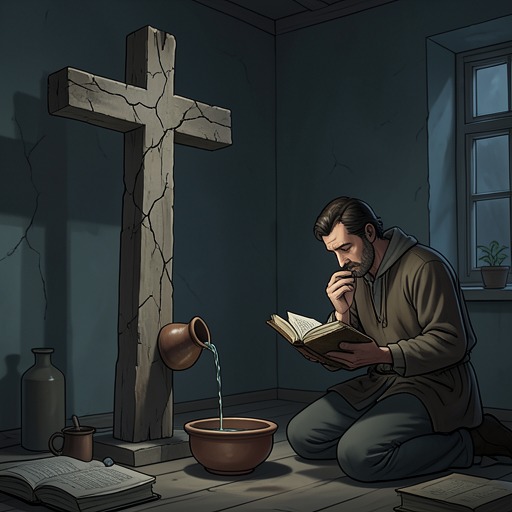
'Salem's Lot: A NovelThe Catholic Church is the novel’s most fully articulated institutional force against the supernatural threat. It is not merely a background religious affiliation or a storehouse of symbolic objects: in Father Callahan’s understanding, it possesses practical spiritual power, but only when that power is activated by genuine belief. Its authority therefore becomes inseparable from the crisis of faith endured by its representative, and the confrontation with Kurt Barlow turns the Church’s rituals into a test of whether inherited forms still contain living force.
Nature and Spiritual Authority
Father Callahan describes himself as being in the business of dealing with the supernatural, treating that work as part of his priestly vocation rather than as an embarrassment to rational modernity. His interest in occult subjects began in childhood and was strengthened, not suppressed, by his calling to the priesthood. Yet age has made him question the nature of evil and his own adequacy as a priest. He admits that he can be jaded, cynical, and caught in a crisis of faith or identity, while still believing in the awesome and mystical power of the Church behind him.
That distinction gives the Church an unusual status in the narrative. For Callahan, it is not simply a collection of ideals, nor a spiritual Boy Scout troop whose ceremonies can be performed casually. It is a Force, and setting such a force in motion requires responsibility. When Matt Burke asks whether Callahan will investigate suspicious events with holy water and a portion of the Host, Callahan refuses to treat those objects as harmless psychological aids. A younger priest might regard them as symbolic props whose use could soothe a supposedly irrational person; Callahan insists that carrying the Host would mean acting as a representative of the Holy Catholic Church and performing the most spiritual rites of his office.
Rituals, Objects, and Investigation
Callahan’s eventual decision to assist is cautious rather than automatic. He does not dismiss Matt as insane, because he has been convinced by the testimony of Matt, Ben Mears, and his own doctor that something beyond ordinary explanation is occurring. At the same time, he recognizes that invoking the Church carries theological consequences. His agreement to proceed with holy water and the Host marks a transition from private suspicion to formally sanctioned spiritual investigation.
The Church’s authority becomes visible in ritual action. After Ben insists that the Catholic Church must be involved, Callahan leads Ben and the others across to the church and hears their confessions. The confession is not presented as decorative piety; it prepares the group for an encounter in which moral and supernatural danger have become inseparable. Later, at the Marsten House, Callahan approaches the evil-tainted building with an eagerness he believed had disappeared from him. He commands the evil to leave in the name of God the Father and strikes the door with his crucifix. Light flashes, ozone fills the air, the fanlight and bay window burst outward, and the new Yale lock is welded into an unrecognizable mass. The scene gives material force to a rite that modern assumptions might reduce to symbolism.
The novel also places religious ritual beside medical and funerary procedures. Danny Glick’s burial is followed by Mike Ryerson’s opening of the coffin, where the child’s face appears vividly alive rather than pallid or rigid. The bodies of the dead are examined, transported, and even stolen from the Cumberland County Morgue, while Jimmy Cody studies Marjorie Glick’s corpse for the absence of lividity and rigor. In this institutional world, diagnosis, autopsy, burial, confession, blessing, and exorcism all attempt to classify or control bodies that no longer obey the boundary between life and death. The Catholic Church offers a different mode of knowledge from medicine, but the narrative repeatedly makes the two systems confront the same evidence.
History, Error, and Institutional Memory
The Church’s response to vampirism is complicated by its own historical memory. In the omitted Father Callahan chapter, the priest explains that vampire hysteria during the medieval black plague was comparable to more recent flying-saucer hysteria. Frightened people reported corpses moving on plague wagons or hands clawing out of cemetery earth, and peasants in Eastern Europe appealed to newly converted Catholic priests for protection. Many priests had never heard of vampires, but, unwilling to admit ignorance, performed rites of vampire-killing anyway.
Callahan presents this history as an institutional embarrassment. The Church is ashamed of having acted on centuries of accumulated belief rather than sufficient investigation, and it uses the episode as a warning against conclusions reached too quickly. The anecdote establishes that religious authority can misclassify events just as secular institutions can. The Church may preserve useful knowledge about the Undead, but its history also contains moments when fear, custom, and clerical pressure turned uncertainty into ritual violence.
This historical self-criticism matters because Callahan’s present crisis is not simply a conflict between faith and skepticism. He knows that religious ceremony can be abused, that symbols can become empty, and that priests can mistake inherited explanations for truth. His caution is therefore a form of intellectual honesty. He is willing to investigate, but unwilling to pretend that a crucifix, holy water, or the Host has power merely because the institution labels it sacred.
Confrontation with Kurt Barlow
Kurt Barlow understands this vulnerability and attacks the Church at its doctrinal center. During the confrontation, Barlow breaks Callahan’s cross and argues that the cross, the bread and wine, and the confessional are only symbols when separated from faith. Without faith, he says, the cross is only wood, the bread merely baked wheat, and the wine only sour grapes. He calls Callahan a false priest and contrasts him with Mark Petrie, whom he regards as a more formidable opponent because the boy’s belief is more direct and less compromised.
Barlow’s criticism is not wholly false, which makes it dangerous. Callahan’s power depends on conviction, and Callahan knows that his conviction has weakened. Barlow claims that Callahan’s own doubt will undo him, describing goodness as requiring an act of faith while evil needs only to wait. In this formulation, evil does not need to prove its doctrine or recruit a confident believer; it can exploit delay, uncertainty, and spiritual exhaustion. The Church’s weakness is therefore not lack of ritual but the failure of the person who must make ritual effective.
Barlow nevertheless treats the Church as a serious adversary. He tells Callahan that he has studied him since arriving in Momson and that the Catholic Church is among his ancient opponents. Although he mocks its bread-eaters and wine-drinkers, he admits that he does not underestimate it. He fears Callahan joined to the Church, even while recognizing that Callahan himself is afraid. The exchange preserves the Church’s supernatural reality while exposing the gap between institutional power and individual faith.
Narrative Significance and Limits
The Catholic Church represents a form of resistance that modern rationality cannot fully replace, but the novel does not portray it as automatically victorious. Its rites can repel evil when belief animates them; they can become powerless when faith has been hollowed out. The decisive contrast is between inherited ceremony and enacted conviction. Callahan’s broken cross demonstrates that sacred objects do not function as mechanical weapons, while the earlier destruction at the Marsten House shows what the same kind of symbol can accomplish when wielded with authority and belief.
The Church also belongs to the novel’s larger inversion of Dracula. In Dracula, Victorian modernity joins blood transfusions, stenography, and typewriting to defeat ancient evil. Here, modern electric light and technological confidence help make vampirism unbelievable, while even a man of God struggles to accept what stands before him. The Church is thus positioned between an old supernatural knowledge and a modern culture that has lost the capacity to believe in the evidence of its own experience. Its importance lies in preserving a language and a ritual capable of naming evil, but its failure lies in the human uncertainty that can prevent that language from becoming action.
The later account of the novel’s conception makes this tension explicit: Father Callahan is the man of God who cannot truly believe in Kurt Barlow even when evidence appears before his eyes, and his defeat sends him into exile. The Church survives as a Force in principle, yet its representative’s spiritual contamination and removal show that institutions do not act independently of the people who embody them. Against vampiric contagion, the Church offers ritual protection; against doubt, it offers no automatic immunity. Its power must be believed, chosen, and enacted before it can become resistance.