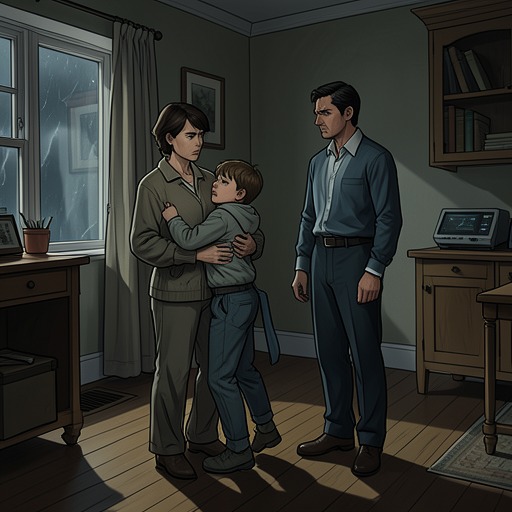
Corey Bryant
'Salem's Lot: A NovelCorey Bryant’s brief trajectory turns an illicit affair into one of the clearest demonstrations of how ordinary shame and desire are absorbed into the supernatural violence overtaking Jerusalem’s Lot. He begins as a human telephone worker, awkwardly enthralled by Bonnie Sawyer, but after Reggie Sawyer exposes and terrorizes him, Corey leaves town in disgrace. His return, altered by an encounter with Kurt Barlow, converts private humiliation into an inhuman appetite: the frightened young man who once begged for mercy comes back through Reggie’s door with dead, fixed eyes and an unstoppable purpose.
Lover and Intruder
Corey enters the story at Bonnie Sawyer’s kitchen door after nightfall. Bonnie answers wearing only a short ruffled apron and high heels, and his immediate reaction is astonishment: his eyes widen, his mouth falls open, and he can barely form her name. Her deliberate display has a physical effect on him that he cannot master. When she orders him to remove the apron, he obeys; when she tells him to get on his knees, he crawls toward her and reaches for the ties while she places a high-heeled foot on each of his shoulders. The scene establishes him not as a confident seducer but as a man overwhelmed by Bonnie’s performance and by his own desire.
Corey’s attraction has become a persistent bodily fixation. He feels like a dry-mouthed child approaching a first at-bat whenever his hands come near Bonnie, and he experiences her presence as an electrical force. She remains lodged in his mind, returning even in dreams, while her capacity for invention seems limitless. This language makes desire less a private decision than an atmosphere transmitted between bodies: Bonnie stages the encounter, and Corey is pulled into it, fascinated, helpless, and increasingly unable to separate erotic submission from danger.
Exposure, Humiliation, and Flight
The affair collapses when Reggie Sawyer returns home and finds Corey Bryant in the kitchen. Corey tries to explain that Reggie has misunderstood the situation, but Reggie answers with a gentle smile and an insult before ordering him to stand. Corey’s response reveals the sudden reversal of power: his mouth fills with loose saliva, he pleads not to be killed, and he offers to accept a beating rather than risk Reggie’s imprisonment. The former telephone worker who had been physically compliant with Bonnie is now reduced to bargaining for survival, while Bonnie’s sobbing from the bedroom makes the consequences of the discovery brutally concrete.
Reggie does not kill Corey. Instead, he ushers him out through the kitchen door and gives him a precise route of escape: Corey is to walk toward town, reach the bus from Lewiston that stops at Spencer’s at quarter to ten, continue through Boston, and leave the country of the affair behind. Reggie warns that Bonnie will have to wear pants and long-sleeved blouses for several weeks, but says that her face has not been marked. The threat forces Corey into exile before he can recover his composure. Stumbling along Deep Cut Road toward his parked phone truck, he smells of his own fear, bears a bump from striking his head when he fainted, and concentrates on the scuff of his boots so that he does not have to think about the sudden ruin of his life. His savings—just over a thousand dollars—offer only the possibility of surviving elsewhere while trying to forget the gun barrel, the humiliation, and the night’s collapse.
Conversion and Return
Corey Bryant’s flight does not carry him beyond the reach of Jerusalem’s Lot. After Reggie Sawyer sends him away, Corey encounters Kurt Barlow, whose invitation transforms the meaning of the night. Barlow praises the town’s supposedly perfect relation to the earth and asks whether Corey truly wants to leave it. Corey, still frightened and suddenly uncertain, answers that he does not; Barlow then promises that he shall remain there ever again. The exchange presents conversion as a perverse reversal of exile: the man who has been driven out is claimed by a new master and returned to the community in a form that no longer belongs to ordinary human life.
The change becomes unmistakable when Corey comes back to the Sawyer house. Reggie, awakened from sleep, assumes that the visitor may be Corey, perhaps drunk and armed in defense of Bonnie, and takes a shotgun from the gun rack. Corey opens the door slowly and stands in the same clothes he wore when he was expelled, but those clothes are now ripped and stained with mud; leaves cling to them, dirt marks his forehead, and his pallor makes the figure at the threshold seem less like a returning man than a body recovered from the ground. Reggie orders him to stop and warns that the shotgun is loaded, yet Corey continues forward with dull eyes fixed on Reggie’s face. His walk is described as remorseless and beyond command, a physical sign that the frightened, negotiable self seen earlier has been replaced by an appetite that recognizes no appeal.
Reggie fires both barrels at close range. The blast tears apart and blackens Corey’s shirt, but the fish-white chest and abdomen beneath remain impossibly unmarked; the flesh appears insubstantial, more like a gauze curtain than living human tissue. The weapon is then knocked from Reggie’s hands, and Corey throws him against the wall with force enough to leave him dazed. Corey does not pause over the defeated man. He walks toward Bonnie, who stands trembling in the doorway, while terror and lust pass across her face in alternating flashes. Her address to him as “Darling” completes the reversal: the adulterous encounter that once left Corey submissive and terrified has become the mechanism through which he returns as a supernatural predator, while Bonnie’s desire is now aligned with the thing that has destroyed him.
Narrative Function and Social Contrast
Corey Bryant’s transformation gives the vampire outbreak a distinctly social and bodily point of entry. His human vulnerability is established through work, sexual secrecy, economic uncertainty, and the prospect of leaving town with only a little more than a thousand dollars saved. Against that precarious life stands the broader local order represented by Lawrence Crockett’s property dealings: Crockett’s office is covered with photographs advertising inexpensive homes, including trailers marketed to workers unable to afford conventional houses, while Crockett’s speculation has made him nearly two million dollars. Corey is not part of that accumulation; he belongs to the mobile, dependent workforce that moves through the town’s commercial spaces, as shown when a night watchman mistakes a visitor seeking boxes for Lawrence Crockett’s employee. The contrast places Corey within the ordinary economic traffic of Jerusalem’s Lot even as the supernatural invasion later converts him into one of its agents.
His return also turns private scandal into public contagion. The original encounter involves only Bonnie Sawyer, Corey, and the threatened authority of Reggie Sawyer; after Corey meets Kurt Barlow, the same domestic threshold becomes a site of supernatural reoccupation. Reggie’s shotgun, once sufficient to control a frightened trespasser, cannot stop the altered Corey, whose body seems emptied of ordinary material limits and whose movement continues despite commands, fear, and violence. The scene therefore makes conversion visible not as a simple change of allegiance but as the destruction of the social self: Corey returns wearing the remnants of his former clothes, yet his former shame, hesitation, and dependence have been replaced by an appetite that can pass through human relationships and recruit them to the vampire order. Barlow’s larger conflict with Matthew Burke and Father Donald Callahan is thus echoed on an intimate scale in Corey’s passage from exposed lover to supernatural instrument.