Eva’s Rooms
'Salem's Lot: A NovelEva’s Rooms is the only boardinghouse in Jerusalem’s Lot and one of the novel’s most important thresholds between ordinary civic life and supernatural occupation. Run by Eva Miller, it begins as a respectable, closely governed lodging house on Railroad Street, a place of kitchens, porches, rooms, rules, and small-town observation. By the end, its cellar has become Kurt Barlow’s hiding place and the staging ground for the return of the town’s newly made vampires, transforming familiar domestic space into an underground center of contagion and resurrection.
A Respectable Boardinghouse in the Town’s Social Network
Eva’s Rooms belongs to the ordinary geography of Jerusalem’s Lot. The town’s nearly circular layout is divided by Brock Street and Jointner Avenue, while the Royal River marks the eastern boundary; Eva’s Rooms stands within this settled network rather than at the isolated edge occupied by the Marsten House. It is nevertheless connected to the town’s social habits. Because most telephone lines are shared party connections, residents always have someone to discuss, and scandal circulates through the boardinghouse as readily as through the Bend, Dell’s, or the town’s other gathering places.
Eva Miller is a decent widow whose authority rests on practical rules rather than ceremony. Her policy concerning women visitors is exact: a woman may enter a male tenant’s room only if she is his mother or sister; otherwise the visit must remain in the kitchen. The rule leaves no room for bargaining. Ann Norton therefore feels relieved when she learns that Ben Mears is staying at Eva’s Rooms, believing that Eva’s standards will prevent sexual impropriety between Ben and Susan Norton. The boardinghouse thus functions as a local instrument of surveillance, respectability, and maternal control.
Ben Mears and Susan Norton’s Evening at the House
Ben Mears first occupies Eva’s Rooms as a returning writer and as one of the volunteers searching for Ralphie Glick. After spending the third day of the search in the woods, he returns hungry, intending to eat canned ravioli and sleep before writing. Instead, he finds Susan Norton working in the kitchen while men recently home from work pretend to converse and watch her. The kitchen is therefore both communal and exposed: it offers company, but it also places private desire under the eyes of the town.
Ben and Susan later approach the house after discussing the Marsten House and Ben’s childhood encounter there. Ben cannot invite her inside because of Eva’s rule, so he brings her to the back porch after retrieving drinks from his room. The porch faces the Royal River; a late-summer moon lays a silver path across the water, and the quiet allows the faint sound of water falling through the dam’s sluiceways to be heard. Susan waits in a wicker rocker while Ben goes inside, and the ordinary domestic arrangement gives their growing attraction a controlled, suspended quality. The boardinghouse protects respectability without eliminating intimacy; it merely displaces intimacy to the porch, the kitchen, and the spaces between rooms.
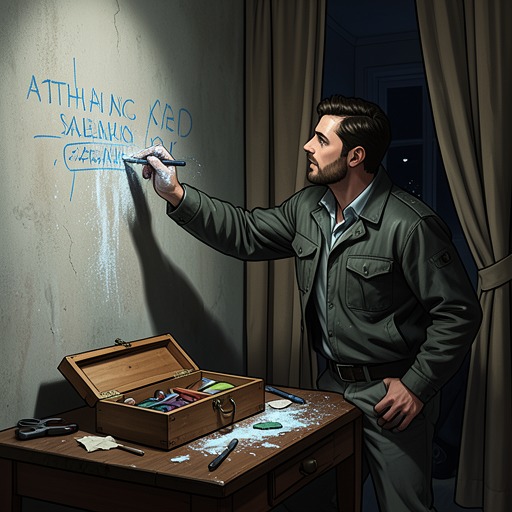
Ben’s room also becomes a place where personal memory and present romance overlap. He recounts his recurring dream of opening a door in the Marsten House, a dream that returns whenever he is under stress. The conversation links Eva’s Rooms to the older house not through physical resemblance alone but through the way both buildings hold what the town would rather keep contained. The difference is initially decisive: Eva’s house appears inhabited, supervised, and socially legible, while the Marsten House carries inherited scandal and violence.
The House as a Haunted and Occupied Space
The apparent safety of Eva’s Rooms is gradually undermined. Years before the final confrontation, Eva tells Jimmy Cody that the ghost of Ralph Glick still seems to inhabit the house. She repeatedly finds objects in the attic or in bureau drawers that she had forgotten, and the old pool table in the basement remains because it belonged to Ralph. She cannot bring herself to sell it through a newspaper advertisement or the local radio trading program. These details make the house a repository of grief and arrested memory: the dead child remains present through both a claimed ghost and an object that survives because Eva cannot relinquish it.
When Ben Mears and Mark Petrie try to determine where Barlow is hiding, Ben suddenly identifies the basement of Eva’s Rooms as the vampire’s location. The insight arrives with the force of certainty rather than the result of a visible search, and Mark immediately wants to act. The boardinghouse’s earlier associations with protection and domestic order are reversed. Its basement, beneath the rooms where tenants eat and sleep, has become a concealed chamber for the town’s master vampire.
The house is already altered when Jimmy Cody and Mark approach it. Ben’s Citroën sits in the lot under wet leaves, the sign reading “Eva’s Rooms” swings and squeaks in the wind, and the building seems to possess the same waiting silence as the Marsten House. Jimmy imagines the grim perfection of Barlow establishing himself in the local boardinghouse and surrounding himself with his “children.” The comparison is not merely atmospheric. A lodging house filled with residents has become an ideal structure for vampiric occupation, providing Barlow with a population close at hand and a domestic façade beneath which predation can proceed.
The Root Cellar and the Vampire Colony
The entrance is unlocked, and the interior kitchen is compulsively neat, but an odor strikes Ben’s companions like an open garbage pit, dry and smoke-laden rather than merely rotten. The cellar light fails, and the descent immediately moves the action from visible household order into an unlit underworld. Eva’s Rooms retains its surface identity as a boardinghouse while its material interior has been converted into a vampire lair.
The root cellar is small and cell-like. It contains dusty bottles, crates, and a bushel basket of very old potatoes whose eyes are sprouting in every direction. At the far end stands Barlow’s coffin, propped against the wall like a sarcophagus, its crest shining coldly in the light carried by Ben and Mark. The cellar’s contents join domestic decay, burial imagery, and latent growth: potatoes sprout in darkness while the coffin houses the force directing the town’s transformation.
The bodies lying before the coffin make the boardinghouse’s social function horrifyingly literal. Eva Miller lies among people Ben has lived with and shared meals with, including Weasel Craig, Mabel Mullican, John Snow, Vinnie Upshaw, and Grover Verrill. The victims are not anonymous outsiders; they are members of the town’s everyday human network. Their arrangement before Barlow’s coffin resembles a line leading toward an altar or a throne, placing the familiar community beneath the authority of the hidden master.
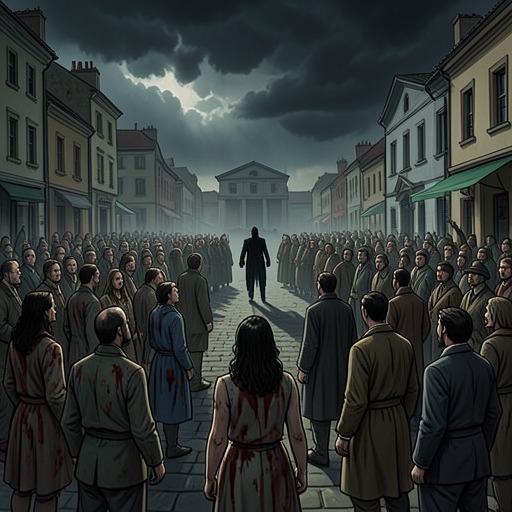
When Barlow’s physical presence is disrupted, dust continues to billow and writhe inside the coffin, and an unseen force passes through the cellar like a strong wind. At the same instant, every window of Eva’s Rooms blows outward. The house can no longer contain what has been stored beneath it. Eva, Weasel, Mabel, Grover, and the other dead then come out of the root cellar, their time in the world resumed. Jimmy Cody and Mark Petrie must rely on holy water to keep them from being touched, while the boardinghouse itself becomes the aperture through which the buried vampire population returns.
Narrative Significance and Transformation
Eva’s Rooms charts the novel’s movement from social control to supernatural control. At first, Eva’s rules regulate who may enter rooms and how desire may be displayed. Later, those same rooms stand within a larger system of surveillance and possession in which Barlow has converted the house’s population into his “children.” The boardinghouse’s respectable order does not prevent evil; it gives evil a ready-made structure of proximity, privacy, and concealment.
Its transformation also mirrors Jerusalem’s Lot’s broader collapse. The town imagines itself as too safe for anything truly nasty to happen, while its inhabitants inherit old scandals, unexplained disappearances, and the long memory surrounding the Marsten House. Eva’s Rooms embodies that contradiction in architectural form: a neat kitchen and regulated lodging house above, a coffin and bodies below. The location’s decisive horror lies in the reversal of its original promise. A house intended to shelter temporary residents becomes a supernatural home for the dead, and the town’s ordinary communal interior becomes one of the principal engines of its occupation.