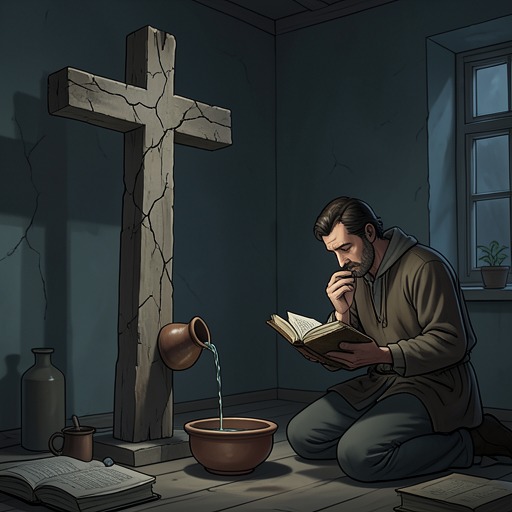
Faith empowers holy symbols
'Salem's Lot: A NovelFaith empowers holy symbols is a supernatural rule governing religious protection in the conflict with the undead. A cross is not automatically powerful because of its shape or material: its force depends on the believer’s active faith. The rule therefore joins inward conviction to outward defense, turning an ordinary object into a barrier, weapon, and visible measure of spiritual strength. Its decisive significance is that protection is neither purely psychological nor mechanically guaranteed; belief gives the symbol real efficacy, while spiritual collapse can withdraw that efficacy at the moment it is most needed.
Definition and Operation
The rule appears most clearly through the cross. When Susan Norton and Mark Petrie enter the underground spaces associated with the Marsten House, Mark tells Susan to take her cross in her hand. She grips it tightly, and the object seems to provide the only warmth and comfort available in the cold, threatening darkness. A faint luminous glow escapes between her fingers, establishing that the cross is not merely a private reminder of belief but an active force in the physical world.
The protection becomes unmistakable when the pair encounter the rats. Mark orders Susan to hold the cross up, and its light expands into an unearthly radiance brighter than the candle. The glow spreads across the crumbled brick walls, while the rats squeal and scatter. The scene gives the rule a practical mechanism: faith does not simply calm the person holding the relic; it changes the surrounding space and drives back hostile creatures. Mark’s own raised cross reinforces the protection, making the act a shared ritual rather than an isolated private gesture.
The same principle governs collective religious action. Father Donald Callahan approaches the Marsten House with Ben Mears, Mark, and Jimmy Cody, seized by an eagerness he had believed was gone. He commands the evil to leave in the name of God and strikes the door with his crucifix. The response is violently material: light flashes, ozone fills the air, the fanlight explodes outward, the bay window sheds its glass, and the new Yale lock is welded into an unrecognizable mass. The crucifix thus operates as an instrument through which faith enters architecture itself, breaking a sealed threshold and exposing the house’s supernatural resistance.
Ritual, Objects, and Thresholds
The rule places holy symbols within a larger pattern of ritual separation. The cemetery scene establishes evil as something that invokes a dark father, offers spoiled meat and reeking flesh, and waits for a sign before beginning its work. Against that sacrificial logic, the cross represents an opposing sign whose authority depends on a living religious relation rather than on material display alone. The contrast is not between symbol and non-symbol; both sides use ritual objects, gestures, sacrifice, and consecrated space. The crucial difference is the source of power and the moral direction of the rite.
The cross also becomes effective at thresholds. At the Marsten House, Callahan’s blow does more than damage a door: it forces a confrontation between sacred authority and a place saturated with evil. The object’s power is therefore spatial as well as personal. In the cellar, Susan and Mark’s crosses create a moving zone of safety against the rats, allowing them to advance through darkness that would otherwise overwhelm them. Their protection enables action, not merely retreat: the believers can enter forbidden spaces, investigate the enemy’s hiding places, and continue toward the coffin.
The coffin scene extends the same ritual logic into destruction. Ben Mears and Mark approach Barlow’s coffin together, and its locks split when they touch them. The event places physical matter on the side of the hunters, as though the accumulated authority of their purpose has made the seals unable to hold. The rule does not mean that every holy object automatically destroys every vampire; rather, it describes a network in which conviction, ritual contact, and material resistance converge. The cross is the clearest emblem of that network, but faith also shapes the hunters’ ability to cross boundaries and act decisively.
Failure of Faith
The rule reaches its most important and most frightening form in Father Donald Callahan’s confrontation with Sarlinov. At first, Callahan’s cross shines with enough force to make him believe it could smash down walls and shatter stones. The power appears to move through his arm, binding bodily sensation to spiritual conviction. Yet the glow begins to die. Fear enters him, the vampire advances, and the cross trembles in his hand before all its light disappears.
The object is then reduced to what it materially is: a piece of plaster bought by Callahan’s mother in a Dublin souvenir shop. The muscles in his arm remember the earlier thrumming, but the force cannot be reproduced. This reversal defines the rule more sharply than the earlier miracles do. The cross was never an autonomous weapon whose power could be summoned by possession alone. Its effectiveness depended on Callahan’s faith, and once that faith faltered, the object’s sacred force vanished with it.
Sarlinov states the principle explicitly while exploiting Callahan’s collapse. He explains that the cross, flag, bread, and wine are only symbols without faith, and that the cross is only wood when the belief sustaining it has failed. The speech turns doctrine into psychological warfare, but it also confirms the supernatural mechanics already demonstrated by Susan, Mark, and Callahan at the house. Sarlinov’s advantage is not simply physical strength; he understands that destroying Callahan’s confidence can disarm the symbol before the vampire ever touches it.
Consequences and Significance
Faith empowers holy symbols, but the rule makes protection demanding rather than convenient. Susan’s cross first comforts her and then becomes visibly radiant; Callahan’s crucifix shatters a supernatural barrier when his faith is active; the same kind of object becomes inert when Callahan can no longer sustain belief. These contrasts prevent religious ritual from functioning as a simple piece of equipment. The object must be held, raised, invoked, and inhabited by conviction, often under conditions of fear, darkness, grief, and direct confrontation with death.
The rule also distributes supernatural agency across people and things. The plaster, wood, metal, light, door, lock, and stone walls all participate in the conflict, but none determines its outcome alone. A person’s faith activates a material object; the activated object alters the environment; that alteration allows the group to proceed; and the resulting action tests faith again. The novel therefore presents religious defense as an assemblage of inward commitment and outward matter rather than as an abstract doctrine detached from bodies and places.
Its deepest dramatic consequence is the exposure of spiritual vulnerability. A believer may possess the correct relic and know the correct words, yet still fail if conviction has been hollowed out by terror. Conversely, a frightened person such as Susan can find courage through contact with the symbol and discover that the object’s radiance answers her need. The rule makes faith both weapon and risk: it can transform the ordinary into the miraculous, but it cannot be separated from the person who must continue to believe while facing evil directly.