Jerusalem’s Lot
'Salem's Lot: A NovelJerusalem’s Lot is a small town in southern Maine, east of Cumberland and twenty miles north of Portland, whose apparently uneventful civic identity conceals one of the strangest histories in the region. Incorporated in 1765, it had celebrated its bicentennial two centuries later with fireworks and a park pageant, yet by the time of the 1970 census it still presented itself as an ordinary, comfortable township of 1,319 inhabitants. Its decisive significance is the contrast between that modest public identity and the darkness that eventually consumes the town: Jerusalem’s Lot is not merely where the vampire outbreak occurs, but a social and physical environment that seems prepared to absorb it.
Geography and Civic Shape
Jerusalem’s Lot is organized around a nearly circular township whose eastern boundary follows the meandering Royal River. Brock Street crosses Jointner Avenue at the center at right angles, giving the town, when seen on a map, the appearance of a telescopic sight. This geometry creates a compact civic core from which roads, houses, farms, woods, cemeteries, and outlying settlements extend. The town is therefore neither an isolated wilderness community nor a dense urban center; its danger can move along familiar routes while remaining hidden within the routines of a small population.
The southwest area contains the Bend, where trailers and exurban development have spread beside rough roads and makeshift housing. Junked cars, tire swings, beer cans, laundry lines, hastily installed septic tanks, and ankle-deep dandelions and witch grass mark a landscape of uneven prosperity. The shacks and trailers are close to woodsheds in appearance, but their residents possess color televisions, pickup trucks, snowmobiles, motorbikes, and other signs of modern consumer life. Dell’s stands near the point where Brock Street becomes Brock Road, linking this marginal district to the town’s commercial circulation while also emphasizing the social distance between the Bend and the older center.
The infrastructure is similarly incomplete and exposed. Jerusalem’s Lot has no public water lines, gas mains, sewage system, or light-and-power network of its own. Central Maine Power pylons cross the town diagonally from northwest to southeast, cutting a swath 150 feet wide through the timberland; one pylon stands near the Marsten House, looming over it like an alien sentinel. The town’s telephone poles, leaning from repeated freezes and thaws, carry the constant hum of transmitted gossip. Crows, sparrows, robins, and starlings roost on the wires, while old cleat marks record generations of repair work. Communication is therefore both practical and uncanny: voices travel across distance, but the town’s most important truths remain difficult to recognize.
The Ordinary Town and Its Memory
At the beginning of its recorded modern life, Jerusalem’s Lot has little to distinguish it from other Maine communities. Its inhabitants are chiefly Scotch-English and French, with only a small mixture of other backgrounds. Most buildings are made of wood; older houses resemble saltboxes, and many stores have false fronts. The physical façades reflect the social structure behind them: everyone understands that the town’s surfaces conceal more than they reveal, just as local knowledge exposes private matters through rumor, familiarity, and surveillance.
The population’s shared memory is narrow but durable. In 1970, the old residents who gathered in the park or around the stove at Crossen’s Agricultural Market had little to discuss beyond the Fire of ’51, when a carelessly thrown match caused one of the largest forest fires in the state’s history. The town’s relationship to national and regional turmoil is described as largely academic; Jerusalem’s Lot appears insulated from the country’s suffering and governed by a slower schedule. Its self-image rests on the assumption that nothing truly terrible could happen in such a pleasant place.
That assumption is repeatedly challenged by the town’s own history. The Marsten House had previously been occupied when four children disappeared over a ten-year period. After a thirty-six-year vacancy, its reoccupation coincides with Ralphie Glick’s disappearance almost immediately. The connection turns the town’s old stories into a pattern rather than isolated local legend. The disappearance of Ralphie, the burial of Danny Glick in Harmony Hill Cemetery on September 28, and the later spread of vampirism transform familiar civic landmarks into stages of an expanding catastrophe.
From Suspicion to Occupation
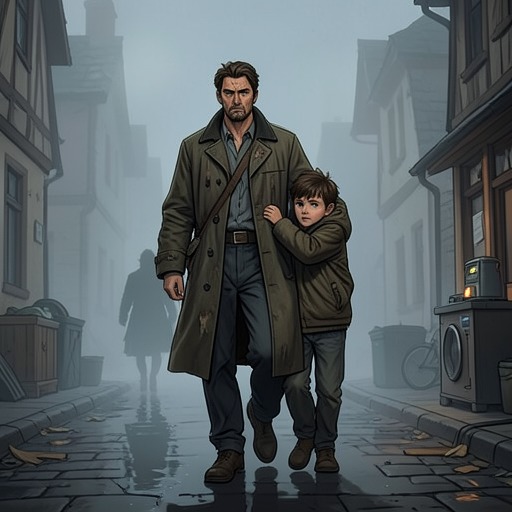
The disappearance of Ralphie Glick is first treated as a local emergency. On Wednesday, September 24, rain ends further searching, and the consensus is that the boy is simply gone. Parkins Gillespie, the constable of Jerusalem’s Lot township, reports the missing child directly, giving the event an official administrative form even as the town’s explanations fail. The telephone network carries the news, but communication does not produce understanding; it multiplies suspicion and anxiety through the same gossip that normally binds the community together.
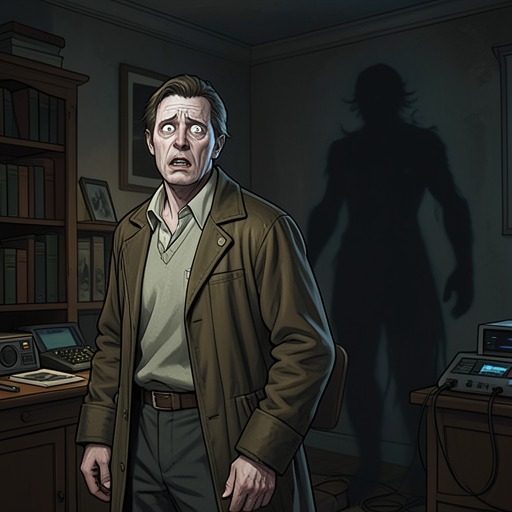
As the crisis develops, Jerusalem’s Lot becomes aware of itself as a threatened collective. Matthew Burke asks whether anyone has noticed anything out of the ordinary in town, and the question marks a shift from private unease to deliberate investigation. The town’s people begin to encounter events that cannot be contained within ordinary categories, while Ben Mears remembers that fantasy and reality have merged and that events are moving too quickly for him to control. The supernatural is no longer an intrusion upon an intact civic order. It is rewriting the order itself.
The vampire presence is connected to the town’s social and architectural spaces rather than confined to a single attack. The Marsten House watches over Jerusalem’s Lot as a structure burdened with accumulated malevolence; the cemetery, houses, roads, businesses, and public institutions become linked points in a network of infection. By the time the vampire’s hour arrives, night is no longer simply the town’s natural period of darkness. It is the condition under which the town’s hidden relations become visible and predatory.
The Emptying of Jerusalem’s Lot
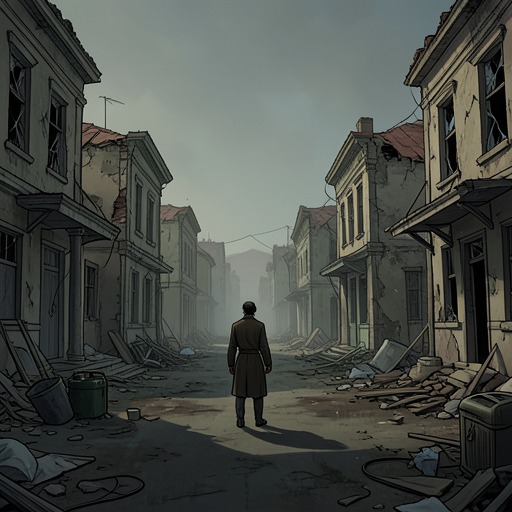
No one formally declares Jerusalem’s Lot dead on the morning of October 6. The town retains every appearance of life, as though ordinary buildings and domestic arrangements could continue after the people who animated them have vanished. This delayed recognition is central to the town’s horror: social death occurs before administrative acknowledgment. A place can remain standing, lit, and apparently habitable while its communal life has already been destroyed.
The final physical condition of the town makes that destruction unmistakable. Every business is closed, including Spencer’s Sundries and Pharmacy, Crossen’s Agricultural Store, the hardware store, Barlow and Straker’s Furniture Shop, the Excellent Café, and even the Municipal Building. The new grammar school and the tri-town consolidated high school built in 1967 are empty; their furnishings and books have been moved to makeshift facilities in Cumberland. The absence of children is not a temporary school disruption but evidence that no children remain in Jerusalem’s Lot. Abandoned shops, deserted houses, overgrown lawns, empty streets, and neglected back roads replace the ordinary signs of habitation.
The surviving rhythms of the town are grotesquely repurposed. Vampires walk the streets and country roads like a trace memory of evil, and some have regained enough rudimentary cunning to lure the living. Lawrence Crockett calls Royal Snow to his office under the pretense of playing cribbage, while Glynis Mayberry approaches Mabel Werts as a frightened woman seeking company and arrives instead as a naked predator. Delbert Markey emerges from his deserted tavern only to encounter further violence. These episodes convert trust, hospitality, employment, and public gathering into mechanisms of predation.
Even those who understand what has happened respond in relation to the town’s broader death. Parkins Gillespie describes Jerusalem’s Lot as dead, like the vampire who has come there, and connects its condition to a wider national decline. He recalls seeing children cheer bloodshed in a Western while eating popcorn, then concludes that the town’s inhabitants may like being vampires, though he refuses that fate for himself. His reaction makes the occupation both local and cultural: Jerusalem’s Lot is a particular disaster, but it also becomes an image of a society that has grown accustomed to violence.
Aftermath and Continuing Threat
The empty town does not mark the end of its significance. Ben Mears returns to the Jerusalem’s Lot turnoff with the memory of arriving earlier to exorcise the demons associated with the place. The contrast between the warmer day of his arrival and the later harder, colder blue of the sky makes the return a confrontation with an altered landscape and with the failure of his earlier confidence. The Marsten House still looks down on the town with rickety malevolence. It is harmless in daylight after the immediate crisis, but its possible danger after dark keeps the town’s threat from becoming safely historical.
The aftermath also joins Jerusalem’s Lot to a deeper supernatural geography. Beneath Jerusalem’s Lot and Chapelwaite, the force associated with the worm is said to continue living. Burning the book has thwarted that force but has not guaranteed its destruction, because other copies exist. The town’s abandonment therefore does not resolve the darkness it contained; it leaves a contaminated space whose buried history can still reach outward.
Later historical claims complicate the town’s legends without erasing them. When Jerusalem’s Lot is historically rediscovered, the church narthex is found rotted but without evidence of an explosion or massive damage. Overturned pews and shattered windows can be attributed to vandals from neighboring towns, while residents of Preacher’s Corners and Tandrell preserve idle rumors about the place. The physical record weakens one version of the past, yet the persistence of rumor shows how Jerusalem’s Lot survives as a story even when its material traces refuse to confirm every detail.
Jerusalem’s Lot ultimately functions as a complete gothic system: a town made of people, buildings, and land, each part reinforcing the others. Its civic familiarity produces complacency, its communication networks spread anxiety without mastery, its roads and institutions provide routes and stages for infection, and its abandoned structures preserve the appearance of a life that has already ended. The town’s most frightening transformation is not that it becomes visibly monstrous, but that its ordinary identity remains recognizable while the human community within it disappears.