Jerusalem’s Lot Fire of 1951
'Salem's Lot: A NovelJerusalem’s Lot Fire of 1951, also called the Fire of ’51 and the great forest fire of 1951, is the central disaster in Jerusalem’s Lot’s twentieth-century memory. A carelessly tossed match started the blaze, which swept out of the Marshes and threatened the town, the sawmill, and the surrounding farms. Although the fire was ultimately checked before it destroyed the settlement, its scale and near approach made it the benchmark against which later danger was measured—and helped preserve the town’s confidence that nothing worse could happen there.
Causes and Immediate Threat
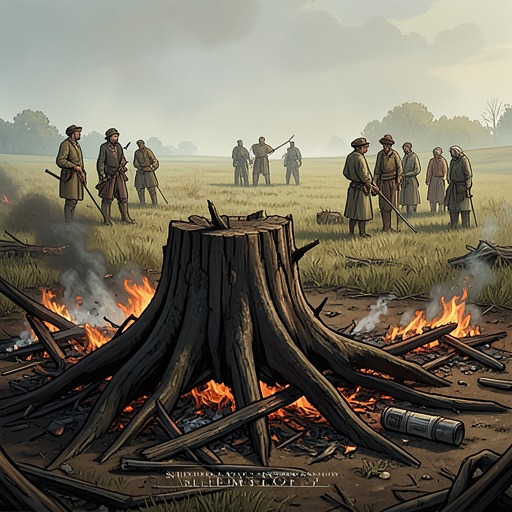
The fire began with an apparently trivial act: a carelessly discarded match. Driven by a twenty-five-mile-per-hour east wind, the blaze moved out of the Marshes and jumped Jointner Avenue, turning what might have been a local accident into one of the largest forest fires in the state’s history. The town’s geography intensified the danger. Jerusalem’s Lot lay around intersecting roads, with wooded high ground to the northwest, open farms and the Royal River to the northeast, and the Marshes and poorer settlement at the southwestern edge. The fire therefore threatened both the town’s built center and the industrial and agricultural spaces around it.
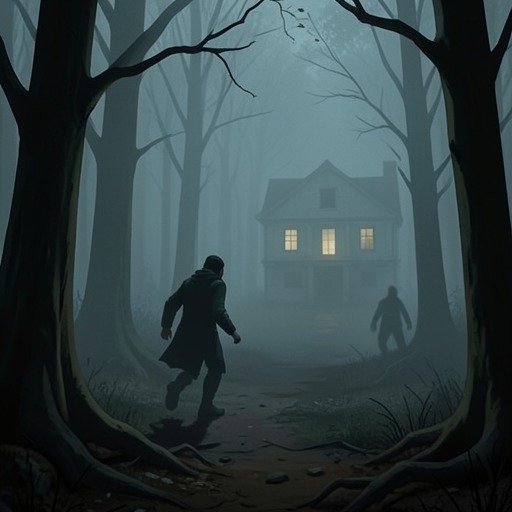
The flames came almost to the yard of the Marsten House before the wind changed. Years later, when Ben Mears returned to Jerusalem’s Lot, the sight of the house brought back the thought that it ought to have burned. That reflection gives the fire an ominous retrospective function: the blaze reached the structure associated with the town’s deepest violence, but stopped short of erasing it. The survival of the Marsten House allowed its history to remain physically present, while the town converted the fire itself into a safer, more manageable communal legend.
Firefighting and Containment
The emergency overwhelmed ordinary local capacity. Fire departments from six neighboring townships were occupied trying to save Jerusalem’s Lot and could not spare men for the Jerusalem’s Lot Sawmill, which seemed certain to be lost. Ralph Miller, then working at the sawmill, organized the entire second shift into a firefighting force. Under his direction, the workers wet the roof and constructed a firebreak that stopped the fire and turned it south, where it could be fully contained.
The sawmill’s survival became one of the few heroic civic stories attached to the disaster. Ralph Miller’s intervention achieved what the combined firefighting force had been unable to do west of Jointner Avenue, and his success later earned him advancement from foreman to the front office. Yet the industrial victory was temporary. Seven years afterward, in 1959, Miller fell into a shredding machine while showing visiting executives through the plant; the sawmill, which he had saved in 1951, closed permanently in February 1960. The fire thus preserved the mill long enough for its later decline to become part of the town’s wider history of lost industry.
Civic Memory and the Town’s Landscape
By the 1970 census, Jerusalem’s Lot had 1,319 inhabitants, an increase of exactly sixty-seven people over the preceding decade. The town remained a sprawling, comfortable rural community whose older residents gathered in the park and around the stove at Milt Crossen’s Agricultural Store. Their principal subject was still the Fire of ’51. In a place where little else seemed to happen, the disaster functioned as a shared civic calendar: it supplied the older generation with a common story and gave the town a rare event large enough to stand against the monotony of ordinary life.
The physical landscape retained reminders of the danger. The southeast farms had escaped the ugly blight and topsoil ruin commonly left by fire, but residents could still see the great barn on Schoolyard Hill and remember what the flames had threatened. In autumn, field burnings produced a controlled echo of the earlier catastrophe, while the Jerusalem’s Lot Volunteer Fire Department truck waited nearby in case anything escaped control. The lesson of 1951 remained active in this ritualized readiness: fire was no longer merely remembered; it was anticipated and managed.
Limits of the Lesson
The town’s memory of the fire was vivid but narrowly framed. Jerusalem’s Lot knew of national wars and political crises largely through television and newspapers, while local dangers were treated as exceptions to an otherwise protected way of life. Despite accidents, alcoholism, traffic deaths, poverty, and social scandal, residents believed that nothing too terrible could happen in such a pleasant little town. The Fire of ’51 was therefore both proof that catastrophe had once come close and evidence, in the town’s preferred interpretation, that catastrophe had already been survived.
That confidence becomes bitterly ironic as people begin to disappear and the Marsten House again becomes a center of fear. The community’s long memory preserves the fire, but it does not teach the town how to recognize a different kind of threat. Residents can recall flames crossing roads, firefighters wetting roofs, and a firebreak turning the blaze south; they are less prepared for an evil that moves through houses, families, graves, and inherited secrets. The fire’s visible violence is easier to remember than the hidden violence attached to the Marsten House, Hubert Marsten, and the town’s older history.
Narrative Significance
The fire establishes Jerusalem’s Lot as a place shaped by accumulated disaster rather than untouched rural innocence. Its official and communal memory is concrete: a date in local history, a wind direction, a road crossed, a mill saved, and a town nearly consumed. Other histories in the narrative are less secure. The town passes down the scandal of the Marsten House ceremonially, remembers vanished children without recovering their bodies, and preserves rumors whose causes have been forgotten. Against that unstable archive, the fire appears unusually verifiable.
Its significance nevertheless changes as the story unfolds. The fire approached the Marsten House but failed to destroy it; the town’s later supernatural crisis spreads through the very social spaces that the fire had seemed to protect. The contrast exposes the limits of physical containment. A firebreak can stop a forest fire, and disciplined labor can save a roof, but neither can remove the buried history that the town has carried forward. Jerusalem’s Lot Fire of 1951 is consequently remembered as the town’s great warning, yet it also marks the last moment when danger could still be imagined as something external, visible, and containable.