Kurt Barlow
'Salem's Lot: A NovelKurt Barlow is the hidden center of the supernatural catastrophe in Jerusalem’s Lot. Publicly, he is a wealthy antiquarian and business partner whose name appears beside Richard Straker’s on imported furniture; privately, he is the vampire Master who turns the Marsten House into a fortress, recruits and controls the undead, and treats the town’s inhabitants as material for a larger feeding order. His decisive importance lies in the contrast between the modest retirement enterprise he presents to the town and the calculated occupation he actually directs.
Identity and Public Mask
Kurt Barlow first enters the town through Richard Straker’s voice and paperwork. Straker tells prospective associates that his partner is British by naturalization, born in Germany, and probably in his seventies. Barlow had fled to England in 1938, apparently just ahead of the Gestapo, and had worked in London’s import-export business since 1945. His earlier records were unavailable, and the name attached to his birth was Breichen. The missing records and uncertain biography establish an identity built from gaps: Barlow is not simply an old foreign businessman but a person whose past has been deliberately obscured.
Straker also supplies a respectable commercial story. The two men had worked together in London and Hamburg and intended their venture in Jerusalem’s Lot to be a modest retirement. They loved old things and fine things, hoped to earn a living, and sought a reputation throughout New England. Barlow remains largely absent from the public negotiations, while Straker deals with officials and customers. That division is crucial: Straker is the visible representative, whereas Barlow’s elusiveness protects the real power behind the enterprise.
The business is anchored by the acquisition of the Marsten House and the former Village Washtub. Lawrence Crockett signs the title papers after Straker returns, though he does so with a powerful sense of doubt. The sale places Crockett at Straker’s beck and call and extends the same vulnerability to his absent partner. The transaction therefore functions as more than a property deal. It transfers a notorious house and a piece of the town’s social infrastructure into the hands of men whose stated commercial purpose conceals a predatory design.
Arrival, Speech, and Predatory Charm
Barlow’s first sustained encounter with Corey Bryant shows how effectively he can make menace feel like companionship. He greets Bryant by name and mocks the American insistence on names, joking that a name is no proof of identity or trustworthiness. He identifies himself as Barlow, then laughs with a derisive good humor that causes Corey to smile despite his troubles. The scene makes Barlow’s charm a weapon: he does not need to threaten Bryant at first because he can make the victim feel that ordinary anxieties have become trivial in the presence of his confidence.
His conversation with Corey also reveals a rhetoric of cultural superiority and concealed appetite. Barlow explains that he came to the town through the recommendation of a brilliant former resident, now dead, and describes the local people as rich, full-blooded, aggressive, and dark. When English fails him, he reaches for foreign words rather than clarifying his meaning. The performance makes him appear worldly and intellectually formidable while reducing the townspeople to a reservoir of qualities he can exploit.
That encounter ends with a promise of finality: Barlow tells Corey that he will never resist again. The line converts social persuasion into domination. By then, Corey has been drawn into Barlow’s emotional field, where laughter, elegance, and apparent understanding conceal the destruction of independent will. Barlow’s public persona is therefore not a disguise that simply hides his nature; it is an instrument through which his nature operates.
The Master of the Marsten House
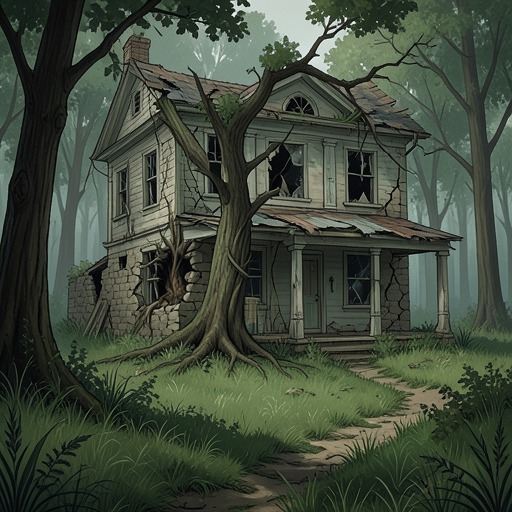
The Marsten House provides Barlow with the architectural form of his power. Seen from the Brooks Road, the house rises above Jointner Avenue and Brock Street with a nearly complete view of the township. Its elevated position allows it to overlook the town physically, while its closed shutters and immense, rambling shape make it appear like a sarcophagus or a monolith of doom. Barlow’s occupation transforms that house from a local site of fear into a supernatural command post.
The imported furniture reinforces the double identity of the operation. In the otherwise empty warehouse, the boxes stand in a portentous collection, with the sideboard placed at the center and standing taller than the other pieces. Most objects bear the stamp of “Barlow and Straker, 27 Jointner Avenue, Jer. Lot, Maine.” The sideboard alone lacks that mark, making it a distinctive object within the shipment and suggesting that the merchandise is not merely stock for a shop. The furniture’s movement into the town is part of Barlow’s establishment of a household, a public business, and a hidden regime at once.
Barlow’s control extends beyond individual attacks. He is understood as the Master whose influence organizes the town’s vampiric transformation, and his followers recognize him in terms of absolute authority. When Eva Miller learns that he has been killed, she responds with grief and asks how anyone could kill the Master. Her reaction reveals that Barlow’s power is not only physical. He has generated devotion, obedience, and a hierarchy in which the transformed inhabitants interpret his destruction as an assault on the source of their new existence.
Manipulation, Violence, and Psychological Control
Barlow’s method combines direct violence with mental domination. When Mark Petrie confronts him, Barlow can imitate the friendliness of Mark’s father and invite the boy to come down, turning familial trust into bait. Mark identifies him by name, recognizing that the apparently familiar voice is a trap. The scene shows Barlow’s ability to invade the emotional grammar of a household: he does not merely enter rooms; he enters the voices and attachments that make those rooms safe.
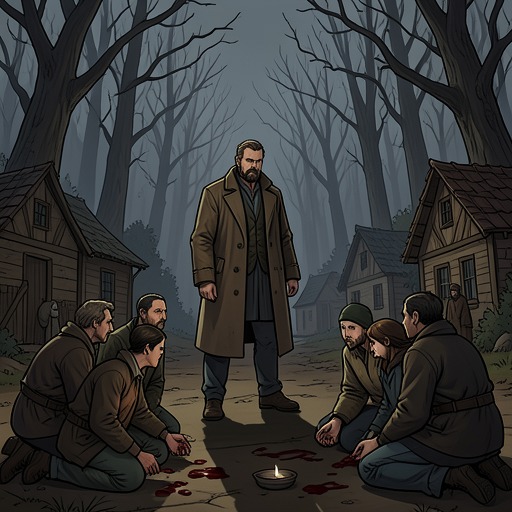
His attack on the Petrie family makes that invasion literal. In the Petrie kitchen, Father Donald Callahan faces Barlow across the room while holding his mother’s cross aloft. Barlow restrains Mark, and Henry and June Petrie lie on the floor amid the shattered glass left by his entry. The arrangement places faith and predation in direct opposition, but it also shows Barlow’s tactical purpose. He uses Mark as leverage, attacks the family’s domestic space, and forces the confrontation into a scene where protection, parenthood, and sacred authority are all under pressure.
Barlow also uses seduction and delayed cruelty. After Susan Norton has been taken, he leaves a message for Ben Mears describing her as someone close to one of them and as an appetizer intended to whet their appetite for the main event. The language is polished, playful, and deliberately obscene in its reduction of Susan to bait. His message turns personal loss into theater: Barlow wants the opposing group not only to suffer but to understand that their suffering has been arranged for his amusement.
His most explicit power appears when he sits up in his coffin after the hunters believe they have found him. His red eyes meet Ben Mears’s, and Ben feels his will draining away. The coffin scene strips away the civilized surface of the antiquarian and reveals the concentrated authority of the Master. Barlow’s gaze is not simply frightening; it is an assault on agency, making resistance itself feel as though it can be emptied from the victim.
Conflict, Death, and Narrative Significance
The opposition to Barlow is collective but also personal. Mark Petrie recognizes his name and refuses the false invitation that imitates his father. Father Donald Callahan confronts him with a sacred object connected to Callahan’s mother. Ben Mears, Jimmy Cody, and Mark ultimately locate him and bring him out as the central target of their campaign. Their alliance matters because Barlow’s power depends on isolation, secrecy, and the conversion of private fear into obedience; the investigators answer it with shared knowledge and coordinated action.
The final confrontation confirms that Barlow can be destroyed, but not without danger. The hunters stake him, while an earlier manuscript ending has them take Sarlinov’s coffin outside and allow sunlight to destroy him. This variation preserves the essential logic of his defeat: the Master’s nocturnal enclosure must be breached, and the body that seemed to command death must be exposed to a force it cannot master. The published account’s staking and the manuscript’s sunlight ending differ in procedure but converge on the same reversal of power.
Barlow’s aliases deepen the instability surrounding him. He is known as Kurt Barlow and Mr Barlow, but he is also associated with Breichen, Count Barlow, Sarlinov, and the title the Master. These names are not decorative variations. They imply a long history of reinvention, concealment, and authority acquired through different social forms. The original ending to Susan (II) even places Count Barlow, called Sarlinov in the manuscript, in a meeting with Straker near the edge of town to discuss the heroes’ progress. That discarded scene preserves the partnership in a more openly conspiratorial form and shows how the novel’s developing plot once imagined the two villains observing the opposition together.
As a character, Barlow is most powerful when the text refuses to separate elegance from monstrosity. His business language, foreign history, humor, and cultivated taste do not humanize him into moral complexity; they make his evil more socially credible. He can appear as a gentleman, a partner, a connoisseur, a storyteller, a host, or a paternal voice, yet each role becomes another route toward control. The Marsten House gives that control a physical shape, the town supplies its victims, and the vampire outbreak supplies its historical consequence. His destruction ends the immediate command of the invasion, but the damage he has organized remains the defining mark of Jerusalem’s Lot’s collapse.