Lawrence Crockett
'Salem's Lot: A NovelLawrence Crockett is the second selectman of Jerusalem’s Lot and the proprietor of Crockett’s Southern Maine Insurance and Realty. At first he appears as a figure of civic routine and commercial self-command, but his role in selling the Marsten House and the defunct Village Washtub places him at the point where ordinary local business meets the town’s concealed evil. His later suppression of Hank Peters’s suspicions shows that he is not merely a witness to the danger: he becomes one of the mechanisms by which the town’s silence is maintained.
Identity and Daily Routine
Lawrence Crockett’s public identity is rooted in small-town administration and property dealing. At noon, when the town whistle gives its twelve-second blast to mark lunch hour at all three schools, he puts away the book he has been reading, sets his watch by the whistle, and hangs a “Back at One O’clock” sign from the shade pull. His routine is precise and repetitive: he walks to the Excellent Café, orders two cheeseburgers with the works and a cup of coffee, smokes a William Penn, and watches Pauline’s legs. The details establish a man who experiences the town through habits, appetites, and local observance rather than through reflection or idealism.
His self-control is also professional. When Richard Throckett Straker reveals that the residence he wants is the Marsten House, Lawrence Crockett keeps his surprise from showing. He has been in business too long to display his thunderstruck feelings, even though the property carries an unsettling reputation and the proposed transaction is far stranger than an ordinary sale. The contrast between his controlled face and his private unease becomes central to his characterization: he is practiced at making disturbance look like business.
The Marsten House Deal
Straker’s approach transforms a real-estate transaction into a pressure point in the plot. He appears at Lawrence Crockett’s office in a sober three-piece suit despite the July heat, carrying a slim black briefcase. The papers later reveal that the land associated with the Portland shopping center has been purchased by Continental Land and Realty, a dummy company with offices in New York’s Chemical Bank Building, where empty filing cabinets and dust are the only apparent contents. The arrangement gives the transaction a legal surface while making its actual ownership structure obscure.
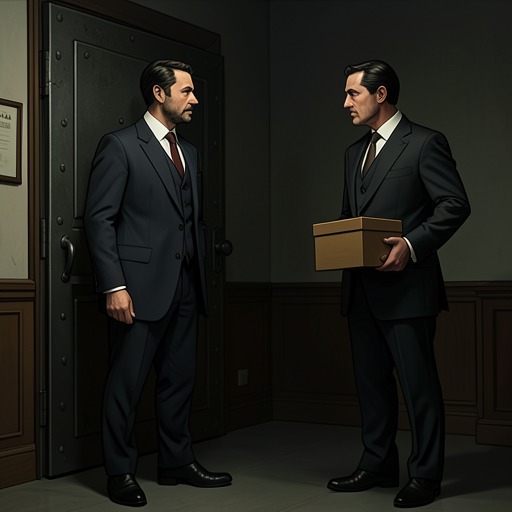
Lawrence Crockett signs the title papers for the Marsten House and the long-defunct Village Washtub after Straker returns on the agreed Friday. He does so with a strong taste of doubt, recognizing that he has violated his personal maxim, “You don’t shit where you eat.” The inducement is high, but the bargain has consequences beyond money: by accepting it, he realizes that he has put himself at Straker’s beck and call, and that the same obligation extends to the absent Mr. Barlow. The sale therefore functions as an exchange of property for leverage. Crockett does not simply dispose of an unwanted building; he creates a relationship in which the buyers can command him.
For a time, ordinary chronology dulls the transaction’s threat. Summer passes into fall, fall into winter, and by spring Lawrence Crockett has nearly forgotten the deal. Yet the papers remain in his Portland safe-deposit box, a material reminder that the past has not disappeared merely because daily life has resumed. The Marsten House’s reoccupation thus reaches back into the town through Crockett’s records, his obligations, and his knowledge of how its ownership was secured.
Recognition of the Glick Mystery
After returning from the Marsten House with Hank Peters, Lawrence Crockett understands that the men have encountered something they do not want to discuss. Both look shaken, and Crockett responds not with an investigation but with containment: he gives each man an extra ten dollars and two six-packs of Black Label, then suggests that it would be best if none of them said too much about the evening’s outing. The compensation is at once practical and coercive, turning fear into a private expense and attempting to keep an alarming discovery outside official scrutiny.
Hank later comes back to the office because he cannot keep silent. He reports seeing what looked like clothes—a shirt, perhaps dungarees, and a sneaker—when he took the keys down to place them on the table. The clothing recalls the description of Ralphie Glick, who was reported to have been wearing jeans, a red pullover shirt, and sneakers. Hank then voices the possibility that the men who bought the Marsten House and the store may have “blew up the Glick kid.” Lawrence Crockett does not dismiss the suspicion as impossible; instead, his response redirects it into a controlled and threatening exchange.
The scene keeps the evidence fragmentary. Hank has not seen a body, and Crockett knows that the clothing alone does not establish what happened. But the absence of certainty does not make the moment harmless. The possible connection between the Marsten House’s new owners and Ralphie Glick’s disappearance is precisely the kind of clue that could expose the transaction’s hidden purpose. Crockett’s position gives him the choice to carry that clue to the authorities or bury it with the rest of the town’s uneasy knowledge.
Coercion, Complicity, and Ending
Lawrence Crockett tells Hank that such a matter would belong to the police and says that he would drive him to see Parkins Gillespie. The offer sounds civic-minded, but he immediately attaches a price to acting on it. He warns Hank that “a lot of nastiness can come up,” including discovery of Hank’s relationship with a waitress at Dell’s and of his dishonorable discharge. The threat is carefully tailored to Hank’s vulnerabilities. Crockett does not need to prove that the accusations will matter; he only needs to make Hank imagine the consequences of disclosure.
His composure makes the intimidation more disturbing. He refills Hank’s cup, and his hand remains cold and steady “as a rock in a frozen brook.” Hank’s face turns deadly pale, while Crockett’s expression and gestures remain controlled. The contrast turns the office into a miniature version of the town’s larger moral structure: frightened people bring disturbing knowledge to an authority figure, and that authority protects order by threatening the person who speaks.
Crockett even invites Hank to take the bottle, but Hank leaves without pausing. Afterward, Crockett does not continue closing the shop. He drinks alone, thinking about “deals with the devil,” a phrase that makes the earlier property transaction newly legible. The metaphor does not require Crockett to understand every supernatural dimension of the Marsten House. It identifies his own recognition that he has exchanged judgment and independence for advantage, then allowed fear and self-interest to govern what he does with the knowledge he possesses.
At last the telephone rings. Crockett listens, says, “It’s taken care of,” hangs up, and pours himself another drink. The call is not explained in the supplied scene, but its placement after Hank’s threatened silence makes the statement ominous. It suggests that the problem has been transferred beyond the office and that Crockett has either received confirmation from the people behind the deal or reported that the danger of disclosure has been neutralized. His final action is not a confession or an appeal for help. It is another drink, another act of concealment, and a surrender to the machinery he helped set in motion.
Narrative Function and Significance
Lawrence Crockett is important because he links the supernatural plot to the ordinary systems of a small town: property records, civic office, lunch routines, local gossip, police procedure, and personal reputation. The Marsten House does not enter Jerusalem’s Lot as an isolated haunted object. It is acquired through contracts, shell companies, and a local businessman’s willingness to accept an attractive inducement despite misgivings. Crockett makes the town’s vulnerability institutional as well as supernatural.
His characterization is built around a revealing contradiction. He is efficient enough to set his watch by the whistle and lock his office door with a final check of the doorknob, yet he cannot secure himself against the consequences of the bargain. He recognizes danger when a car appears at the Marsten House and feels disquiet in his chest, but recognition does not become resistance. Instead, his habits of business and self-protection convert warning into silence.
The threat against Hank also shows how the town’s corruption operates socially. No grand declaration is needed; private indiscretions, employment connections, and a dishonorable discharge are enough to discipline a witness. Crockett’s knowledge remains partial, but his actions are decisive. By paying for silence, invoking the police without taking Hank there, and finally declaring the matter settled, he helps preserve the conditions under which the Marsten House’s owners can continue to act unseen. His significance lies less in supernatural power than in the ordinary complicity that allows extraordinary evil to take root.