Mark Petrie and his parents
'Salem's Lot: A NovelMark Petrie and his parents, Henry and June Petrie, embody the family at the point where ordinary parental protection meets a supernatural threat that adults cannot initially accept. Mark is an unusually perceptive child whose knowledge of monsters begins in play and imagination, but the crisis forces him to become the family’s most reliable witness. Henry and June love him, worry about him, and try to protect him; yet their inability to believe what Mark and Father Callahan know leaves the household fatally exposed. Their relationship therefore becomes one of the novel’s clearest records of childhood knowledge turning into adult responsibility.
Family Life and Contrasting Temperaments
Henry Petrie is an educated, ambitious, and rigorously rational man. He holds degrees from Northeastern and Massachusetts Tech, has earned a Ph.D. in economics, and has moved from junior-college teaching into an administrative position with the Prudential Insurance Company. His intellectual world is governed by confidence in physics, mathematics, economics, and, to a lesser extent, sociology. His love for June and Mark is described as sturdy and unswerving rather than demonstrative, a dependable attachment expressed through order, discipline, and practical commitment.
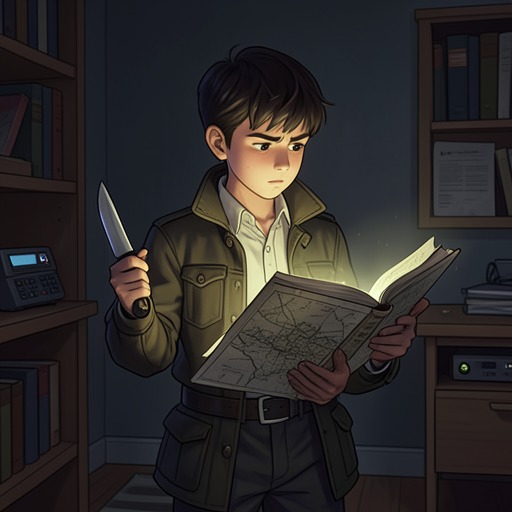
Mark’s imaginative and “fey” streak does not come from Henry’s temperament. The boy listens to his parents through the old heating grates in the farmhouse on South Jointner Avenue, whose structure carries sound from the living room to his second-floor bedroom. The detail makes the family physically close while also showing Mark as an observer who gathers knowledge from the margins of adult conversation. He works on a model of Frankenstein’s monster and keeps a tableau of Dracula, the Mad Doctor, Mr Hyde, and their victims, treating fictional monsters as objects of fascination before he encounters a real one.
Mark’s parents remain attentive to him even when they do not understand him. They have sensed a change in their son and know that he has always possessed what June calls a “Deep One” quality. That awareness gives their later fear a specific history: Mark is not suddenly strange to them, but his inwardness has always exceeded their ability to interpret it. The deaths and disappearances surrounding Ralphie Glick and Danny Glick hover over the household even before Henry and June openly recognize the danger.
Mark as Child, Witness, and Protector
Mark’s childhood culture gives him a vocabulary for terror, but it does not reduce his experience to fantasy. At school, Richie Boddin identifies him as the clever new boy who knows all the answers in mathematics, while Mark’s private room contains the monsters through which he imagines death. When Danny Glick appears at Mark’s window with grave-pale skin, reddish eyes, bloodlike darkness around his mouth, and teeth grown long and sharp, Mark understands immediately that the encounter is more than a threat to his life. The child who once arranged toy monsters now faces a creature that has crossed from story into the world.
The family’s crisis is also a crisis of who can produce trustworthy knowledge. Mark’s parents do not have direct access to what he has seen, while Mark recognizes the vampire’s danger before the adults around him can act. His use of a tongue-depressor cross to repel Marjorie Glick gives him a practical method of defense, and his later instinctive assessment of Richard Straker shows that he has learned to distinguish the human agents of the vampires from the supernatural creatures themselves. His father’s target pistol is not presented as a sufficient answer, but Mark still understands that Straker can be attacked and that the household cannot rely on conventional authority alone.
The parents’ protective role persists even as Mark becomes the family’s crucial observer. After Father Callahan brings him home, Henry and June try to make sense of the account of vampires and threats. Henry listens carefully, asks lucid questions when the narrative becomes unclear, and appears increasingly calm as the story grows more grotesque. Yet the same composure that makes him methodical also becomes a barrier to recognition. Mark’s testimony is treated as a delusion or an impossible proposition rather than as an accurate warning.
Disbelief, Protection, and the Attack
Father Callahan comes to the Petrie home because Kurt Barlow has threatened Henry and June. A telephone call announces that Mark is with Callahan and will be brought home shortly, while the parents debate whether to contact Parkins Gillespie. The family is already living under pressure from the earlier Glick deaths, but the evidence has not yet been assembled into a conclusion that Henry can accept. The household therefore waits at the exact point where disbelief is most dangerous.
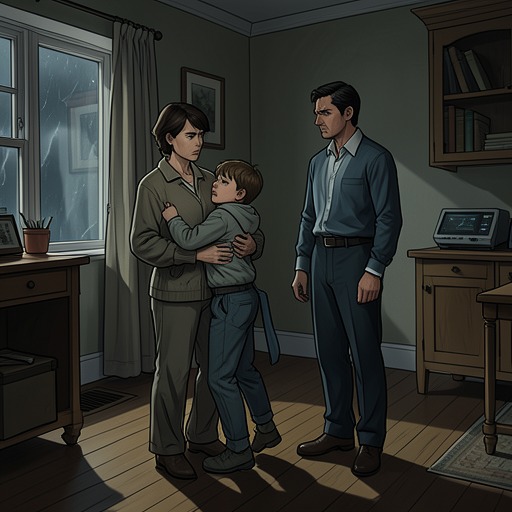
Henry’s verdict on the story is “Impossible.” The word is not merely a denial of the supernatural; it is the culmination of his entire intellectual identity. He proposes that he and Callahan work through the matter as two reasonable men, attempting to preserve rational procedure in a situation that has already escaped ordinary explanation. June is more visibly agitated, and when Henry raises his hand she falls silent and draws Mark slightly away from Callahan. Her gesture is protective, but it also places Mark physically between competing adult interpretations of his experience.
Henry’s rational confidence continues even after the house begins to fail around him. When the telephone line goes dead, he dismisses the possibility that vampires have disrupted the service, irritatingly invoking the ordinary unreliability of Jerusalem’s Lot’s telephone system. The lights then go out. In rapid succession, the household loses communication, illumination, and physical security; the window crashes inward, and the family is plunged into an invasion that Henry’s explanatory system cannot contain.
Kurt Barlow enters the kitchen as a white, grinning, red-eyed figure with long fangs. He seizes Henry’s head in one hand and June’s in the other and brings them together with a fatal crack. Their deaths fulfill Barlow’s first threat and destroy the parental structure that had defined Mark’s safety. The violence is deliberately intimate: the parents are killed not separately but through the forced collision of their heads, turning the family bond itself into the mechanism of their destruction.
Mark’s Loss and Survival
Mark reacts without calculation, throwing himself at Barlow. The gesture is both a son’s defense of his parents and the decisive emergence of his agency. Barlow captures him instantly, but Mark does not surrender his judgment. When Barlow attempts to manipulate Father Callahan by offering Mark’s release in exchange for Callahan’s cross, Mark remains aware that the offer is part of a larger spiritual and tactical struggle.
Barlow lets Mark go, and the boy runs to his parents before looking back. For a moment he cannot accept what he sees and says that he thinks they are dead. The repetition that follows when he later reaches the others—his parents are dead, Barlow beat their heads together, and Barlow killed them—shows trauma becoming testimony. Mark is not simply rescued; he carries the knowledge of the murder into the resistance against Barlow.
He escapes through the forest and across Taggart Stream, arriving with bramble marks on his face and wet trousers up to the knees. When Jimmy Cody checks his neck for signs of conversion, Mark is unmarked. His survival is therefore physical, but it is not a return to childhood innocence. He tells the others that Barlow killed his parents and that he intends to kill Barlow. The vow is born from grief, yet it also gives his grief a direction.
Matt Burke responds by calling Mark a poor, brave boy, while Ben Mears catches him as his face breaks and he begins to cry for his mother. The scene restores a temporary form of care after Henry and June’s deaths: adults now shelter Mark, but they also depend on him. Matt asks what Mark saw, heard, smelled, or touched that might reveal Barlow’s hiding place, and Mark understands that finding Barlow is the immediate task. His parents’ deaths have changed him from a child being protected into a witness whose memory may determine whether anyone else survives.
Narrative Significance
The Petrie family relationship dramatizes the failure of ordinary adulthood before a danger that first appears impossible. Henry’s intelligence and professional competence cannot protect the household because the central problem is not lack of reasoning but refusal to admit that the established categories are inadequate. June’s protectiveness remains emotionally immediate, yet it cannot overcome the family’s dependence on Henry’s judgment. Mark, by contrast, occupies the supposedly powerless position of the child while possessing the clearest perception of the threat.
Their destruction also changes the meaning of Mark’s later resistance. He is not fighting only as a gifted boy with knowledge of vampire weaknesses; he is fighting after witnessing the murder of the two people who should have stood between him and violence. His determination to find and kill Barlow joins personal vengeance to collective survival. The family relationship thus becomes a bridge between domestic tragedy and the wider battle for Jerusalem’s Lot: the vampire invasion is understood not only through abandoned institutions and public disappearances, but through the collapse of one household and the forced maturation of its surviving child.