Marsten House murder-suicide
'Salem's Lot: A NovelThe Marsten House murder-suicide is the decisive historical trauma behind the house’s reputation in Jerusalem’s Lot. Hubert Marsten killed his wife, Birdie Marsten, inside the house and then ended his own life; what the town remembers as a notorious domestic crime becomes, through secrecy, repetition, and the house’s continuing presence, the human prehistory of the supernatural horror that follows.
Crime and Historical Background
Hubert Marsten had been president of a large New England trucking company during the 1920s, a business rumored to have made much of its profit by running Canadian whisky into Massachusetts after midnight. He and Birdie retired wealthy to Jerusalem’s Lot in 1928, although the stock-market crash of 1929 consumed a substantial part of their fortune. Their arrival therefore placed a compromised, secretive past inside a town whose collective memory was already inclined to preserve scandal.
The crime occurred before the principal events of the novel, but it never becomes merely an old newspaper story. The town treats the Marsten couple as its closest equivalent to a skeleton in the closet, and small-town memory passes the house’s violence ceremonially from one generation to the next. The community knows that Hubert killed Birdie, yet it does not know what preceded the shooting or what passed between the couple in the kitchen immediately beforehand. The central fact is public; the emotional and moral circumstances remain concealed.
What the Town Knows and Does Not Know
The murder-suicide is surrounded by layers of incomplete knowledge. Older residents remember that Larry McLeod found charred papers in the upstairs fireplace, but they do not know that the papers represented twelve years of correspondence between Hubert Marsten and an Austrian nobleman named Breichen. Nor do they know that the correspondence began through a peculiar Boston book merchant who died violently in 1933, or that Hubert burned the letters one by one before hanging himself, watching the flames consume their elegant handwriting.
This distinction between rumor and suppressed evidence gives the event its unusual force. The town possesses a narrative of guilt without possessing the whole story. Its official or communal version reduces the horror to a recognizable domestic catastrophe, while the missing details suggest a larger history of corruption, occult association, or psychological collapse. The murder-suicide consequently functions as both an explanation and a concealment: it accounts for the house’s notoriety while leaving its deepest darkness inaccessible.
The House as the Event’s Continuing Witness
The physical house preserves the crime more persistently than the town’s language does. It had been vacant for more than twenty years when the horror associated with its new occupants began to draw near. The great forest fire of 1951 burned almost to its yard before the wind shifted, leaving the structure standing at the edge of the charred landscape. Its FOR SALE sign was replaced three times and eventually bleached unreadable by the sun; a gale in the fall of 1960 tore it away, leaving only sheriff’s NO TRESPASSING signs, renewed with mechanical regularity each spring and fall. A year before the later action, a new sign finally announced that the property had been sold.
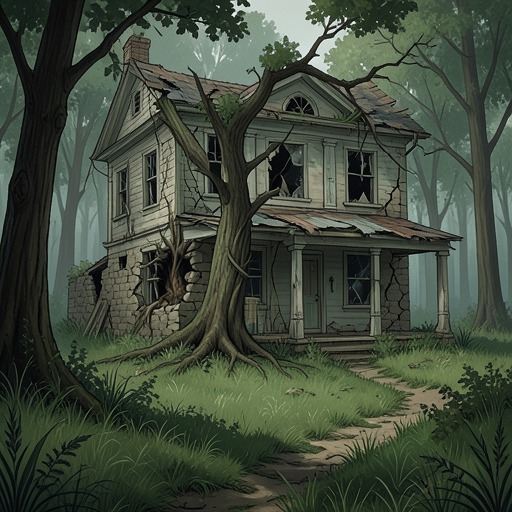
When Ben Mears returned to Jerusalem’s Lot, the house’s unchanged appearance helped persuade him to remain and write the book already forming in his mind. Twenty-four years after his childhood encounter, it was still unpainted, leaning, and ominous. Its upstairs windows resembled vacant eyes beneath steep eaves, their faded green shades like cataracts; broken glass from boys’ stones intensified rather than weakened the impression of malignancy. The shutters, once green in Ben’s memory, had become uniformly weather-beaten gray and were pulled shut. The house is thus not simply the location of a past killing. It is the material form in which the past remains closed, watchful, and unresolved.
Yet the house also contradicts its public image. When Susan Norton and Mark Petrie look through broken slats, they see wine-colored silken wallpaper, wing chairs, a deep green velour sofa, a mahogany rolltop desk, a framed reproduction of Rembrandt’s Boy at his Studies, sliding doors, and the crystal glimmer of a chandelier leading toward the kitchen where Birdie died. The intact elegance is almost indecently unlike the town’s campfire stories and inherited rumors. That contrast makes the crime more disturbing, not less: violence has occurred within a space whose surface still preserves the order and taste of a Victorian mansion.
Secrecy, Recurrence, and Supernatural Meaning
The murder-suicide belongs to a broader pattern of concealed violence in Jerusalem’s Lot. The town knows that Albie Crane killed his wife, weighted her body, and dropped it down an old well, but the remains stay hidden beneath blackberry creepers. In the same narrative movement, the community’s partial knowledge of Hubert and Birdie is exposed as another instance of violence buried beneath ordinary civic life. The Marsten crime therefore becomes part of the town’s moral geology: one more secret preserved by silence, gossip, and the passage of time.
The house’s history also extends beyond the couple. In records covering 1928 to 1939, four children disappeared while Hubert and Birdie lived there, and none was ever found. Those disappearances are not proved to be connected to the murder-suicide, but their proximity deepens the house’s reputation and makes the couple’s eleven-year residence seem historically charged. Later reflection explicitly treats Hubert’s killing of Birdie as perhaps only the least of the terrible things that happened within the walls.
The event’s significance becomes even broader when Robert Boone’s decoded diary reveals that Jerusalem’s Lot itself was founded in 1710 by a splinter Puritan sect led by James Boon, and that the town, its desecrated church, and a forbidden book were connected through a history of obsession and madness. The diary’s first entry is dated June 1, 1789, and its last October 27, four days before the catastrophic disappearance remembered by Mrs. Cloris. This older history does not prove that Hubert and Birdie consciously belonged to the same tradition, but it places their crime within a town where violence, secrecy, religious extremity, and supernatural contamination recur across centuries.
Consequences and Narrative Function
The murder-suicide gives the Marsten House a human origin for its Gothic power. Before the house becomes associated with vampires, it is already a place where marriage, domestic space, and death have collapsed into one another. Birdie’s murder in the kitchen makes the ordinary home an archive of terror, while Hubert’s suicide prevents the community from receiving a complete explanation from the perpetrator himself. The missing confession is replaced by rumor, burned correspondence, architectural decay, and the persistent certainty that the visible crime was not the whole story.
Its influence is therefore cumulative rather than confined to the night of the killings. The town’s long memory keeps the event alive; Ben’s childhood memory and adult return reactivate it; the house’s vacancy and eventual sale provide a temporal bridge between the old crime and the later outbreak. Even when the building appears unexpectedly elegant from within, the kitchen, the closed shutters, and the remembered violence remain present beneath the surface. The murder-suicide is the first human wound in the house’s recorded modern history and the narrative’s clearest demonstration that evil does not need to arrive as a supernatural force to make a home uninhabitable.