Municipal Building
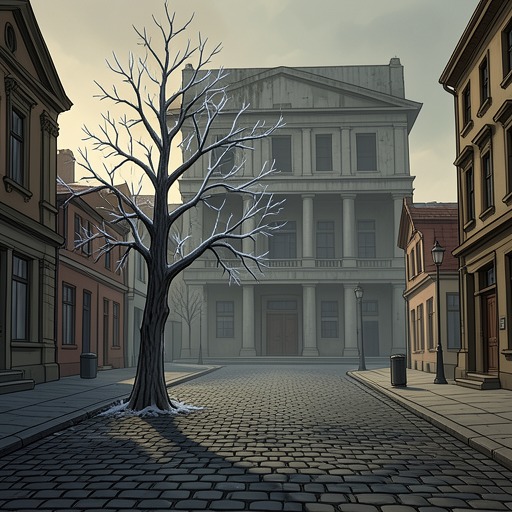
'Salem's Lot: A NovelMunicipal Building is the civic center of Jerusalem’s Lot and one of the town’s most revealing spaces. It houses local administration and police work, faces the town park, and occupies a position within the town’s geometric street plan that makes it both a practical public institution and a symbol of communal order. Yet its presence does not dispel the town’s darkness: the building’s authority is limited, its records coexist with rumor and concealed crimes, and its bulk can literally block the view of the Marsten House.
Setting and Civic Position
Municipal Building stands on the west side of the town park. Ben Mears and Susan Norton enter the park from that side, facing the building across the shadowy paths, the wading pool, and the trees. The building is therefore part of the ordinary visual field of a public evening: close to the War Memorial, streetlights, and the recreational space where town residents meet or avoid being seen. Its placement gives the civic center a quiet, watchful relation to the town’s social life without making it feel secure.
The building’s position also reflects the larger geometry of Jerusalem’s Lot. Brock Street crosses Jointner Avenue at right angles through the town’s center, and the nearly circular township resembles a telescopic sight when viewed on a map. Municipal Building belongs to this organized civic landscape, in contrast with the wooded north, the agricultural southeast, and the improvised trailers and shacks of the Bend in the southwest. The orderly plan suggests a community that can be mapped and governed, even though the forces shaping its history repeatedly escape those boundaries.
Administration and Police Work
Municipal Building is the workplace of Parkins Gillespie, the town’s police chief, and Nolly Gardener. After Parkins returns to his office, he calls for Nolly, removes his coat and galoshes, consults the Portland telephone book, and places a call to an FBI office in Portland. The scene presents the building as a point from which local unease can be escalated toward outside authority. Its procedures are mundane—an office, a telephone directory, a desk, and a telephone—but the call indicates that the town’s problems have begun to exceed the reassuring scale of local routine.
The building also contains the everyday rhythms of municipal employment. In another office scene, Nolly listens to rock ’n’ roll on WLOB, snaps his fingers, and turns the radio down when Parkins tells him to. This small exchange places law enforcement inside the changing culture of the 1970s rather than outside it. The police office is not an austere command post; it is a workplace shaped by radio, crossword puzzles, interruptions, and familiar address. That informality helps explain both the town’s intimacy and its vulnerability: authority is embedded in the same habits and local knowledge as everyone else.
Public Memory and Concealed History
The building faces the War Memorial, whose lists of names extend from the Revolutionary War through Vietnam. When Ben and Susan walk around it, the newest names appear as fresh cuts in the brass. The memorial makes history publicly visible, while Municipal Building represents the continuing civic structure that administers the present. Their proximity creates a contrast between official remembrance and the unrecorded or distorted histories circulating through Jerusalem’s Lot.
The town’s public knowledge is fragmentary. Residents remember the violence associated with the Marsten House across generations, and the disappearances of four children between 1928 and 1939 remain an unresolved part of the town’s past. Other crimes survive as rumor or are misunderstood: residents think they know what happened to Albie Crane’s wife, while the deeper truth is hidden at the bottom of an old well; they know that Hubert Marsten killed Birdie Marsten, but not the circumstances immediately preceding the murder. Municipal Building thus stands within a community that possesses institutions without possessing complete knowledge. Civic order records some things, but local memory, gossip, and silence preserve others.
A Landmark Beside the Marsten House
During Ben and Susan’s walk through the park, Ben looks back toward the Marsten House. Municipal Building blocks it from view. This is a precise spatial image of the building’s narrative function: the civic institution can interrupt the sightline to evil, but it cannot remove the thing being concealed. The house remains present beyond the obstruction, while the public building briefly supplies a reassuring screen.
That contrast becomes sharper because the town repeatedly insists that nothing truly terrible should happen there. Jerusalem’s Lot receives national wars and crises largely through television, and its residents treat the country’s torment as something academic and distant. The town imagines itself as too pleasant for catastrophe. Municipal Building belongs to that self-image, representing the confidence that local administration, public memorials, telephones, and familiar officials are sufficient to keep disorder at a manageable distance. The supernatural crisis exposes the weakness of that confidence.
Narrative Significance
Municipal Building is not the source of the town’s horror, but its civic setting allows the novel to measure the distance between normal governance and hidden threat. It is connected to the park, the memorial, police procedure, and communication with outside agencies; at the same time, it stands in a town whose secrets outlast generations and whose residents instinctively turn on their lights and reach for religious symbols without understanding what they fear.
The building’s significance therefore lies in its double role. It is a genuine center of communal administration, but it is also part of the ordinary landscape through which danger becomes visible only gradually. Its offices continue their routines while the town’s deeper history presses against them. Like the building’s obstruction of Ben’s view of the Marsten House, civic order offers temporary concealment rather than final protection: the public structure remains standing, but the darkness it appears to contain has already entered the life of Jerusalem’s Lot.