Religious relic protection against vampires
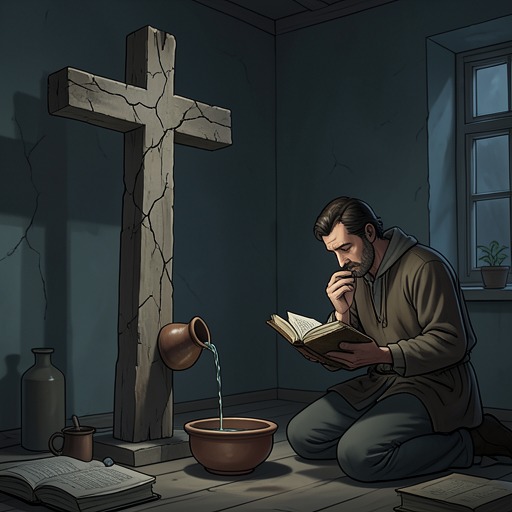
'Salem's Lot: A NovelReligious relic protection against vampires is the rule that consecrated objects can defend living people against the undead and, in some circumstances, drive them away or cause them pain. Its force is not presented as automatic magic attached to every religious object. Instead, protection emerges through a combination of sacred material, belief, ritual action, and the user’s willingness to confront evil. Across the events surrounding Jerusalem’s Lot, holy water, crosses, a Bible, and the formal language of Christian exorcism become instruments of resistance against a supernatural contagion that ordinary medicine, law, and social custom cannot contain.
Definition and Religious Basis
The rule is established through a contrast between material form and spiritual force. A cross may be only an object, while faith gives it authority; the same principle governs holy water and other relics. The action of blessing a makeshift cross shows that the defenders do not possess a complete ceremonial system. Jimmy Cody binds two tongue depressors together with Red Cross tape and asks Ben Mears to bless the improvised object. When Ben admits that he does not know how, Jimmy tells him to make it up, assigning the writer the role of metaphysician as well as fighter. The scene presents ritual as urgent, adaptive, and participatory rather than as a procedure available only to an established priesthood.
Christian practice also supplies a language for confronting the vampire’s hidden hierarchy. Father Donald Callahan understands Richard Straker as the human watchdog and bodyguard of Kurt Barlow, a familiar who performed rites for the Dark Father and prepared the town for Barlow’s arrival. That interpretation places the vampire outbreak within a corrupted ritual structure: sacrifice and propitiation welcome evil, while blessing, prayer, the cross, and holy water oppose it. The conflict is therefore not merely between living bodies and predatory bodies, but between rival systems of ceremony and allegiance.
Holy Water as Immediate Protection
The most systematic use of holy water occurs when Ben Mears and Mark Petrie prepare to enter danger. At St Andrew’s Catholic Church, Ben empties several small ampoules and fills the bottles with holy water. He then tells Mark to bathe his face and hands. Mark hesitates because he regards the act as sacrilegious, but Ben rejects that concern in the emergency and directs him to proceed. Together they dunk their hands in the church’s still water and splash it over their faces, using the water as both protection and a physical shock that restores their readiness for the world outside.
The church itself reinforces the rule’s double character. It is cool, gray, and empty, yet its central aisle is flanked by plaster angels holding bowls of holy water. The setting joins institutional religious memory to immediate practical necessity: the old forms remain in place, but their significance becomes unmistakable only when the defenders carry the water into the vampire’s territory. The holy water is poured into small bottles rather than treated as an abstract blessing, making consecration portable and usable during the hunt.
That portability becomes decisive in the root cellar beneath Eva Miller’s boardinghouse. After Ben and Mark destroy Barlow, the undead emerge from below, including Eva, Weasel, Mabel, Grover, and others. Mark is overwhelmed, and Ben shouts that the holy water will protect them because the vampires cannot touch them. He orders Mark up the board and turns back toward the advancing dead. The water therefore functions as a boundary: it does not erase the danger or restore the dead, but it creates a temporary protected space through which the living can escape.
Crosses, Bibles, and Repulsion
The cross operates as both a personal ward and a public declaration of authority. When Father Callahan approaches the Marsten House, the house seems to exude evil, yet he does not hesitate. He commands the evil to leave and strikes the door with the crucifix. A flash of light, the smell of ozone, and a violent crack follow; the fanlight and bay window explode, while the new Yale lock is welded into an unrecognizable mass. The event gives the religious object visible physical force and marks the house as a place in which ordinary architecture cannot withstand sacred confrontation.
The same principle appears in the account of Herb Tooklander and Booth during a snowstorm. Janey Lumley has become a dead thing returned to life, with red eyes and lengthened teeth. Tookey makes the sign of the cross at her, and she flinches before grinning again; distance and fear prevent the gesture from stopping her. The scene shows that religious protection can be real without being unlimited. The cross establishes a reaction, but it does not automatically defeat a vampire when the defenders are too far away or too frightened to act effectively.
A Bible produces a stronger result at close range. Janey reaches toward Booth, asks to be picked up, and exposes the fangs inside her mouth. As she is about to seize him, a black object strikes her chest. Smoke and a brief glow appear, and she retreats hissing, her face twisted by rage, hatred, and pain. The object is identified as her mother’s Douay Bible. Janey then disappears into a twisting knot of snow that the wind scatters across the fields. The Bible’s intervention turns a sentimental appeal to childhood and family into a predatory trap, while its sacred force interrupts the transformation of affection into violence.
Conditions, Limits, and Consequences
Religious relic protection depends on active use. The defenders must bless, carry, apply, or present the object; passive possession is not enough. Callahan’s assault on the Marsten House combines verbal command with physical contact between crucifix and door. Ben and Mark use holy water on their bodies and preserve it in ampoules for later defense. Tookey’s sign of the cross affects Janey but cannot reach her decisively, whereas the Douay Bible strikes her directly. These variations establish a practical scale of efficacy based on proximity, intention, and action.
The rule also distinguishes repulsion from destruction. Holy water keeps the undead from touching Ben and Mark, but it does not eliminate the vampires emerging from the cellar. The cross drives back or injures an attacker, but the vampire survives unless a more final protocol is completed. Even the dramatic failure of ordinary religious confidence is part of the pattern: sacred objects can create an opening, delay an attack, or expose the supernatural nature of an enemy, yet they do not remove the need for courage, planning, and physical confrontation.
In this sense, relics help reorganize the defenders’ knowledge. The town’s inherited memories preserve the Marsten House as a “skeleton in its closet,” passing its scandal and violence from generation to generation. Ben’s theory that a house can absorb emotional charge and produce an active manifestation gives a psychological vocabulary for that inheritance, but the later use of holy objects converts speculation into action. Ritual knowledge, like local gossip and funeral custom, becomes a form of communal memory that can either preserve fear or guide resistance.
Narrative and Thematic Significance
Religious relic protection against vampires makes faith tangible without making it effortless. The story repeatedly places sacred objects beside improvised tools, medical supplies, coffins, locks, and household spaces. Jimmy’s makeshift cross, Ben’s ampoules, the church’s bowls, Callahan’s crucifix, and the Bible from the Scout’s family all show different levels of institutional authority, yet each becomes meaningful through a human decision to use it against the undead.
The rule also creates a sharp contrast between ritualized care for the dead and the return of the dead as predators. At Danny Glick’s funeral, Father Donald Callahan conducts the children’s burial service through the established stations of house, church, and Harmony Hill Cemetery. The ceremony attempts to place death within a recognized sacred order. Mike Ryerson’s later opening of Danny’s coffin violates that order and reveals a body with open eyes, rosy cheeks, and hideous vitality. Against this counterfeit resurrection, religious relics provide not a comforting explanation but a defensive practice.
Finally, the rule connects the novel’s vampire mythology to the tradition that first shaped its imagination. Ben’s recollection of reading Dracula emphasizes the pursuit of Count Dracula by an intrepid band whose weapons include holy ritual and collective courage. In Jerusalem’s Lot, that inherited pattern is modernized through churches, ampoules, improvised crosses, and emergency action, but its central insight remains: evil is strongest when people wait for ordinary explanations to become adequate. Faith requires an act, and the sacred object becomes powerful at the instant someone accepts responsibility for wielding it.