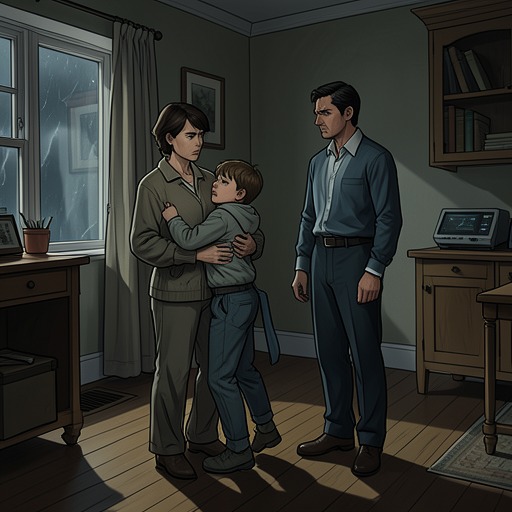
Sandy McDougall
'Salem's Lot: A NovelSandy McDougall is introduced at 6:05 in the morning as a seventeen-year-old mother whose life has narrowed into exhaustion, poverty, and anger. Her encounter with the vampire outbreak begins not as a supernatural spectacle but inside a cramped trailer, where resentment toward marriage and motherhood has already eroded her capacity for care. After her death, her body is hidden with those of her husband and infant son and later recovered by Jimmy Cody and Mark Petrie, turning a private domestic catastrophe into one of the concrete horrors of Jerusalem’s Lot’s wider collapse.
Identity and Domestic Circumstances
Sandy is seventeen years old and has been married to Royce McDougall for only a little more than a year. She married him six months pregnant, and at the time marriage appeared to her as a blessed escape hatch, a phrase associated with Father Callahan’s description of marriage. By the time she is introduced, that imagined escape has become a trap. Royce works at the mill, then spends his evenings drinking or playing poker with his gas-station companions, leaving Sandy alone with their ten-month-old son, Randy.
The setting makes her dissatisfaction materially specific. The McDougalls live in a shabby trailer out in the Bend, where the Formica is already peeling from the counters and the domestic environment offers no comfort or dignity. Sandy remembers the life she abandoned for it: high school, friends, and hopes of becoming a model. Her anger is directed at the trailer, at Royce, and at the child who resembles his father, so that motherhood becomes entangled with her resentment toward the man and circumstances she believes have consumed her future.
Exhaustion and Violence
Randy’s thin morning cries wake Sandy from a shallow sleep. Still bleary-eyed, she strikes her shin against the nightstand, curses, and retrieves his bottle from the refrigerator. She considers warming it, then decides that he can drink it cold if he wants it badly enough. The gesture establishes care as an obligation performed under pressure rather than as tenderness freely given.
When Sandy reaches Randy’s room, she finds feces smeared over his hands, the wall, and his hair. He is sickly for his age and has only recently begun crawling, details that intensify her sense of burden and helplessness. His screaming provokes an abrupt eruption of violence: she throws the plastic bottle, striking his forehead, pulls him from the crib, and punches him twice before she can stop herself. The scene does not present the assault as a calculated act. It is a sudden discharge of accumulated rage, followed almost immediately by pity, gratification, horror, and apology.
Sandy’s remorse does not undo the damage. She mutters that she is sorry and tries to clean Randy up, but the episode exposes the destructive pressure inside the family long before the supernatural threat becomes visible. Her domestic frustration is therefore not merely background characterization. It establishes a human world already marked by neglect, economic confinement, gendered labor, and failed escape, a world in which the vampire horror will arrive through the same household structures that should have offered protection.
Death, Denial, and the Returned Body
The next morning, Sandy wakes with the knowledge that something is wrong before she can identify its cause. Royce is away fishing, nothing is burning, and she feels no injury; what is wrong is the sun. Randy’s bedroom window stands open even though she always closes it, and the crib is empty. She finds the infant’s body thrown into a corner, still dressed in wash-faded Dr Dentons, one leg jutting upward grotesquely. His body is cool to the touch.
Her response is immediate denial. She calls to Randy, smiles at him, pats his cheeks, and tries to wake him by offering his favorite Gerber’s chocolate custard. She speaks to him in baby talk and pushes the custard between his slack lips even while her hands reveal that she already understands the truth. Rage and terror then break through the performance of ordinary breakfast, and she screams for him to wake. The repetition of her commands turns maternal language into a frantic refusal of death.
The aftermath confirms that the tragedy is larger than the child’s death. Jimmy Cody reports that a ten-month-old baby in the McDougall family has died and that Mrs. McDougall has been taken away in restraints. The disappearance of the baby’s body, along with the later disappearance of other corpses, becomes part of the evidence that the Lot’s deaths are not ordinary. Sandy’s fate is thus registered through fragments: a violent domestic morning, a child found dead, a mother removed in crisis, and a body later concealed beneath the family trailer.
Infection and the McDougall Family’s End
As the outbreak spreads, Ben Mears and Jimmy Cody recognize that the McDougall baby may have been one link in a chain of infection. Jimmy imagines how Danny Glick could have infected Mike Ryerson and how the McDougall child might have infected one or both parents. The uncertainty is crucial: the town’s familiar family network has become a possible transmission network, and ordinary relationships now carry an unseen supernatural danger.
Later, Jimmy and Mark locate three sets of feet in the trailer’s crawl space: work boots, knitted slippers, and tiny bare feet. The arrangement resembles a family scene reduced to its most terrible physical outline. Mark struggles with the thought of killing a baby, while Jimmy, a doctor, confronts the contradiction between healing and violence. Their conclusion is that destroying the bodies is a form of release, an attempt to return the infected dead to their souls rather than leave them in an awful state of undeath.
Jimmy pulls Sandy from the crawl space, and Mark drives the stake into her. Royce proves far harder to subdue: his strength and thrashing make the attack resemble an encounter with a maddened horse, and Mark’s failed blows cut him before the decisive strike. The family’s final destruction is therefore both a practical act of vampire hunting and a grim reversal of domestic violence. The trailer that once contained Sandy’s resentment now contains the bodies of all three McDougalls, and the rescuers must enter it to end the family’s transformation rather than preserve its false return to life.
Narrative Function and Social Context
Sandy’s brief appearance is framed by the routines and networks of Jerusalem’s Lot rather than isolated from them. Her household belongs to the town’s working margin, a trailer community shaped by mill labor, absent husbands, limited money, and the loss of older forms of neighborly attention. The wider town is held together by gossip, telephone calls, schools, stores, and family visits, yet those same networks fail to protect the McDougalls. News of the baby’s death travels through Mrs. Evans, Dr. Plowman, Jimmy Cody, and their relatives, but it arrives as rumor and incomplete medical knowledge rather than as an effective intervention.
That failure becomes more disturbing because Sandy’s suffering is first legible as an ordinary social problem. A teenage mother is exhausted, resentful, and violent; her child seems sickly; the father is away or absent from family life. Nothing in the initial scene requires a supernatural explanation. The vampire outbreak exploits a household already strained by poverty and isolation, making the later transformation feel less like an intrusion into a stable community than like a monstrous extension of pressures the town has already normalized.
The Family as a Transmission Network
The McDougall family also demonstrates how the outbreak converts kinship into a mechanism of spread. Jimmy Cody observes that a vampire colony could be founded with alarming ease in a bedroom town where absenteeism might go unnoticed, schools are consolidated across several communities, many residents work elsewhere, and television has weakened neighborhood gatherings. Against that civic background, the McDougalls’ disappearance can remain hidden long enough for infection to move through the family.
The precise order of infection is never established. Jimmy considers the possibility that Danny Glick infected Mike Ryerson and that the McDougall baby infected one or both parents, but the uncertainty itself is part of the horror. The family once represented a closed domestic unit; under vampirism, it becomes an opaque chain of contact in which affection, dependence, and physical proximity all acquire lethal consequences. Sandy is therefore connected not only to Randy and Royce but also to the larger epidemiological pattern that allows Jerusalem’s Lot to fall without immediately recognizing what is happening.
Afterlife as Domestic Distortion
Sandy’s return is not depicted through a long confrontation or a developed supernatural voice. Instead, the narrative emphasizes the grotesque persistence of household imagery. Her body lies beneath the trailer with Royce’s and Randy’s, and the rescuers first see only the family’s feet: work boots, knitted slippers, and the baby’s tiny bare feet. The arrangement is recognizable enough to suggest an ordinary domestic tableau, yet the corruption beneath it has turned the family home into a burial place and hunting ground.
The scene’s moral difficulty rests especially on Randy’s presence. Mark Petrie cannot easily reconcile the destruction of a vampire child with his understanding of himself as a child and with Jimmy’s identity as a doctor. The act is presented as an effort to restore the dead to their souls, but it remains physically violent and emotionally terrible. Sandy’s own stake-driven destruction is quicker, while Royce resists with the force of a strong adult body, making the family’s eradication a sequence in which the remnants of domestic identity survive only as obstacles to be overcome.
Sandy’s story consequently ends without conventional recovery or reconciliation. The apology she offers Randy after beating him cannot repair the family, and the later staking cannot restore the life that preceded the outbreak. What it can do is prevent the McDougalls from continuing as predatory versions of themselves. The rescuers’ violence becomes a merciful final boundary: Sandy, Royce, and Randy are no longer active members of the vampire colony, and their trailer is no longer a concealed reservoir of danger.
Thematic Significance
Sandy embodies the novel’s insistence that supernatural evil does not erase human responsibility or social suffering; it enters through them. Her rage has identifiable causes in the evidence: adolescent motherhood, a marriage entered under pressure, economic confinement, domestic solitude, and the collapse of ambitions. The vampire attack does not create every wound in the McDougall household. Instead, it takes a damaged family and converts its vulnerability into a further instrument of destruction.
Her repeated commands to Randy—first as an angry demand for silence, later as a desperate plea to wake—trace a devastating reversal in maternal speech. In the first scene, language attempts to suppress the child’s life and noise; in the second, it tries to summon life back into a body that has already become unreachable. The same domestic voice moves from irritation to violence, then from denial to terror, revealing how quickly ordinary care can be transformed when death refuses to remain final.
The McDougall episode also enlarges the novel’s portrait of communal collapse. The town’s telephone wires carry gossip like voices trapped in wood, while Mabel Werts watches the Marsten House through binoculars and the town preserves its secrets with an impassive face. Against this background, Sandy’s family is both seen and missed: its crisis produces fragments of report, its bodies disappear, and only later do Ben Mears, Jimmy Cody, and Mark Petrie understand that the missing dead belong to a continuing pattern. Sandy’s significance lies in that collision between the intimate and the systemic. Her tragedy is a domestic catastrophe, a consequence of the vampire contagion, and one of the clearest signs that Jerusalem’s Lot is being conquered through the ordinary bonds by which a town knows itself.