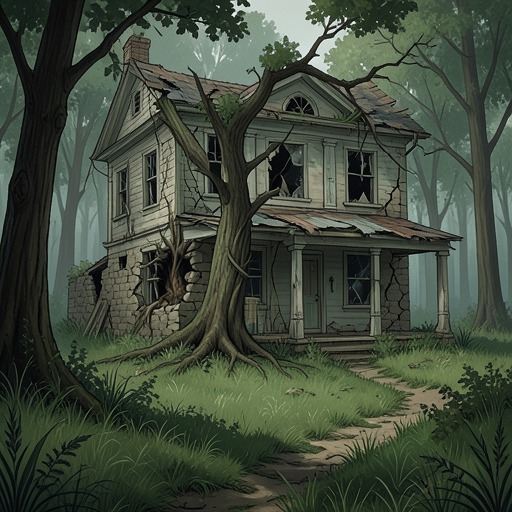
Susan Norton and Mark Petrie enter the Marsten House
'Salem's Lot: A NovelSusan Norton and Mark Petrie enter the Marsten House in a decisive act of investigation that converts suspicion into direct confrontation. Susan arrives first with a makeshift wooden stake and a gold crucifix, while Mark, already watching the property and aware that Richard Straker is present, joins her. Together they cross the boundary between the ordinary town and the house’s concealed evil, but the attempt ends when Straker ambushes them and knocks Mark unconscious.
Susan’s Decision and Preparation
The entry begins with Susan’s rebellion against passivity. After spending the weekend bewildered by events she cannot explain, she decides to go to the Marsten House that afternoon rather than continue taking the long route around it. The decision is partly practical and partly psychological: she wants to take positive action and recover a sense of purpose, even though the house has become the focus of fears that ordinary explanations no longer contain.
Susan prepares in the language of popular vampire fiction. Outside the village limits, she breaks a picket from a roll of red-painted snow fence, bends it until the wire snaps, and recognizes the three-foot piece as a natural stake. Her knowledge comes from having seen enough Hammer films to understand that a vampire must be staked through the heart, although she has not stopped to consider whether she could actually drive such a weapon through a man’s chest. She then buys a small gold crucifix at a country store. These objects are improvised, almost absurdly ordinary, yet they mark her movement from fearful spectator to participant in a ritualized defense against the supernatural.
Watching the House
Susan approaches cautiously through Carl Smith’s west pasture, carrying the snow-fence stake and using the trees, junipers, and tall uncut grass as cover. She crawls when the screening trees become too thin, finally reaching a position from which she can see the west side of the house. The physical details make the Marsten House appear abandoned but not harmless: its shutters have broken slats, its grass remains yellow and knee-high, and no effort has been made to maintain the grounds.
The stillness breaks when an old black car backs into the driveway and turns toward town. Susan sees Richard Straker clearly: a large bald head, deeply sunken eyes, and the collar and lapels of a dark suit. The sight confirms that the house is not simply a deserted property undergoing renovation. Someone is actively using it, and that someone is connected with the danger Susan has come to investigate. Her effort to reduce the house to plaster, wallpaper, tools, ladders, and buckets cannot withstand the fear that remains beneath those explanations.
Mark Petrie has been observing the same place from near a tree since twelve-thirty. He has brought his own stake, fashioned from a length of yellow ash taken from the woodpile behind his house and sharpened with his Boy Scout hatchet. Mark considers Susan’s snow-fence stake inadequate, but he also recognizes that she understands enough to know she is entering danger. He has sensed what he calls the poisonous atmosphere surrounding the house from half a mile away, an impression that becomes thicker as he approaches.
When Straker’s car leaves, Mark decides that the two investigators should work together rather than approach the house separately. He runs up the slope and touches Susan’s shoulder, warning her not to yell. She does not scream, though terror forces a breath from her; he identifies himself as Mark Petrie and tells her that he knows her as Sue Norton. The meeting changes the scene from a solitary act of defiance into a temporary alliance between two people who possess different kinds of knowledge: Susan has the adult motive to investigate, while Mark already understands the danger and has been studying the house’s movements.
Crossing the Threshold
Mark and Susan examine the exterior before entering. Through the broken slats of a shutter, Mark sees a boxy parlor coated with dust, marked by many footprints, peeling wallpaper, old easy chairs, a scarred table, and cobwebs near the ceiling. The room’s disrepair gives the house a visible history, but the tracked dust suggests recent movement within it. The house is simultaneously ruin and occupied space, a contradiction that makes its threshold more threatening.
Mark breaks the hook-and-eye fastener with the blunt end of his stake, causing the shutter lock to fall in two rusty pieces. He then knocks away the protruding glass from a broken pane, reaches through, and unlatches the window. The window moans as it rises. Susan could still withdraw, but instead she pushes the shutter open, climbs over the sill, and drops into the dusty parlor; Mark follows her into the house’s interior.
Inside, Susan encounters a fear larger than any rational equation can solve. She has previously treated fear as the product of the unknown and believed that the unknown could be reduced to a creaky board or another ordinary cause. At the Marsten House, that method fails. The smell seems to seep from the walls, deeper than plaster rot or the accumulated waste of animals, and evokes tears, vomit, and blackness. Her decision to continue despite this fear gives the entry its moral weight: moving forward becomes an act of courage rather than a consequence of confidence.
The Cellar and Straker’s Ambush
Mark and Susan move through the kitchen, where the old linoleum is gritty and pocked, the sink is worn black, and a scarred table holds a yellow plate, a knife, a fork, and a scrap of raw hamburger. The meal-like arrangement is an unsettling sign of habitation. More ominously, the cellar door stands ajar. Its narrow opening admits no light, and the darkness appears to wait at the edge of the kitchen.
Mark identifies the cellar as the place they must investigate. He opens the door and looks down, but before the pair can proceed Susan hears something behind her and turns too slowly. Richard Straker is standing there, grinning. Mark attempts to dive around him, yet Straker’s fist crashes into his chin and knocks him unconscious. The event reverses the investigators’ position: the people who entered seeking evidence become trapped inside the hostile space, and the house’s apparent emptiness is exposed as a carefully guarded façade.
The intrusion therefore ends not with an explanation but with capture and separation from safety. Susan and Mark’s improvised stakes, the crucifix, their caution, and their shared resolve allow them to cross the threshold, but none is sufficient to overcome Straker’s physical control of the house. Their entry nevertheless changes the larger investigation. It establishes that the Marsten House contains active, organized danger; confirms Straker’s role as its guard; and demonstrates that confronting the supernatural requires more than inherited stories or cinematic knowledge. The threshold has been crossed, and the consequences are no longer theoretical.