The Great Fire of Jerusalem’s Lot
'Salem's Lot: A NovelThe Great Fire of Jerusalem’s Lot is the decisive physical aftermath of the town’s supernatural occupation. It destroys the built community after residents begin disappearing, the schools close, and newcomers either flee or vanish. Yet the fire does not end the threat: the town later appears abandoned, but disappearances begin again, making the blaze both an attempted cleansing and an incomplete ending.
Causes and Background
Jerusalem’s Lot is arranged almost like a telescopic sight, with Brock Street crossing Jointner Avenue at right angles through the nearly circular township. The Marsten House stands on the wooded high ground of the northwest quadrant, above the town and near the last of the old logging roads. That elevated position gives the house a physical dominance over the streets below and makes it a natural point from which the town’s darkness seems to radiate.
Before the fire, the town’s ordinary life has already begun to fracture. The Bend in the southwest quadrant is crowded with trailers, junked cars, children, motorbikes, improvised septic systems, and houses resembling woodsheds. Dell’s, rebuilt after burning down in 1971, serves as a social center where people drink, listen to music, and sometimes fight. The town’s two- and six-party telephone lines sustain a constant circulation of gossip, but that communal surveillance does not produce genuine knowledge. Jerusalem’s Lot hears about national wars and political crises from television while treating its own danger as impossible: nothing truly terrible, the town assumes, can happen in such a pleasant place.
The later account gives the fire a direct supernatural context. During one dark October month, residents disappear in stages: first a few, then more, then a great many. The schools close, and the town remains empty for most of a year. Some outsiders move in because property values are low, but most soon leave, while the rest disappear as well. Only after this social collapse does the fire occur. The survivors believe it began near the Marsten House on the hill overlooking Jointner Avenue, but no one knows the precise cause. The uncertainty is crucial: the fire is remembered as a fact, while its origin remains part of the town’s forbidden knowledge.
What Happens
The blaze burns out of control for three days during a long, dry fall. Its duration turns it from a single accident into a consuming historical episode. Fire strips the town of its visible structures and interrupts the ordinary geography of streets, businesses, homes, and institutions. The destruction is especially resonant because the town had preserved the memory of an earlier fire; residents watching autumn field burnings can still see the Jerusalem’s Lot Volunteer Fire Department truck waiting in case flames escape, and the lesson of 1951 has remained with them.
The fire’s immediate consequence is a brief impression of improvement. After the burning, things are better for a time. That apparent restoration, however, proves temporary. The evil has not been reduced to the buildings that carried it, and the destruction of the town does not destroy the force that has taken hold of its population. The event therefore reverses the expected meaning of a conflagration: it removes the town’s material shell without securing a final victory.
The later narrative presents the aftermath through an impersonal, uncertain recollection of what happened. The account says that the town burned flat and that the fire was thought to have started near the Marsten House, but it avoids claiming knowledge no survivor possesses. Even the word “vampires” is rarely spoken. The fire becomes the visible, tellable surface of an event whose deeper cause remains surrounded by fear, euphemism, and silence.
Immediate Consequences
In the days surrounding the supernatural crisis, Jerusalem’s Lot acquires the appearance of a graveyard. Houses that remain occupied are brightly lit, yet those awake do not know the truth and do not look out their windows. They move from room to room collecting crucifixes, medals, rosaries, and other religious symbols without fully understanding why. The scattered lights can look ordinary to a passing driver, who might slow while searching for a fire or accident and then continue toward Portland, but inside the town the lights mark frightened isolation rather than safety.
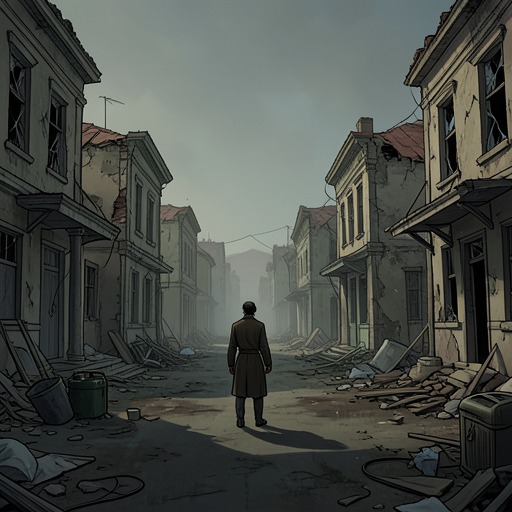
The ruined town later becomes nearly motionless. Spencer’s remains open while the Excellent Café is shut, its green blinds drawn, its menus removed, and its daily-special board wiped clean. The Municipal Building has closed shades, the town park is empty, and a falsely cheerful “Be back soon” sign hangs in Larry Crockett’s office. These details turn civic absence into a physical condition: the institutions that once organized public life are still present as buildings, but their social function has vanished.
Ben Mears encounters that aftermath at dawn after buying a spade and pick in Westbrook. He returns to Eva’s Rooms, finds his room unchanged, and then retrieves Jimmy Cody from the cellar. He drives Jimmy’s body to the Petrie house, where he buries Jimmy and the Petrie family in a wooded clearing near Taggart Stream. The burial gives the dead a final human enclosure even as the town itself loses every communal place of burial, worship, commerce, and governance.
Aftermath and Recurrence
By four o’clock Ben has filled the grave and left Jimmy’s car in front of the Excellent Café with the keys in the ignition. Rain falls softly over the deserted streets, the park where Ben once met Susan Norton is forlorn, and nothing moves around Eva’s Rooms. The landscape has become a sequence of emptied signs: recognizable places remain, but the people who made them meaningful are gone. Ben finally understands that the town is dead with the same certainty he once felt when he saw Miranda’s shoe lying in the road, and he begins to cry as he leaves.
The fire’s later historical description confirms that the destruction is not a clean conclusion. Jerusalem’s Lot burned flat, but “after that, for a time, things were better. And then they started again.” The recurrence transforms the event into a failed boundary between one era and the next. Fire separates the surviving memory of the town from its next manifestation, yet the evil returns because it is not identical with the houses, streets, or institutions it destroys.
When travelers later ask why the road is drifted in and why no lights burn anywhere, they are told that Jerusalem’s Lot burned out three years earlier and was never rebuilt. The statement is both accurate and radically insufficient. The town has become a ghost town in the practical sense of abandoned property, but the absence of rebuilding also preserves the site as a charged remnant. The Great Fire of Jerusalem’s Lot thus ends the town as a civic settlement while leaving its danger unresolved.
Narrative Significance
The event converts social collapse into landscape. Before the fire, the town’s class divisions, gossip networks, roads, farms, trailers, cemetery, and commercial center establish a legible social map. After the fire, that map remains only as deserted architecture and remembered routes. The blaze erases distinctions that had once seemed stable, but it does not create communal solidarity; people hide behind lit windows, clutch religious objects, and avoid looking outside.
Its religious dimension is equally double-edged. The town’s residents instinctively reach for sacred objects, and Father Callahan’s later use of the crucifix against the Marsten House demonstrates that faith can exert material force. Yet the fire itself is not presented as a complete ritual purification. It is closer to a violent, collective response to contamination whose success cannot be verified. The burned town offers neither secure rebirth nor a restored sacred order.
The Great Fire of Jerusalem’s Lot finally embodies the novel’s recurring contrast between ordinary time and catastrophic time. The town once believed that national suffering belonged elsewhere and that its own pleasant routines were protected from history. The fire breaks that illusion in the most literal way, but its recurrence shows that history does not stay buried. Jerusalem’s Lot can burn, empty, and disappear from the map while the pattern of evil waits to begin again.