The Harmony Hill cemetery ritual
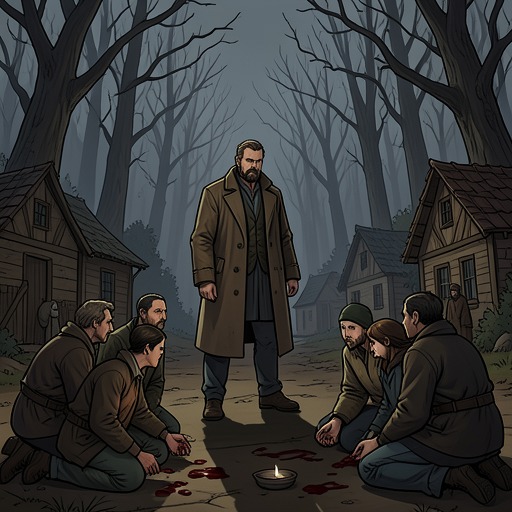
'Salem's Lot: A NovelThe Harmony Hill cemetery ritual is the decisive occult action that exposes the evil gathering around Jerusalem’s Lot as purposeful rather than accidental. Performed at 11:59 p.m., while the town lies mostly asleep, it joins a cultivated invocation, a desecrated sacred space, and the sacrifice of a child into one compact ceremony. The ritual’s significance lies not only in the horror of what is offered, but in the waiting that follows: the officiant seeks authorization and a sign before beginning the work, implying an organized power behind the violence that will spread through the town.
Setting and Temporal Threshold
The ritual occurs at Harmony Hill Cemetery as the day trembles on the edge of extinction. At that hour, darkness has settled over the houses, while the hardware store, Foreman Funeral Home, and Excellent Café cast mild electric light onto the pavement. A few residents remain awake, but most sleep “the sleep of the just and the hard-working.” This contrast places the ceremony outside the town’s visible social life. Jerusalem’s Lot continues its ordinary cycle of work, fatigue, and domestic sleep, even as a separate nocturnal order prepares an act of desecration. The cemetery itself is a threshold space. It is consecrated ground, a place associated with burial, communal memory, and the boundary between the living and the dead. The officiant’s request for a sign “on this ground” does not erase that sacred status; it turns the cemetery’s sanctity into the very surface against which profanation is measured. The wind carries the whisper of leaves and grasses together with carrion from the dump up the road, joining natural movement, burial ground, and decaying matter in a single atmosphere. The ritual therefore makes the town’s geography disclose a hidden continuity between respectable streets and the waste places beyond them.
Invocation and Sacrifice
A dark figure stands meditatively inside the gate and speaks in a soft, cultured voice. The diction is controlled rather than frenzied, and that composure makes the ceremony more disturbing: the act is not an eruption of madness but a practiced appeal to an intelligible authority. The figure addresses “my father” and asks the Lord of Flies for favor, presenting spoiled meat and reeking flesh as a sacrifice. The invocation frames evil through the language of filial dependence and religious petition. Its structure resembles prayer, but its offering reverses the moral direction of prayer: corruption is brought before a power associated with flies, carrion, and decomposition. The figure says that the sacrifice has been made with the left hand and asks for a sign before beginning the work. This detail gives the action the form of a rite with procedure, intention, and anticipated consequence. The sacrifice is not merely an act of violence committed for its own sake. It is an attempt to secure favor, obtain confirmation, and initiate a larger operation. The ritual thus anticipates the novel’s later pattern in which supernatural violence follows recognizable rules and is carried out through repeated acts of invitation, transformation, burial, exhumation, and destruction. The offered body is initially described only as “the figure of a child.” The figure stoops, rises with the child in his arms, and announces, “I bring you this.” The narration then refuses to render the next moment directly, stating only that it became unspeakable. That withdrawal is itself part of the scene’s method. The ritual moves from precise ceremonial speech to an act beyond ordinary representation, making the child’s sacrifice the point at which social language and moral comprehension fail. The child is not presented as an individual participant with agency; the body is reduced to an offering, and that reduction establishes the scale of the evil confronting the town.
Relation to Death and Transformation
The ritual’s imagery gains further force beside the novel’s later treatment of the dead. At Danny Glick’s funeral, Father Donald Callahan confronts mourners whose grief has already unsettled their sense of reality: Marjorie Glick clings to her purse like a life preserver, while Tony Glick looks around as though checking whether he is truly among the mourners. The formal funeral attempts to place Danny within an accepted sequence of death, burial, and mourning. The Harmony Hill ceremony has already shown a darker alternative, in which a child’s body is not released into sacred order but claimed as sacrificial material. That contrast becomes literal when Mike Ryerson opens Danny Glick’s coffin and finds the boy’s eyes open, his cheeks rosy, and his face marked by hideous vitality rather than death’s pallor. The cemetery ritual consequently functions as an early grammar for the novel’s later reversals: flesh that should decay becomes animated, burial becomes a beginning rather than an ending, and consecrated ground becomes vulnerable to an opposing power. The ritual does not by itself explain every mechanism of vampirism, but it establishes the governing connection between sacrifice, the dead, and the spread of corruption. The same ritual logic returns in the actions of the living defenders. Jimmy Cody constructs a small cross from tongue depressors and asks Ben Mears to bless it; Father Callahan later strikes the Marsten House door with his crucifix, commanding the evil to depart, and the lock welds into an unrecognizable mass as the fanlight and bay window explode. These counter-actions mirror the cemetery ceremony in form while reversing its allegiance. Both involve words, a charged object or offering, a threshold, and an appeal to a power beyond ordinary human strength. The difference is ethical and spiritual: the cemetery rite petitions corruption to begin its work, whereas the cross and Callahan’s command attempt to stop it.
Narrative Consequences and Significance
The Harmony Hill ritual changes the reader’s understanding of the events that follow. Before its appearance, deaths, disappearances, and disturbing encounters can still be interpreted as isolated crimes, accidents, illness, or local rumor. The figure’s invocation supplies a hidden center. Something is not merely happening to Jerusalem’s Lot; a will is acting upon it. The later disappearance of corpses, the reanimation of the dead, and the vampire outbreak therefore appear as stages in an initiated process rather than unrelated horrors. The ceremony also establishes a pattern of corrupted communal ritual. Jerusalem’s Lot possesses its civic rites, its church services, funerals, anniversary celebrations, and legal procedures. The town had incorporated in 1765 and later marked its bicentennial with fireworks and a pageant in the park, but beneath that public history lies another ceremonial order, one that uses cemeteries, bodies, and midnight to prepare the town’s undoing. The contrast between civic celebration and occult sacrifice makes the ritual a dark counter-anniversary: a private rite that interrupts the town’s official sense of continuity. Its ending is deliberately incomplete. The figure waits for a sign, and the scene closes before the requested work is visibly carried out. That suspension gives the ritual a prophetic function. It is both an event and a promise, a moment in which evil pauses at the threshold of action. The later discovery of the opened coffin, the investigation into missing corpses, and the confrontation with the forces occupying the town fulfill what the cemetery scene announces. Harmony Hill is therefore not simply the location of an isolated sacrifice; it is the point where Jerusalem’s Lot’s hidden history becomes active again, and where death is reorganized into an instrument of supernatural conquest.