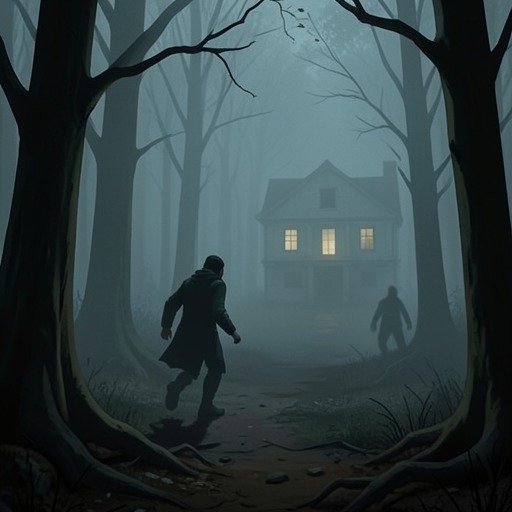
The Marsten House as an evil dry-cell
'Salem's Lot: A NovelThe Marsten House as an evil dry-cell names Ben Mears’s central theory about the house: evil generated by human beings may persist after its original acts, gathering in a place until the building itself functions as a reservoir of malign power. The idea links Ben’s childhood trauma, his research into Hubert Marsten, and the house’s continuing significance as more than an ordinary structure.
Origin in Ben Mears’s Childhood
Ben’s theory begins with an experience he has carried for twenty-four years. As a boy, he entered the Marsten House on a dare as an initiation into a club, with the task of bringing something out. He completed that task, but before leaving he went upstairs to the second-floor bedroom where Hubert Marsten had hanged himself. Ben saw Hubert hanging there, then saw the corpse open its eyes, and fled. The memory remained psychologically active rather than becoming a closed childhood incident.
Ben’s return to Jerusalem’s Lot is therefore connected to an attempt to write the experience out of his system. His interest in the Marsten House is neither detached antiquarian curiosity nor merely a novelist’s convenient subject: it is a return to the site of a formative terror. The house’s alleged supernatural power is first inseparable from the way its rooms have preserved, and continue to reactivate, Ben’s own memory.
The Theory and Its Research
The theory also rests on Ben’s research into Hubert Marsten. That research concerns Marsten, his wife, and the house, and includes the widely known association with devil worship. Knowledge of that history is treated as deeply rooted in the town, described as almost tribal in the way local people preserve and transmit it. Ben’s personal vision and his historical investigation thus reinforce one another: the childhood encounter supplies experiential evidence, while the history of the household supplies a pattern in which the encounter can be interpreted.
The theory is presented as an old parapsychological idea that human beings manufacture evil just as they manufacture physical waste. In this model, evil is not exhausted by the deed that produces it. It does not simply disappear when the perpetrator dies or when the witnesses move away. Instead, it remains as a residue capable of attachment, accumulation, and later effect.
The House as a Storage Battery
Ben applies that idea specifically to the Marsten House, which may have become a kind of evil dry-cell, or malign storage battery. The electrical metaphor gives the house an active but stored force. A dry-cell contains energy until something draws on it; similarly, the Marsten House is imagined as holding the accumulated charge of violence, corruption, and ritual evil, ready to express that charge through later encounters.
The metaphor changes the meaning of the building. The Marsten House is not merely haunted in the narrow sense of containing a ghost, nor is it simply a setting whose bad reputation influences frightened observers. It is conceived as an apparatus of persistence: a structure in which past evil has been concentrated and retained. Its rooms become material containers for history, and its physical continuity allows the old malignity to outlast the people who first created it.
Skepticism and Interpretation
Matthew Burke recognizes the theory as a familiar parapsychological notion and observes that he and Ben have read the same books. His response places Ben’s explanation between folklore and intellectual speculation: it has a recognizable conceptual lineage, but it is also an attempt to account for an experience that ordinary explanations cannot settle. Ben’s language gives a systematic shape to what otherwise remains a terrifying conjunction of memory, local history, and supernatural suggestion.
Susan Norton rejects the theory. She maintains that houses are only houses and that evil dies with the perpetration of evil acts. Her position denies that architecture can retain moral or supernatural energy after the human action has ended. The disagreement is consequential because it establishes two opposed readings of the Marsten House: Susan treats evil as bound to the agent and the act, while Ben treats it as transferable and accumulative, capable of becoming embedded in place.
Narrative and Gothic Significance
The evil dry-cell idea turns architecture into a form of memory. The Marsten House holds together a boy’s traumatic vision, the history of Hubert Marsten and his wife, the town’s inherited knowledge of their corruption, and the possibility that evil can become materially durable. Its horror comes from the collapse of the boundary between event and residue: what happened there may not be over simply because the original perpetrators are dead.
The theory also gives the house a gothic function as a sealed historical container. A bedroom, a hanging body, and a returned gaze are not isolated images; they become evidence in a larger argument about whether places can be contaminated by what human beings do within them. The phrase “evil dry-cell” is therefore both explanatory and defensive. It lets Ben translate an overwhelming childhood apparition into a theory, while simultaneously suggesting that the Marsten House remains dangerous because the past has not discharged its charge.