The Salem’s Lot Vampire Epidemic
'Salem's Lot: A NovelThe Salem’s Lot Vampire Epidemic transforms a seemingly stable Maine town into a landscape of contagion, silence, and predation. Its decisive horror lies not only in the presence of vampires but in the speed with which an entire social world becomes compatible with them: houses remain lit, roads remain open, telephones still carry gossip, and daily life continues even as the town is being emptied and remade from within.
A Town Prepared for Its Own Undoing
Jerusalem’s Lot is organized like a target. Brock Street crosses Jointner Avenue at right angles, dividing the nearly circular township into distinct social and geographical quarters. The wooded northwest rises toward the Marsten House; the northeast opens onto the Royal River; the southeast contains farms and established homes; and the southwest, especially the Bend, is crowded with trailers, junked cars, beer cans, improvised septic systems, and houses that are almost indistinguishable from woodsheds. The epidemic therefore spreads through a mapped social space, moving across class boundaries and between places that ordinarily appear separate.
The town’s apparent security is ideological rather than actual. Its inhabitants receive the nation’s wars, political crises, and social unrest mainly through television, while local violence is treated as an exception. The town’s knowledge of national torment remains “academic,” and its residents believe that nothing truly terrible can happen in such a pleasant place. That conviction becomes the epidemic’s first line of defense: disbelief is not merely a reaction to the vampires but a condition that allows them to operate.
The town’s communications network also has a double function. Telephone wires hum with the voices that carry local gossip, and conversations circulate fragments about unusual purchases, strange behavior, and the activity around the Marsten House. Yet gossip does not produce knowledge. It produces speculation, partial explanations, and social surveillance. The same network that notices disturbance repeatedly converts it into anecdote, preserving the town’s ordinary interpretation of events while the supernatural threat grows.
Rumor Before Recognition
Before the vampire explanation becomes speakable, Jerusalem’s Lot is understood through competing stories. Surrounding towns begin a whispering campaign in which the Lot is called haunted. Reports of colored lights hovering over the Central Maine Power lines encourage talk of UFOs, while other explanations invoke a “dark coven,” black mass rituals, and divine punishment. Less supernatural observers compare the disappearances with missing young men later found in mass graves. These explanations reveal a community trying to name catastrophe without accepting the form it has actually taken.
The suspicion of satanic activity is reinforced by an incident discussed at Dell’s. A newspaper report describes youths desecrating a Catholic church in Florida, covering its religious furnishings with obscene writing and leaving both animal and human blood behind. The possibility that similar devil worship might be occurring in the Lot is raised and dismissed as excessive imagination. The exchange demonstrates how outside news supplies a vocabulary for local fear while simultaneously diverting attention from the actual danger.
The epidemic also develops against a background of unexplained disappearance. Henry Petrie, his wife, and his son are gone, as are a local mortician, librarian, beautician, and other residents. Because missing persons are considered common in a mobile, automobile-oriented society, absence can be normalized. People move, fail to leave forwarding addresses, or become entangled in debt; the ordinary explanations are sufficiently plausible to delay recognition of the extraordinary one.
The Epidemic Enters Ordinary Space
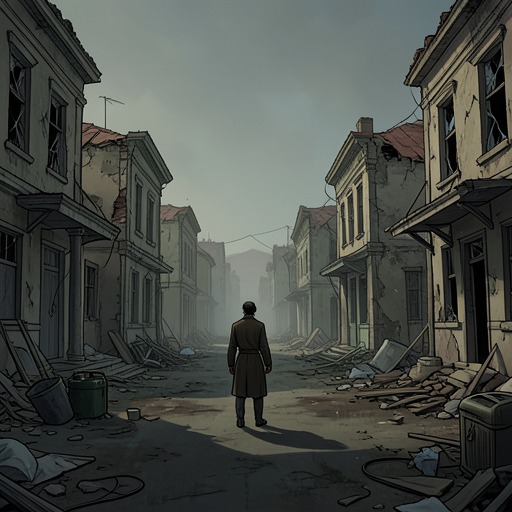
The epidemic’s progress is marked by the collapse of public life. Businesses close one after another: Spencer’s Sundries and Pharmacy, Crossen’s Agricultural Store, the hardware store, Barlow and Straker’s Furniture Shop, the Excellent Café, and finally even the Municipal Building are boarded up. The grammar school and the tri-town consolidated high school stand empty, their furnishings and books transferred to makeshift facilities in Cumberland. The absence of children becomes the most concrete measure of the town’s transformation: Jerusalem’s Lot is left with deserted houses, overgrown lawns, empty streets, and abandoned back roads.
The vampire presence does not initially produce spectacular public disorder. It infiltrates domestic and civic routines. The town’s geography remains recognizable, but its functions change. Shops become sealed spaces, schools become evidence of demographic extinction, roads become routes of flight, and houses become potential lairs. Even the cemetery, ordinarily a site of ritual closure, becomes part of the epidemic’s active circuit when the dead return rather than remain buried.
Danny Glick’s burial marks the beginning of “real fall” in the narrative and gathers the town around death in a formal public ritual. Cars travel to Harmony Hill Cemetery with their lights on despite the brilliance of day, and the funeral procession includes classmates, relatives, curious townspeople, and older residents accustomed to attending funerals. The ceremony appears to place death within a familiar communal order, but the epidemic has already made that order unstable. Burial does not end Danny’s story; it prepares the ground for the return of the dead and the spread of infection.
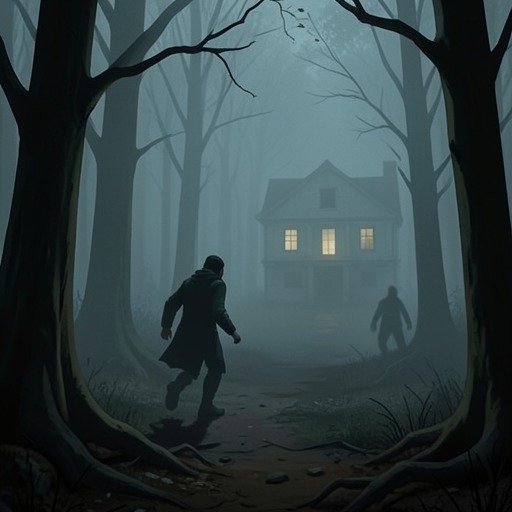
The threat becomes unmistakable in the encounter involving Mark Petrie. At first, the approaching silence is so complete that it seems to contain no sound beyond the characters’ own blood. Yet they know they are not alone. The scene turns an ordinary interior into a threshold, where a stake is gripped tightly and a book on a small end table becomes part of the surrounding tension. The vampire epidemic advances through such enclosed spaces: bedrooms, halls, houses, and cellars where the distinction between shelter and trap disappears.
Collective Paralysis and Defensive Instinct
As the crisis deepens, some residents remain unaware while others respond without understanding what they are facing. People who are awake turn on every light in their homes, search bureau drawers, attic boxes, and bedroom jewelry collections for religious symbols, and move slowly from room to room as if their bodies had become fragile glass. They do not look out the windows. This behavior is significant because it combines instinctive resistance with cognitive denial. The inhabitants sense that ordinary visibility has become dangerous, yet they cannot formulate the truth that would explain their actions.
The refusal to look outside turns the home into both refuge and enclosure. The residents illuminate their interiors while abandoning the exterior world to darkness. Their religious objects are retrieved before the supernatural threat is consciously identified, suggesting that ritual memory survives when rational explanation fails. At the same time, their silence isolates them from one another. Each household performs a private defensive act, but the town lacks a shared language for coordinated resistance.
Authority is similarly paralyzed. When Ben Mears and Mark Petrie attempt to tell Constable Parkins Gillespie what has been happening, Gillespie refuses to hear them. His refusal condenses the epidemic’s social mechanism: official authority rejects the testimony that would force it to abandon ordinary categories. The danger is therefore strengthened by institutional silence as well as private fear.
From Hidden Threat to Total Occupation
The event is framed by a recurring image of the town’s sleep. An excised account describes the town sleeping “like a stone, like the dead,” in contrast with cities whose anxious sleep is interrupted by sirens, neon, and traffic. The phrase gives the epidemic a collective rhythm: Jerusalem’s Lot is not merely quiet but submerged, its inhabitants absorbed into a deeper and more ominous condition. The town’s sleep resembles death before the population has fully recognized that death is already moving through it.
That sleep is not complete. The lights of the Marsten House shine above the town like a fearful yellow pupil, making the house appear to be the eye of the darkness itself. The building becomes the epidemic’s visible center and supernatural beacon, while the town below remains outwardly ordinary. The contrast between the quiet houses and the illuminated hill concentrates the event’s spatial logic: evil is rooted in one commanding site but gains power by entering every surrounding structure.
Eventually, the word that had been avoided is spoken plainly: vampire. The repetition of that word marks a change in knowledge. It is no longer a comic-book image, a folkloric superstition, or a category belonging only to old novels and poorly made films. It becomes the name for the actual force acting upon the town. The epidemic thus produces an epistemological reversal: modern language and technological confidence have not disproved the vampire; they have helped make disbelief possible.
The conception of the outbreak deliberately reverses the structure of Dracula. Instead of ancient evil entering a confident modern city and being expelled by modern methods, the vampire is imagined as thriving in post-Vietnam America, where electric lights, automobiles, mass media, and consumer routines make belief in him nearly impossible. The resulting monster combines aristocratic authority with the physical appetite of popular-culture vampires. The town’s class structure also becomes part of the metaphor, since the vampire’s mastery resembles a social order in which the rich grow richer while the poor are left with whatever protection they can obtain.
The epidemic’s intended trajectory is toward victory for the vampires. Its most chilling formulation welcomes the transformed town as a place where blood sausage becomes the local specialty, turning civic hospitality into an announcement of predation. Yet the event does not end in the complete triumph initially imagined. Human characters prove stronger than expected, and the epidemic becomes the condition through which courage, cooperation, and heroic action emerge. The vampires’ power is therefore immense but not absolute: the town is reorganized by evil, but the resistance of its survivors prevents that reorganization from becoming final.