The White
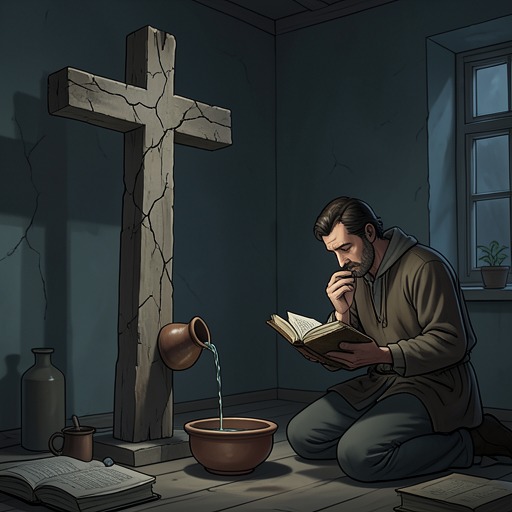
'Salem's Lot: A NovelThe White is the novel’s metaphysical designation for the force aligned with goodness, faith, and resistance to the vampire. Its clearest material sign is the cross, but the narrative insists that the object itself is insufficient: the cross becomes effective through faith, and loses its force when faith collapses. The White therefore operates both as a supernatural power and as a test of spiritual commitment, especially in the confrontation between Father Callahan and Kurt Barlow.
Nature and Opposition
The White belongs to a moral and supernatural order that Kurt Barlow recognizes even while opposing it. In his taunting address to Father Callahan, Barlow acknowledges that Callahan bears “the symbol of White” and can move in daylight as well as darkness. He also concedes that Christian and pagan charms and potions may possess real efficacy. This admission is significant because Barlow does not dismiss religious protection as superstition; he treats it as an actual force in the conflict, one whose operation he has studied and learned to evade.
Barlow nevertheless presents the opposition as unequal in experience and cunning. He claims to have lived longer than Callahan and describes himself as crafty, even calling himself “the father of serpents.” His argument is not that the White is unreal, but that its representative is vulnerable. He tells Callahan that the priest’s faith is “weak and soft,” while his language of love is presumptuous and his understanding becomes reliable only when he speaks of alcohol. In Barlow’s formulation, the decisive battlefield is not merely the physical encounter between vampire and priest; it is the condition of the priest’s belief.
The White thus stands against a form of evil that is ancient, intelligent, and strategically adaptive. Barlow compares his observation of Callahan and the other opponents to a chess player studying the games of an adversary. He recognizes the Catholic Church as an old opponent, remembers its early weakness, and contrasts its rites with older rites of his own. Yet he also says that he is not jaded and that he understands goodness as well as evil. The conflict is consequently not between knowledge and ignorance, but between two powers that understand ritual, history, fear, and desire.
The Cross as Its Instrument
The cross is the most immediate instrument through which the White enters the action. While the anti-vampire group prepares for an attack, Matthew Burke raises a cross and explains that it will stop Barlow, though it might not stop a human being whom Barlow is using, as he used Floyd Tibbits. The distinction gives the object a precise dramatic function: it can repel the supernatural master directly, but it does not make every servant or accomplice harmless. Faith offers protection, not universal immunity.
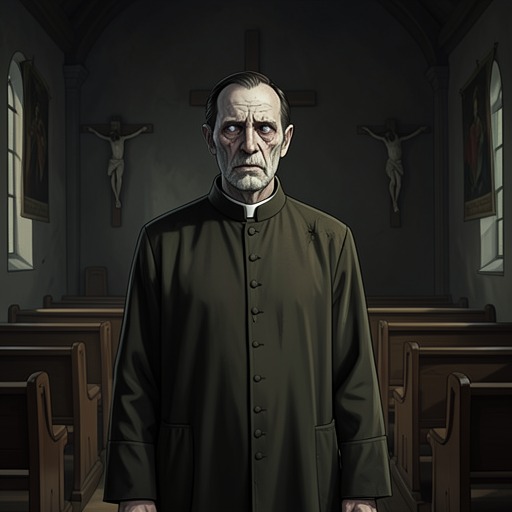
The cross’s power is displayed in the confrontation between Father Callahan and Barlow. When Callahan thrusts it forward and commands Barlow to get back, the cross flares with a dazzling supernatural brilliance. Barlow recoils and throws his hands before his face, and Callahan momentarily has the opportunity to banish him. The scene makes the White visible as force: the cross does not merely symbolize a theological principle, but produces an effect in the physical space between priest and vampire.
That force is conditional. As Callahan hesitates, the cross’s glow begins to die. The lapse is not caused by damage to the object; it follows the priest’s inward crisis as he weighs whether to reject Barlow’s challenge or continue. When the last light vanishes, the cross becomes only plaster, a souvenir bought by Callahan’s mother in Dublin. The narrative sharply separates material substance from spiritual efficacy: the same object that had transmitted enough power to smash walls and shatter stone is reduced to powerless matter when the sustaining faith is gone.
Barlow immediately exploits the change. He plucks the cross from Callahan’s fingers, breaks both its arms, and throws it to the floor. The destruction is therefore both physical and theological. Barlow can break the plaster only after the White has ceased to animate it, and the broken relic records Callahan’s spiritual defeat more visibly than any abstract confession could. The object’s transformation from blazing ward to meaningless fragment dramatizes the novel’s rule that faith empowers holy symbols rather than the reverse.
Faith, Failure, and Vulnerability
Father Callahan’s encounter with Barlow makes the White inseparable from the priest’s crisis of faith. Callahan still invokes God and commands the vampire to stay back, but the command follows the extinguishing of the cross’s light rather than reversing it. The sequence places ritual language under pressure: words and gestures retain their outward form while the inward certainty that once made them effective has weakened.
Barlow’s attack is calculated around this weakness. He does not simply overpower Callahan at the first opportunity; he provokes him, challenges his courage, and waits for the spiritual contradiction to become visible. The vampire’s confidence grows as Callahan retreats toward the kitchen table and finds that there is nowhere left to go. Barlow explicitly treats the scene as evidence that the priest’s faith has failed. The White can resist evil, but it cannot be wielded mechanically by someone who no longer fully believes in the source of its authority.
This conditional structure also explains why the White is not equivalent to institutional religion alone. Barlow mocks the Catholic Church as a club of bread-eaters and wine-drinkers, yet he takes its symbols seriously. His contempt is directed toward Callahan’s weakened representative, not toward the possibility of sacred power. The novel’s supernatural logic therefore makes personal faith more decisive than office, history, or possession of a consecrated-looking object. Callahan carries the sign, but the sign’s power depends upon the person who raises it.
Narrative Function and Significance
The White gives the vampire conflict a moral vocabulary without reducing it to a simple contest between invulnerable good and invulnerable evil. Barlow’s age, intelligence, and knowledge of religious protections make him a formidable opponent, while Callahan’s failure shows that goodness requires active faith rather than passive affiliation. In this structure, evil needs only to wait for weakness; resistance requires a continuing act of belief.
The concept also joins the novel’s medical and material worlds to its supernatural one. Bodies are examined, catalogued, and compared: Daniel Francis Glick is identified in a dated record; James Cody examines a corpse; Marjorie Glick’s body is studied for the absence of surface lividity and rigor; and stolen bodies from the Cumberland County Morgue reveal that ordinary institutions cannot contain the crisis. Against this procedural language, the White supplies another mode of recognition. The cross’s sudden brilliance, its fading, and its reduction to plaster make spiritual condition legible through physical change.
The White’s force is likewise contrasted with daylight. Barlow notes that Father Callahan moves in the day as well as the night, but daylight alone does not settle the conflict. The vampire can reason about protective symbols, manipulate human agents, and attack through psychological pressure. The decisive question remains whether the human defender can sustain the belief that gives the symbol power. The White is therefore strongest not as an abstract promise of safety, but as a practiced alliance among faith, ritual, courage, and action.
In the novel’s larger design, The White prevents the supernatural struggle from becoming merely a contest of bodies. Vampires can be tracked through corpses, morgues, wounds, and physical transformations, but their defeat depends on meanings that matter to the living: the cross, the authority of a command, the memory of belief, and the willingness to act. Its most devastating demonstration is also its most paradoxical one. The White genuinely works against Barlow, yet its representative can lose access to it. The force exists, but it must be inhabited; when faith gives way, the sacred object remains while its power disappears.