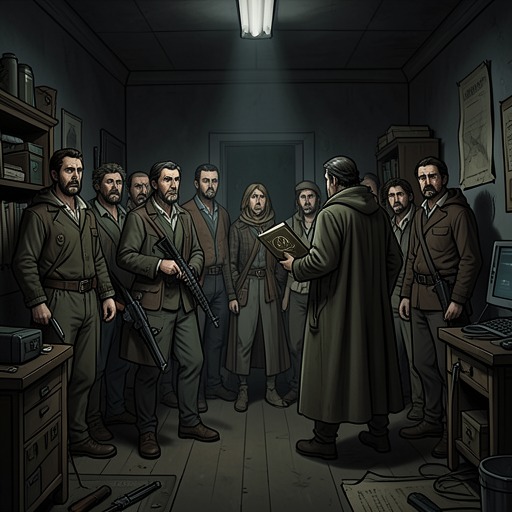
The evil that men do lives after them
'Salem's Lot: A Novel“The evil that men do lives after them” names the novel’s central idea that violence does not end when its perpetrator dies. Evil can remain in a place, in the stories people tell, in bodies that refuse ordinary death, and in a community’s inability to recognize what has already entered its daily life. The phrase is given its clearest interpretation through the Marsten House, whose history makes Hubert Marsten’s past crime feel less like a closed episode than a continuing force.
Meaning and Immediate Context
The expression appears in a conversation about Birdie Marsten’s reported psychic knowledge of her sister’s murder. The account is unsubstantiated in a narrow evidentiary sense, yet the discussion treats telepathy or precognition as less disturbing than the possibility that human evil has an afterlife of its own. The contrast is important: an extraordinary transmission of information may be strange, but it is morally neutral; the persistence of evil suggests that a person’s actions can continue exerting power after the person has vanished.
The phrase therefore shifts attention from whether a supernatural perception can be proven to what kind of reality the Marsten House represents. The house is described as a possible monument to Hubert Marsten’s evil and as a supernatural beacon, a place that may have held the essence of his wrongdoing in its moldering structure. The image turns architecture into moral residue. The house does not merely contain a history; it potentially broadcasts that history, making past violence perceptible in the present.
Hubert Marsten and the Marsten House
Hubert Marsten’s crime gives the expression its most concrete human meaning. The canonical history identifies his murder of Birdie Marsten as a defining event, and the house becomes inseparable from that marital violence. Its evil is not presented only as a remembered fact about a dead man. It is imagined as an accumulated presence, preserved in the building and capable of attracting or amplifying later supernatural forces.
This understanding also explains why the Marsten House functions as more than a haunted setting. It is a moral and supernatural instrument: a site where earlier wrongdoing remains available for repetition. The house’s significance lies in the way it converts a private act into a public contamination. What happened within it does not stay within the marriage or within the past; the structure stands over the town as a continuing source of dread and as a beacon for the larger vampire threat.
Evil Entering Ordinary Life
The expression gains force through the novel’s collision between commonplace routines and evidence that the dead are no longer behaving as the dead should. Matthew Burke’s home is introduced through domestic details: a small living room furnished in Early American Junk Shop, an ancient Motorola television, a KLH sound system, and spaghetti sauce drifting from the kitchen while Matthew Burke wears a red-and-white checked apron. This ordinary household setting later becomes connected to the examination of a corpse, showing how the supernatural crisis enters spaces associated with hospitality, music, food, and domestic comfort.
The investigation of the body demonstrates the limits of ordinary explanation. Parkins Gillespie circles the corpse and asks whether the man is really dead, while James Cody, M.D., arrives and compares the condition with that of the Glick boy. The question is not merely procedural. It marks the moment when death becomes uncertain and when the living must confront consequences that cannot be contained by routine medical language.
The same uncertainty surrounds Marjorie Glick’s body. In Green’s workroom, she lies on a stainless-steel table in a burgundy quilted housecoat and knitted slippers, with a Band-Aid still visible on her shin. James Cody observes no surface lividity and no sign of rigor or incipient rigor, a condition strikingly similar to that of Mike Ryerson. The details preserve the identity of an ordinary woman even as her corpse becomes evidence of an extraordinary process. Evil survives here not as an abstract curse but through the violation of recognizable domestic bodies.
From Individual Wrongdoing to Collective Threat
The theft of bodies from the Cumberland County Morgue in Portland expands the phrase’s scale. What began as the moral residue of one man’s violence becomes a disturbance affecting medical and civic institutions. The report evokes a grotesque reanimation of literary horror, but its practical consequence is more alarming: corpses have been removed from a place designed to classify, preserve, and account for the dead. The boundary between death and social order has been breached.
The later recovery of Roy McDougall makes that breach visible in physical form. Mark Petrie and Jimmy Cody pull Roy McDougall from a crawl space into drizzle and white light. Under the light, his body writhes; steam and moisture emerge from his pores, his skin sags and yellows, his eyes roll beneath closed lids, and his respiration takes on a Cheyne–Stokes pattern. The reaction stops when he retreats wholly into shadow. This scene gives the expression a literal supernatural dimension: the dead do not simply remain influential in memory; they return as active bodies whose former identities and human behavior have been corrupted.
The progression from the Marsten House to stolen corpses and returning bodies establishes a cause-and-effect pattern. Past evil creates a contaminated center; that contamination spreads through human victims, corpses, and institutions; the resulting threat forces the living to reinterpret familiar signs. A body, a house, a medical observation, or a town rumor may now carry the afterlife of violence.
Narrative and Thematic Significance
As an expression, “The evil that men do lives after them” links moral history to supernatural plot. It provides a premise for the recurrence of the dead and for the town’s gradual discovery that its present is governed by acts committed earlier. The phrase also complicates the idea of haunting. The haunting is not merely a ghost’s return or a building’s eerie reputation; it is the continuation of human wrongdoing through material spaces, social memory, and new acts of predation.
Its strongest irony is that evil does not need to announce itself as evil. In the evidence surrounding the phrase, it appears beside salad, television, spaghetti sauce, slippers, medical tables, cigarettes, and municipal reporting. The familiar world keeps functioning while the consequences of violence move through it. That contrast makes the expression more unsettling than a simple declaration that the dead return: it suggests that ordinary life itself can become the medium through which old evil persists.
The phrase consequently serves as a compact moral map of the novel. Hubert Marsten’s violence remains attached to the Marsten House; the house becomes a beacon; bodies disappear from institutional custody; corpses display signs of unnatural return; and the community is compelled to understand that death has not ended the consequences of what people have done. Evil lives after its makers because it has been deposited in places, bodies, memories, and systems that continue to exist.