The recurrent power of evil
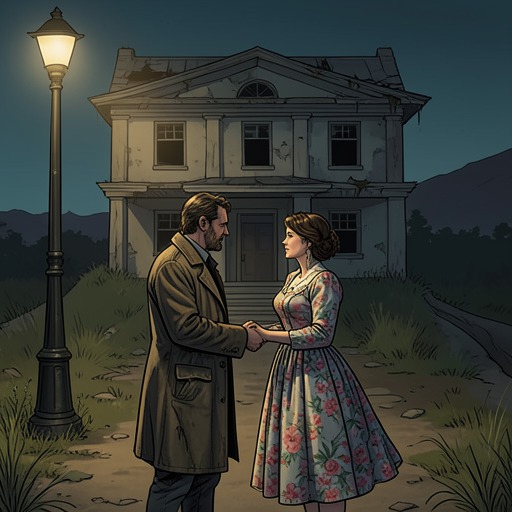
'Salem's Lot: A NovelThe recurrent power of evil names the central pattern Ben Mears discovers beneath the apparent accidents of Jerusalem’s Lot. His investigation begins as research for a book about the Marsten House, but the house gradually becomes evidence that violence can outlive the person who committed it. Hubert Marsten’s crimes do not remain sealed in the past; they leave behind an atmosphere, a local silence, a structure capable of drawing later events into its orbit, and a new disappearance that makes Ben question whether history is repeating itself. The concept therefore links supernatural horror to social memory: evil survives not only as a monster, but as what a community refuses, distorts, or fails to understand.## Origins in the Marsten HouseBen’s first approach to the concept is historical. He has researched Hubert Marsten and learned from Boston police records and from Minella Corey, Birdie Marsten’s sister, that Hubert was a mobster whose trucking company served as a front. The house is consequently not an innocent setting later invaded by supernatural forces; it is already marked by organized violence, secrecy, and the unresolved fact of Birdie’s murder. Ben’s research into old copies of the Ledger from 1928 to 1939 deepens that history. Four children disappeared during those years, and none was ever found. The missing remains, the absence of physical explanation, and the coincidence that Hubert and Birdie lived in the house for eleven years turn the building into a repository of suspicion rather than a mere haunted landmark.Ben’s interpretation is sharpened by the remembered sentence, “And whatever walked there, walked alone.” He uses it to describe a form of evil that is radically isolated yet repeatedly consequential: it may originate in one person, but its effects continue to move through other lives. His proposed subject is therefore not simply Hubert Marsten or the ghost of an individual murderer. It is “the recurrent power of evil,” the capacity of wrongdoing to return after apparent extinction and to make the past active again.## Evil as a Supernatural ResidueBen distinguishes the disturbing persistence of evil from easier forms of the supernatural. He considers Minella Corey’s account of receiving, through an episode of apparent extrasensory perception, knowledge that Birdie had been murdered with a shotgun. Telepathy or precognition can be dismissed, he suggests, because belief in them costs little; the idea that evil itself survives its perpetrators is more unsettling because it threatens the assumption that death closes moral history. The fact of evil’s continuation is harder to quarantine than an isolated paranormal message.The Marsten House becomes the physical expression of this idea. Ben imagines it as Hubert Marsten’s monument to evil and as a “supernatural beacon,” a psychic sounding board that may have held the essence of Hubert’s evil in its decaying structure. The image makes architecture an active participant in the narrative. The house does not merely preserve memories for human observers; it seems to gather, amplify, and transmit what occurred there. Its moldering bones convert past violence into a continuing presence, so that the building functions as both archive and transmitter.The decisive reversal comes when the house is occupied again. Ben had expected to confront his childhood fear on his own terms: perhaps the house would have been demolished, or perhaps he would rent it, investigate it, and use its atmosphere for a frightening book. In each imagined version he remained in control. The new occupants destroy that arrangement. A child disappears, and Ben cannot accept the possibility that the event has nothing to do with the house. Reoccupation transforms the Marsten House from a dead monument into a renewed source of action; the old evil has not merely remained, but has acquired access to the present.## Recurrence Across Bodies and InstitutionsThe novel extends recurrence beyond the house by repeatedly placing unexplained violence beside ordinary systems of knowledge. A child’s record appears in a dated administrative form naming Daniel Francis Glick on September 23, 1975, an impersonal document that gives bureaucratic shape to an event the community cannot yet interpret. Later, Matt Burke’s household contains the ancient Motorola television and a KLH sound system with quad speakers, details that place modern technology inside an otherwise domestic setting. The contrast matters because the town’s contemporary devices do not guarantee understanding or safety; they coexist with an older, returning evil that modern life cannot automatically master.When Mike Ryerson’s body is examined, conventional medical observation becomes the first language available for the impossible. Parkins Gillespie circles the body and asks whether the dead man is really dead. James Cody then examines him, while Matt Burke recognizes a connection to what Ben had said about the Glick boy. The scene turns uncertainty into a social process: the body is inspected, questioned, and compared, but the available categories cannot contain what is happening. Marjorie Glick’s corpse produces the same crisis. Jimmy Cody notes that her condition resembles Mike Ryerson’s, with no surface lividity and no sign of rigor or incipient rigor. The recurring bodily signs create a pattern before the characters possess an explanation; the dead repeat one another.The recurrence becomes even more literal when bodies are stolen from the Cumberland County Morgue in Portland. The theft is described as something like a grotesque creation from Boris Karloff and Mary Shelley, but its narrative function is broader than shock. The morgue, a place designed to stabilize death through identification and custody, is breached. Bodies that should remain evidence are removed and returned to the story’s active field. Evil thus survives through institutional failure as well as supernatural agency: the medical and civic structures that separate the living from the dead prove unable to preserve that boundary.The body of Roy McDougall makes the pattern physically undeniable. When Mark Petrie and Jimmy Cody pull him from a crawl space into daylight, the corpse begins to writhe. Steam and moisture emerge from the pores; the skin sags and yellows; the eyes roll beneath closed lids; the arms thrash; and a hitching, Cheyne-Stokes-like respiration begins in the light and stops when Roy is wholly in shadow. The corpse’s repeated movement is not simply a return from death but a demonstration that death has become conditional. The old evil persists by using bodies as temporary continuations of itself, turning the corpse into a medium through which the past acts upon the present.## Historical Repetition and Collective VulnerabilityBen’s theory also belongs to the wider history of the town. Jerusalem’s Lot is shaped by earlier violence and environmental scars: the Royal River remains clear while feeding the polluted Androscoggin, the sawmill has closed, and the town’s physical layout retains the marks of logging and extraction. The municipal system has no public water lines, gas mains, sewage, or light-and-power; Central Maine Power pylons cut a 150-foot-wide gash through the timberland, with one looming near the Marsten House like an alien sentinel. These details place the supernatural recurrence within a landscape already organized by accumulated consequences. The town’s past is not gone; it is embedded in roads, rivers, power lines, abandoned industry, and remembered disasters.The 1951 fire provides the clearest civic precedent. From a knoll near Burns Road and Harmony Hill Cemetery, Ben recalls that the old-timers believed the fire began with one careless cigarette, spread across the Marshes, and could not be stopped. The event becomes a model for recurrence: a small initiating act crosses boundaries, gathers force, and leaves a lasting lesson. The same structure appears in the Marsten House. A private act of evil becomes a public condition, then a renewed catastrophe. What looks at first like a contained origin proves to be the beginning of an expanding chain.The town’s social life reinforces that chain. Its two-, four-, and six-party telephone lines ensure that people always have someone to talk about, while scandal simmers as a shared local resource. Such communication preserves communal memory, but it also encourages evasion and distortion. In the conversation between Susan Norton and her mother, the question of whether Susan has been sleeping with Floyd Tibbits receives only the repeated answer, “None of your business.” The phrase marks a boundary around private knowledge, yet the town’s culture depends on precisely such concealed matters circulating indirectly. Evil can recur because the community remembers selectively, speaks obliquely, and leaves crucial histories unresolved.## From Literary Idea to Narrative LawThe concept begins outside the immediate plot as a response to the tradition represented by Dracula. The older vampire novel imagines a confrontation between a foreign child of darkness and scientifically equipped British protagonists, with modern inventions and rational organization helping the hunters prevail. Ben’s story is conceived against that optimism. Its world is one in which technology has become sinister: society chokes on its own effluent, consumes diminishing energy resources, and lives under the threat of nuclear weapons and proliferation. In that setting, the vampire does not merely threaten isolated individuals; the vampire exposes the weakness of the systems that were supposed to make history progressive and controllable.The writing process itself mirrors the theme. Ben initially imagines that he can control the house, confront his terrors, and turn its atmosphere into a profitable book. Yet the story repeatedly defeats attempts at containment. A book that begins as an investigation of a town becomes a book about one house; a house thought to belong to the past becomes occupied; a disappearance that might be coincidence becomes part of a larger pattern; and medical anomalies accumulate until the dead can no longer be treated as inert. The narrative’s form therefore enacts the idea it describes: suppressed material returns, each recurrence changing the meaning of what came before.The recurrent power of evil is not presented as a single supernatural explanation that abolishes human responsibility. Hubert Marsten’s criminal past remains human in origin, and the town’s silence, gossip, institutions, and failures help determine how long its consequences can endure. The Marsten House concentrates that history into an almost autonomous presence, but its power depends on contact with living people and vulnerable structures. Evil persists through transmission: from perpetrator to place, from place to occupant, from corpse to witness, and from private memory to public disaster. Its most frightening quality is therefore not simply that it returns, but that every return can make the next one easier to recognize only after it has already begun.