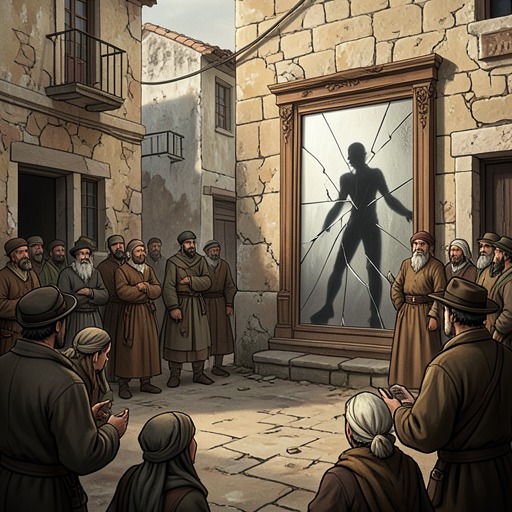
The town knew about darkness
'Salem's Lot: A Novel“The town knew about darkness” is the novel’s governing expression for Jerusalem’s Lot’s collective condition. It first names the familiar darkness of night and the hidden darkness of human behavior, then expands into a judgment on the town itself: its people, buildings, and land form an accumulated identity capable of concealing secrets and absorbing evil. By the time the vampire outbreak arrives, the phrase has ceased to describe mere local knowledge. It suggests an environment prepared to recognize darkness without necessarily resisting it.
A Town Defined by Darkness
The expression appears in the chapter’s direct account of Jerusalem’s Lot: “The town knew about darkness.” The statement immediately divides darkness into two kinds, the darkness produced when the earth’s rotation removes it from sunlight and the darkness found in the human soul. The town is then described as an accumulation of three parts whose combined force exceeds their separate components: the people who live there, the buildings in which they live and conduct business, and the land itself. Darkness therefore belongs neither only to individual residents nor only to the supernatural threat; it is woven through the town’s social, architectural, and geological existence.
The physical town reinforces that definition. Jerusalem’s Lot is nearly circular, with Brock Street crossing Jointner Avenue at right angles through the center, giving the map the appearance of a telescopic sight. The northwest quadrant rises into heavily wooded north Jerusalem, where old logging roads climb toward the Marsten House. The northeast opens toward the Royal River, the Brock Street Bridge, and the cliffs called Drunk’s Leap. The southeast contains farms and Schoolyard Hill, while the southwest, especially the Bend, gathers trailers, junked cars, makeshift yards, beer cans, and hastily installed septic tanks. This arrangement creates a geography of visibility and concealment: central roads and familiar businesses coexist with woods, ravines, marginal housing, and a sinister house standing above the town.
Ordinary Darkness and Collective Intimacy
The phrase also describes the intensity of small-town knowledge. Jerusalem’s Lot is connected by two-, four-, and six-party telephone lines, so residents always have someone to discuss. Gossip functions as a communal system of observation. The Bend generates much of the scandal, but people of higher social standing periodically contribute to the same shared store of rumor. In this town, private life is never entirely private: residents know who has lost work, who is having marital trouble, where men gather to drink, how the roads lie, and which paths can be crossed without getting boots wet.
That knowledge is reciprocal. The town knows its inhabitants as intimately as they know it, including their physical discomforts, financial anxieties, domestic fantasies, and self-deceptions. The relationship is portrayed as more than civic familiarity; belonging to the town is a daily, bodily interpenetration in which the individual possesses the town and is possessed by it. At night, the town and its people sleep together “like the dead,” an image that links ordinary rest with lifelessness before the supernatural plot has fully exposed its meaning. The expression thus carries an unsettling paradox: communal intimacy provides knowledge, but it also makes concealment and collective surrender possible.
Secrets Beneath the Surface
The town’s darkness is most clearly revealed through the secrets it keeps. Residents believe they know that Albie Crane’s wife ran away with a traveling man, but the fuller truth is that Albie killed her after the man abandoned her, weighted her body, and threw it down an old well. The community’s version of the event survives as a simplified explanation while the buried crime remains physically hidden beneath blackberry growth and weathered boards.
The same pattern surrounds Hubert Marsten and Birdie Marsten. The town knows that Hubert Marsten killed his wife, but it does not know the circumstances leading to the murder, including Birdie’s plea that he kill her. The gap between public knowledge and concealed reality is essential to the expression. Jerusalem’s Lot does not lack information; it possesses partial information that has hardened into accepted story. Its social memory can preserve a scandal while leaving the most disturbing truth buried.
Other secrets extend the pattern from private shame into supernatural horror. Reverend John Groggins conceals disturbing dreams, Hal Griffen hides pornographic books, and George Middler secretly dresses in women’s clothing. Carl Foreman witnesses the impossible return of Mike Ryerson’s body but cannot produce a scream, while the infant Randy McDougall is taken from his crib by Danny Glick after suffering earlier abuse from his mother. These facts are not arranged as isolated eccentricities. Together they establish a town in which violence, repression, sexuality, fear, and death exist beneath ordinary routines, while the community maintains what the narration calls an ultimate poker face.
When Evil Arrives
The phrase acquires its decisive force when the narration states that the town cares no more for the work of the devil than for the work of God or man: “It knew darkness. And darkness was enough.” This does not mean that every resident consciously welcomes evil. Rather, the town has become so accustomed to secrecy, cruelty, grief, and moral compromise that supernatural evil enters an already prepared structure. Its arrival appears almost preordained because the town’s slow, repetitive life has made darkness familiar and because its secrets have taught it to preserve appearances.
The contrast with the town’s self-image is sharp. Jerusalem’s Lot receives national wars and political crises mainly through television, and its knowledge of the country’s suffering remains largely academic. Local residents can regard the town as a safe place where nothing truly terrible should happen. The belief that nothing too nasty could occur in such a pleasant little town is precisely what the expression undermines. The town’s apparent normality is not innocence; it is a surface maintained over accumulated violence and denial.
The later outbreak makes that distinction visible. The first real day of fall is identified with the day Danny Glick is buried at Harmony Hill Cemetery, and the funeral draws a long procession of relatives, classmates, curious onlookers, and older people accustomed to funerals. The public ritual turns private loss into a communal event, but the town’s collective presence does not produce understanding. As the supernatural crisis deepens, residents remain divided between ignorance and vague suspicion, while familiar streets and houses become part of an expanding field of danger.
The Expression’s Final Resonance
Near the climax, darkness is no longer only a metaphor for hidden human behavior. Mark Petrie and Susan Norton find themselves listening to an absolute silence and know that they are not alone, turning the town’s familiar darkness into an immediate physical threat. Elsewhere, awake residents turn on every light, search drawers and attic boxes for religious symbols, and move through their rooms without looking out the windows. Their bodies respond before their minds understand the truth. The town’s knowledge is instinctive, embodied, and incomplete.
The expression therefore moves through three stages. At first, it describes a settlement familiar with night, local secrets, and the concealed impulses of its inhabitants. It then becomes a theory of social complicity: the town preserves what it knows behind a calm public face. Finally, it becomes an ominous description of supernatural receptivity. Jerusalem’s Lot does not simply encounter darkness from outside; it recognizes it because darkness has long been part of the town’s physical landscape, communal memory, and moral life. “The town knew about darkness” is consequently both diagnosis and foreshadowing: the town knows enough to live beside evil, but not enough—or not willingly enough—to stop it.